Spinoza and the Architecture of Reality
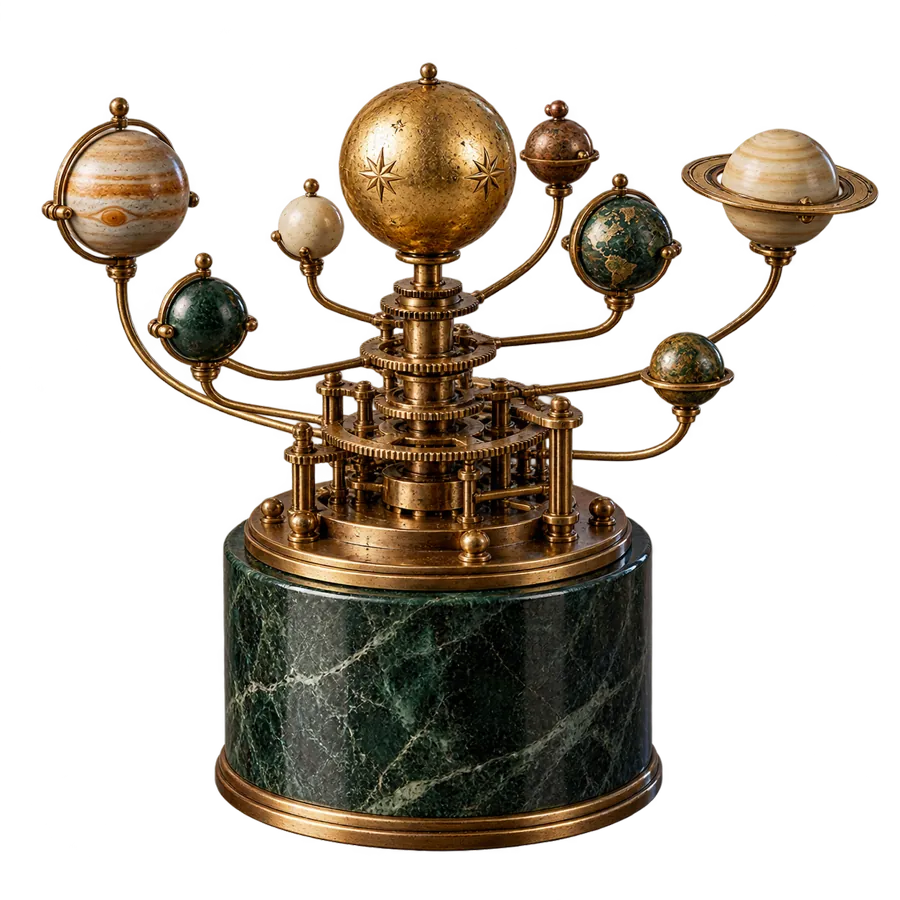
How substance, attributes, and modes form one of the most austere metaphysical systems ever created.
I.
The universe is not a collection of things. It is one thing, expressed under different aspects, and every object you have ever named is a temporary ripple in that single substance. This is the claim at the center of Spinoza's metaphysics, and it is more radical than most readers are prepared to receive. He does not adjust the familiar furniture of the world. He removes the room.
Most philosophy begins with what everyone already believes: there are tables, chairs, minds, bodies, causes, effects, and somewhere behind or above them, perhaps, a God. Spinoza begins elsewhere. He begins with what must be true if anything is true at all, and he follows the logic wherever it leads, even when it dissolves the distinction between you and the chair you sit on.
The result is a system so austere that it has been called everything from atheism to pantheism to the purest expression of rationalist metaphysics ever attempted. None of these labels is quite right, because the system is simpler than any of them. To understand it is to see why the architecture of reality, for Spinoza, is not a cathedral. It is a geometric proof.
II.
Substance is that which exists in itself and is conceived through itself. The definition is Definition 3 of Part I of the Ethics, and everything else follows from it. If you grant Spinoza this definition, you have already granted him the entire system, whether you know it or not.
What does it mean for a thing to exist in itself? It means the thing does not depend on anything else for its existence. It is not caused by another thing. It is not a property of another thing. It is not a modification of another thing. It stands. Everything else borrows its existence. Substance alone owns it.
Now consider the ordinary objects of experience. A table exists, but it exists because wood was cut, joined, and shaped. The wood exists because a tree grew. The tree exists because soil, water, and sunlight combined under biological laws. None of these things exists in itself. Each exists through another. If you trace the chain backward, you eventually arrive at something that does not point further. That terminus is substance.
III.
The second half of the definition is more subtle. Substance must be conceived through itself. This means the concept of substance does not require the concept of anything else to be intelligible. To understand what a table is, you must understand wood, craft, function, and extension. To understand what a mind is, you must understand thought, body, and their relation. But substance, as Spinoza defines it, requires no such borrowing. Its concept is self-contained.
From these two conditions, Spinoza derives an extraordinary conclusion: there can be only one substance. If there were two, each would have to be conceived through itself, and neither could interact with or limit the other without violating the definition. A substance cannot be caused by another substance, because that would make it dependent. A substance cannot share an attribute with another substance, because then they would not be truly distinct. Therefore, there is exactly one substance, and it is infinite.
This is the famous substance monism. Everything that exists is either that one substance or a modification of it. There is no third category.
IV.
But if there is only one substance, what are we? What are tables, trees, stars, and minds? Spinoza's answer is that they are modes: particular determinations of substance, ways in which substance exists at a given place and time. A mode does not exist in itself. It exists in substance, as a wave exists in water. The wave is not separate from the water. It is the water, arranged in a particular way, for a particular duration.
This is where the system becomes psychologically difficult. You experience yourself as a separate entity, a self with boundaries, desires, memories, and a future. But for Spinoza, this experience is not false. It is merely partial. You are a mode of substance, a finite expression of an infinite reality. Your individuality is real, but it is not fundamental. It is a local configuration of something vastly larger.
The ego that insists on its own ultimacy is like a wave that believes itself independent of the ocean. The belief is not absurd from the wave's limited perspective. It is simply wrong.
V.
If substance is one, how do we account for the obvious diversity of experience? Spinoza introduces the concept of attributes. An attribute is what the intellect perceives as constituting the essence of substance. Substance has infinitely many attributes, but human beings have access to only two: extension and thought.
Extension is the attribute under which substance appears as physical reality, as bodies in space and time. Thought is the attribute under which substance appears as mental reality, as ideas, perceptions, and consciousness. These are not two substances. They are two ways of apprehending the same substance. Every mode of extension has a corresponding mode of thought. Your body, as a physical object, is the same thing as your mind, conceived under a different attribute.
This is Spinoza's solution to the mind-body problem that had bedeviled Descartes. Descartes could not explain how an immaterial soul interacts with a material body. Spinoza dissolves the problem by denying the dualism. There is no interaction because there are not two things to interact. There is one thing, seen from two angles.
VI.
The doctrine of parallelism is often misunderstood as a claim about correlation. It is stronger than that. For Spinoza, the order and connection of ideas is the same as the order and connection of things. This is not an empirical observation. It is a necessary truth, because ideas and things are the same reality expressed under different attributes. When you think of a circle, the idea in your mind and the circular shape in extension are not causally linked. They are identical.
This has practical consequences. If the mind is the idea of the body, then the mind's power is proportionate to the body's complexity. A more capable body, one that can act and be acted upon in more ways, produces a more capable mind. The division between mental and physical training collapses. To strengthen the body is to strengthen the mind, not metaphorically, but ontologically. They are the same thing.
VII.
One of the most persistent errors in reading Spinoza is to treat his metaphysics as a form of mysticism dressed in geometric clothing. The error is understandable. The claim that everything is one thing can sound like Eastern monism, and the language of intellectual love can sound like religious ecstasy. But Spinoza's system is not mystical. It is rationalist to the core. Every proposition is defended by a proof that claims to follow from axioms and definitions with the necessity of geometry.
The austerity is the point. Spinoza does not ask you to feel the unity of all things. He asks you to understand why it must be so, given what existence and conception logically require. The emotional response, if it comes, is a consequence of understanding, not a substitute for it.
This makes his system uniquely demanding. You cannot skim it. You cannot excerpt the inspiring parts and discard the difficult ones. The architecture is load-bearing at every point. Remove the definition of substance, and the proof of monism collapses. Remove monism, and the doctrine of modes makes no sense. Remove modes, and the theory of the mind becomes unintelligible. The Ethics is not a collection of insights. It is a machine, and every part drives the next.
VIII.
What does this architecture do to ordinary human concerns? It reframes them entirely. Spinoza's metaphysics does not leave room for a personal God who intervenes in history, answers prayers, or dispenses rewards and punishments. Substance does not have preferences. It does not choose. It simply is, and everything that follows from it follows necessarily.
This is the aspect of Spinoza's thought that most enraged his contemporaries. To identify God with Nature, Deus sive Natura, was to deny providence, miracles, and the entire apparatus of revealed religion. Spinoza was called an atheist, and the charge stuck for centuries. But he did not deny God. He redefined the term so thoroughly that the old concept collapsed under the weight of its own incoherence.
The God of Spinoza does not love you. But it also does not judge you, threaten you, or demand your fear. It is simply the immanent cause of everything that exists, the logical ground of reality, the substance without which nothing could be. Whether this is comforting or terrifying depends entirely on what you thought you needed from a God.
IX.
The architecture of reality, as Spinoza constructs it, has a consequence that is rarely discussed but deeply important: it eliminates the category of the supernatural. If everything that exists is either substance or a mode of substance, and if substance operates according to necessary laws, then there is no room for events that violate those laws. A miracle is not a special act of divine intervention. It is a gap in human understanding, filled by imagination until knowledge arrives.
This elimination is not an attack on religion. It is a purification of thought. Spinoza is not saying that the supernatural does not exist as a matter of empirical fact. He is saying that the concept itself is incoherent within a rational metaphysics. To posit something beyond nature is to posit something beyond substance, and by definition there is nothing beyond substance. Nature is all there is, and its laws are the laws of God.
X.
The practical yield of this metaphysics is not nihilism. It is clarity. If you understand that you are a mode of a single infinite substance, several illusions lose their grip. The illusion of radical separateness weakens. The terror of death, which is the terror of annihilation, looks different when you recognize that annihilation is not possible. The mode changes, but the substance persists. You are not a thing that will be destroyed. You are a pattern that will dissolve, and the material of the pattern was never yours to begin with.
This does not make death pleasant. It makes it intelligible. And for Spinoza, what is intelligible loses its power to terrorize. The free man thinks least of death, not because he is brave, but because his wisdom is a meditation on life, not on its cessation.
XI.
The system has limits, and Spinoza knew them. Finite modes have finite knowledge. We apprehend only two of the infinite attributes of substance. We do not know what the world looks like under the attribute of whatever else constitutes the divine essence. We know extension and thought, and from these we reconstruct as much of reality as our nature permits. The rest is darkness, but it is not chaos. It is order beyond our reach, necessity we cannot trace.
This epistemic humility is the complement to Spinoza's metaphysical ambition. He claims to demonstrate the structure of reality from first principles, but he does not claim to exhaust it. The infinite attributes remain unknown. The infinite modes, the immediate and mediate modifications of substance that constitute the fabric of the universe, are acknowledged but not detailed. The system is complete in its principles and incomplete in its phenomena, and this is not a contradiction. It is a recognition that finite minds encounter the infinite only at the points where their nature permits contact.
XII.
Why does this austere architecture matter now? Because most contemporary thought is metaphysically unconscious. People operate with inherited assumptions about selfhood, causality, freedom, and meaning that they have never examined, and those assumptions produce needless suffering. The person who believes himself a self-contained substance will experience every limitation as an injury and every loss as an amputation. The person who understands himself as a mode of a larger order can accept limitation as structure and loss as transformation without the same reflexive panic.
Spinoza does not offer consolation. He offers comprehension. The difference is everything. Consolation is a feeling that passes. Comprehension is a reorganization of the mind that lasts. When you understand that the architecture of reality is not a collection of separate things but a single substance expressing itself through infinite attributes and finite modes, the world does not become easier. But it becomes more intelligible, and intelligibility is the beginning of freedom.
This is the strange gift of Spinoza's metaphysics. It takes away the personal God, the immortal soul, the free will, and the cosmic meaning that most people consider indispensable. And in their place it leaves something more durable: a universe that can be understood, and a mind that becomes more powerful the more adequately it understands.