A history of commerce & power · 1602–1799
Verenigde Oostindische Compagnie · VOC
The Dutch
East India
Company.
Capital. Commerce. Empire.
The company that helps us understand
what enterprise can build, and what it can cost.
Oostindische
Compagnie
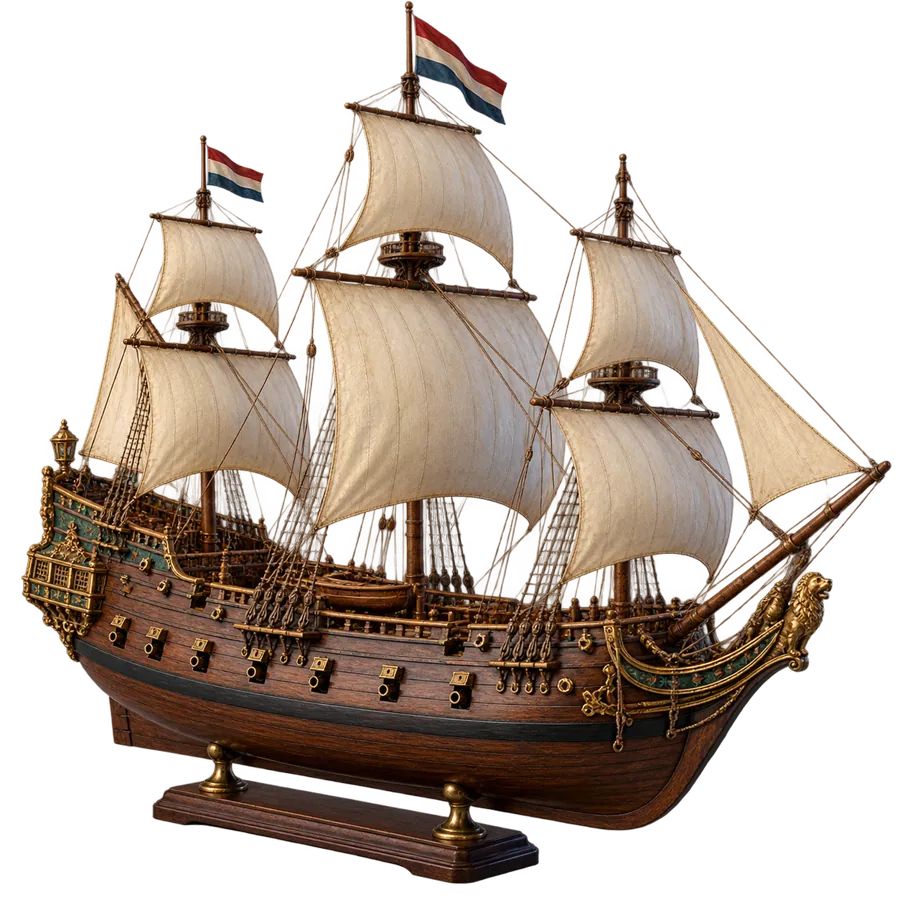
Hendrick Cornelisz Vroom · The Return to Amsterdam of the Second Expedition to the East Indies, 1599 · Rijksmuseum, public domain. A pre-VOC voyage; detail shown. Artwork record ↗
An illustrated history · About 14 minutes
A trading company.
A financial experiment.
A colonial power.
The Dutch East India Company joined private investment to state-granted monopoly and overseas force. For nearly two centuries, its ships connected markets, moved goods and people, and carried the ambitions of an expanding commercial republic.
This is a history of ingenuity and its consequences. Follow the money, the ships, and the people, and keep one question in view:
Who gained the freedom to trade?
Explore the chapters 11 chapters · 6 places · 17 sources
Before the charter
The sea was already full of commerce.
Long before a Dutch ship rounded the Cape, the Indian Ocean connected ports, producers, pilgrims, and merchants. The VOC entered a world of established commercial relationships. Its later maps can make that world look like a set of European possessions; its business depended on people and institutions it did not create.
The Dutch Republic’s maritime economy was also older and broader than the company. Regional shipping, fisheries, shipbuilding, merchants, and urban finance supplied capabilities that an overseas venture could assemble. The revolt against Spanish rule gave commercial rivalry a political setting. Trading at a distance could serve both private ambition and the Republic’s struggle for security.
Dutch expeditions began reaching the East Indies in the 1590s. Vroom’s painting above celebrates the return of a successful second expedition in 1599, three years before the VOC existed. Separate ventures initially equipped their own fleets. Competition between them helped make consolidation attractive: a united organization could pool resources and bargain with greater force.
Start with a distinction that matters throughout this history: building a better ship, persuading a customer, and preventing a rival from trading are different ways to earn money. The VOC used commercial skill, but also sought privileges and force. Its success cannot be explained by treating all three as the same activity.
1602 · A political invention
A company with a charter and a sword.
In 1602, the States General brought competing Dutch ventures together as the Verenigde Oostindische Compagnie: the United East India Company, usually called the VOC. Its initial charter ran for twenty-one years. It granted exclusive Dutch trading rights within a vast overseas charter area, described in relation to the Cape of Good Hope and the Strait of Magellan.
This was a monopoly against other Dutch entrants, not a declaration that the VOC already controlled every port in Asia. Portuguese, English, and Asian merchants remained competitors. Local rulers could grant access, negotiate terms, resist Dutch demands, or expel a trading post. A claim written in the Netherlands did not make distant societies obey it.
The charter also authorized extraordinary public powers overseas, including making agreements with rulers, building forts, and maintaining armed forces. Commercial organization and delegated sovereignty were joined. A board concerned with cargoes and returns could also make decisions with consequences for war and government.
That combination is essential to understanding the company. Calling it simply a private business misses its political authority. Calling it simply a state misses its investors, commercial calculations, and internal conflicts. It was an institution in which these interests overlapped, and could pull in different directions.
The financial experiment
Let the money stay. Let the owner leave.
Oceanic trade required spending long before receipts arrived. Ships, wages, supplies, and overseas establishments could not be funded like a stall whose stock sold each afternoon. Pooling investment across a continuing organization made it possible to sustain activities beyond a single expedition.
The VOC became a landmark in the development of transferable shares, durable corporate capital, and the separation of investors from managers. These features did not spring into existence as a complete modern package in 1602. Research by Oscar Gelderblom, Abe de Jong, and Joost Jonker traces their formation through 1623: arrangements changed as directors and investors confronted practical problems.
Here is the useful idea behind a secondary share market. If one investor sells a holding to another, the buyer pays the seller. The company does not have to dismantle a ship or return the original investment. Ownership can change while productive resources remain committed. That is a different transaction from the company raising new money.
The same structure creates an enduring question: how can people who supply capital hold its managers accountable? Transferability provides an exit, but it does not by itself guarantee reliable information or effective control. A share price is a judgment about an enterprise, not proof that its conduct is fair or its accounts are sound.
Sources: 03
Pool capital in the company.
Funds ships, trade, and establishments.
A new buyer pays an existing owner.
Simplified mechanism, not a reconstruction of a particular transaction. A resale transfers ownership; it does not itself put new cash into the company.
An organization across oceans
Six chambers. Seventeen directors. Months of distance.
The VOC retained six regional chambers: Amsterdam, Zeeland, Delft, Rotterdam, Hoorn, and Enkhuizen. They organized work such as outfitting ships and handling sales. The central board, the Heeren XVII or Gentlemen Seventeen, coordinated company policy. Overseas, the governor-general and council in Batavia exercised authority over an extensive network of establishments.
The diagram below is a guide to the organization, not an exact chart of every office or every period. Decisions traveled by ship. Orders could be outdated on arrival; local officials had information the directors lacked. Distance made delegation necessary and supervision difficult.
An institution this large needed more than daring captains. It needed accounts, inventories, correspondence, translation, provisioning, and routines for comparing instructions with results. The surviving records of Batavia’s Bookkeeper-General show how goods moved between establishments as well as between Asia and the Netherlands.
Imagine trying to run a business when a reply takes months. You would need rules clear enough to coordinate people, and discretion broad enough to handle events you could not foresee. Those needs can conflict. The VOC’s history makes that organizational problem visible on a very large, and often violent, scale.
- In the RepublicSix regional chambers
Amsterdam · Zeeland · Delft · Rotterdam · Hoorn · Enkhuizen
- Central coordinationHeeren XVII
The Gentlemen Seventeen
- In AsiaGovernor-general & council
Batavia and the overseas network
A simplified view of responsibilities. Instructions and reports traveled both ways; local circumstances shaped what could actually be done.
Explore the network
An Asian business, as well as a European one.
The familiar picture is a ship taking silver east and returning with spices. It is incomplete. The company also carried goods between Asian ports. Indian textiles, Japanese metals, and Southeast Asian produce belonged to connected circuits; not every cargo was intended for Amsterdam.
The Bookkeeper-General database preserves eighteenth-century cargo records across this network. Its entries distinguish products, quantities, places, and accounting values. They also require interpretation: a recorded shipment is not automatically a completed voyage, a cargo value is not a profit, and surviving years do not represent every year of company history.
Explore six places below. This is a schematic selection across the VOC period, not a geographical map, a precise sailing itinerary, or a claim that all these relationships remained unchanged. The important connections are between commercial opportunity, local authority, and the kinds of power the company could exercise.
Sources: 05
1621 · The cost of monopoly
The people behind the price of nutmeg.
Nutmeg and mace made the small Banda archipelago exceptionally valuable to merchants seeking control of supply. Bandanese producers and traders had their own commercial relationships. For them, an exclusive agreement with the VOC meant surrendering the freedom to choose other buyers.
In 1621, forces led by Jan Pieterszoon Coen violently imposed Dutch control. The campaign involved mass killing, enslavement, and deportation; others fled. The Nationaal Archief describes the destruction as genocide. Precise population and death estimates vary, but uncertainty about totals does not make the character of the violence uncertain.
The company reorganized nutmeg production around plantations worked by enslaved labor. This was not merely an unfortunate event adjacent to an otherwise independent trade. Violence helped create the production and supply system from which the monopoly benefited.
Banda changes how we should read a profitable cargo. The sale price records what a buyer paid, not the full human cost of producing the goods. To understand an enterprise, follow its supply chain beyond the auction room: who can refuse, who can leave, and who determines the terms?
A city of commerce and coercion
Look closely at the picture of prosperity.
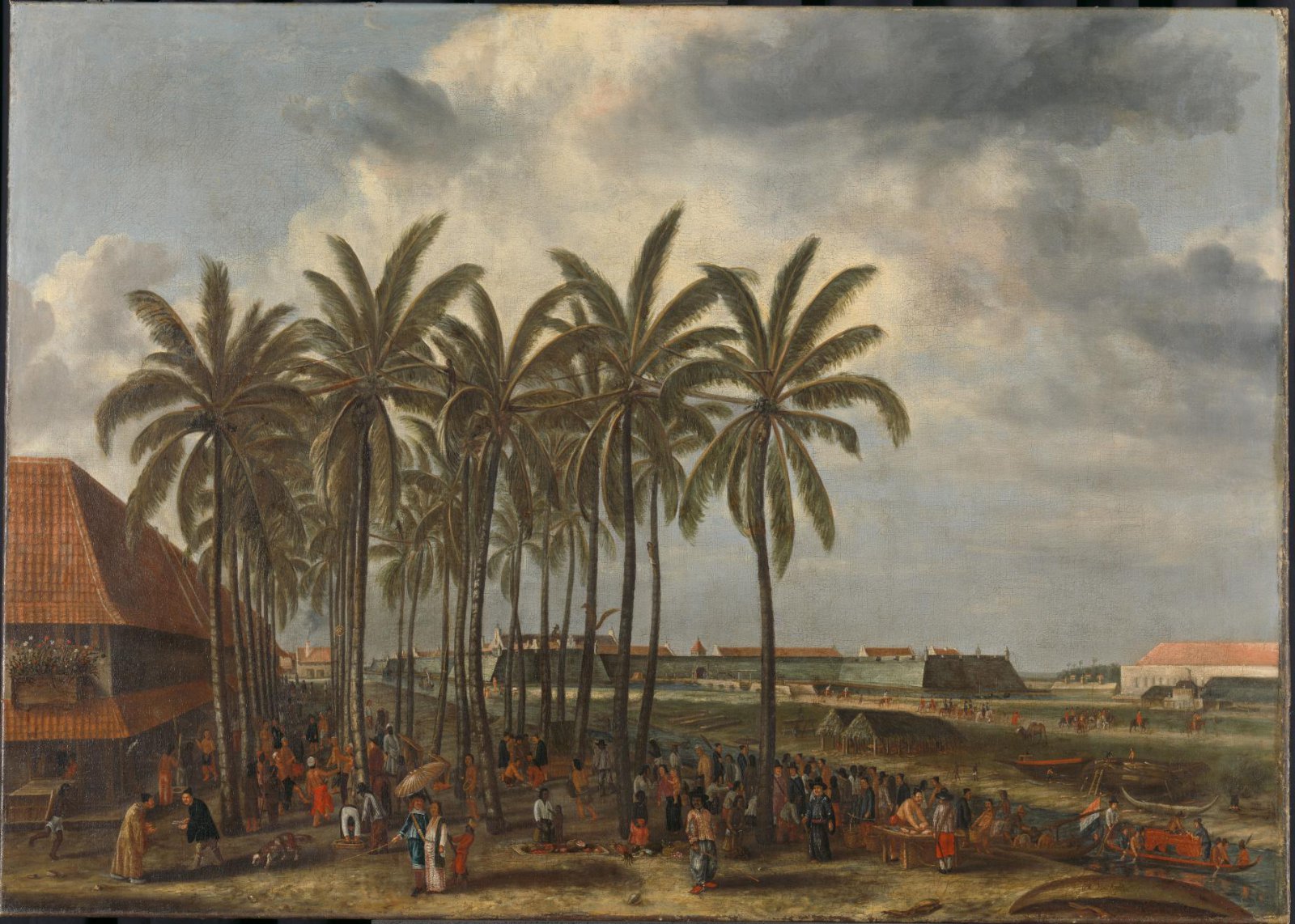
In 1619, Coen’s forces destroyed Jayakarta and established Batavia, the company’s principal Asian headquarters, on the site of present-day Jakarta. Its harbor and administration made it a center of the VOC network. Its commercial life depended on a population much more varied than the Dutch officials who claimed authority over it.
Andries Beeckman’s painting presents that diversity through carefully arranged figures. The Rijksmuseum identifies Japanese and Indian people, Mardijkers (formerly enslaved people), and others. The museum also cautions that this is a constructed overview: these people would not all have stood together in this scene. The company acquired the painting for its Amsterdam chamber.
A painting can be evidence without being a transparent window. Ask what its patron wanted to see. The orderly vista gives prominence to the city, its people, and the company’s presence. It cannot tell the whole story of unequal status, forced labor, conflict, or the lives of those outside the frame.
In October 1740, Chinese residents of Batavia were subjected to a massacre. A contemporary print in the Rijksmuseum depicts burning houses and bodies in the streets and canals. Its title invokes alleged treachery; the museum’s description identifies that allegation as supposed. Read both the violence represented and the language used to justify it. Commercial diversity did not guarantee security for the people who sustained the city.
The same discipline applies to business stories today. A polished image may accurately show a building or product while leaving out how it was made. Look at the image, then seek another kind of evidence: a contract, a labor record, a testimony, an account from someone with less power.
The era of enterprise
What, exactly, was free?
The Dutch Republic offered an extraordinary setting for commerce, but ‘free enterprise’ needs a precise meaning. Freedom to invest, freedom to enter a market, freedom to choose a buyer, and freedom from forced labor are separate conditions. An institution can expand one while restricting another.
Amsterdam’s Wisselbank, founded by the city in 1609, helped merchants navigate a confusing world of circulating coins and payments. This reminds us that commerce relied on institutions: public rules, enforceable agreements, and mechanisms that made exchange more dependable. Markets were organized, not simply left to happen.
The VOC’s charter deliberately restricted Dutch competition within its assigned sphere. Overseas, the company sometimes traded under another ruler’s conditions and sometimes pursued exclusive control backed by arms. There was no single, uniform ‘VOC market.’ Its relationships ranged from bargaining to conquest.
A useful reading therefore preserves two truths. The company helped develop ways to coordinate capital and activity over great distances. It also concentrated privileges and imposed severe costs on people who had little say in its decisions. Recognizing either truth does not require erasing the other.
The table below is an analytical framework, not a seventeenth-century slogan. It separates freedoms that triumphal accounts often bundle together. Ask of any commercial arrangement: freedom for whom, to do what, under whose rules?
| Freedom | What to look for | The VOC tension |
|---|---|---|
| To invest | Can ownership change without liquidating the business? | Transferable shares helped capital remain committed. |
| To compete | Can another business enter? | The charter excluded Dutch rivals from its trading sphere. |
| To choose a buyer | Can a producer refuse an exclusive deal? | Monopoly enforcement could destroy that choice. |
| To leave | Can a worker refuse or depart? | Enslavement denied that basic freedom. |
The work beneath the enterprise
A company is also the people who cannot leave.
Ships needed crews; ports needed workers; households and plantations demanded labor. The VOC’s world included salaried employment and enslavement. Neither ‘European’ nor ‘Asian’ describes a single experience: status, occupation, gender, and location shaped what a person could do and what could be done to them.
At the Cape, the company’s supply station became part of a slave society. Iziko’s Slave Lodge museum documents people transported and confined to work for the VOC. Its history brings the abstraction of ‘labor supply’ back to men, women, and children, separated from homes and subjected to coercion.
The VOC and the Dutch West India Company were different organizations. The WIC operated in the Atlantic world; the VOC’s sphere connected southern Africa and Asia. That distinction matters geographically, but it must not become a way of assigning slavery only to the Atlantic company. The VOC also traded in and exploited enslaved people.
Resistance, survival, family relationships, and individual lives belong in this history alongside directors and fleets. Company records often classify people according to an employer’s or enslaver’s needs. Museums and historians read those records critically to recover lives the accounting categories obscure.
The eighteenth century
More trade did not mean a stronger company.
The VOC’s business changed over time. Textiles, coffee, and tea became increasingly important alongside the famous spices. The scale of activity could grow even as financial resilience weakened. Maintaining an overseas apparatus of administration, soldiers, forts, and ships imposed substantial continuing costs.
The Fourth Anglo-Dutch War, beginning in 1780, struck a business already under pressure. Disrupted shipping and the loss of expected receipts intensified dependence on credit and state support. The company’s decline cannot be reduced to the morality tale that a few corrupt officials ruined an otherwise sound machine. Costs, competition, military commitments, finance, and political change interacted.
State intervention replaced the directors during the revolutionary transition of 1795–96. The charter expired at the end of 1799; the Dutch state inherited the company’s affairs. Different institutional dates explain why short accounts sometimes give different ‘end’ years. The disappearance of the VOC did not end Dutch colonial rule.
The practical distinction is between activity and durability. A harbor can look busy while the institution behind it struggles to pay its obligations. To judge an enterprise, ask how costs are funded, how long money is tied up, and what happens when expected income does not arrive.
What remains
A modern question in an early modern world.
The VOC is a major chapter in corporate history, not a neat origin story for everything in modern business. Partnerships, public debt, banking, and earlier trading companies already existed. The English East India Company was chartered in 1600. Claims that the VOC was simply the first company, or that an easy conversion proves it was worth trillions today, obscure more than they explain.
Its surviving archives are distributed across countries and recognized by UNESCO’s Memory of the World program. They make it possible to study movements of goods and people, corporate government, and encounters across cultures. They are also an inheritance of power: what officials chose to record is not identical to everything that happened.
For readers coming from Spinoza, the connection is a question rather than a claim that he endorsed the company. What makes people and institutions act as they do? An explanation based only on praise or blame is incomplete. Examine incentives, fear, dependence, information, and the capacity to act, and still judge what those actions do to others.
For readers coming from Euclid, practice separating a conclusion from its premises. ‘The company was profitable’ does not prove ‘its markets were competitive.’ ‘Its finance was innovative’ does not prove ‘its power was legitimate.’ Each conclusion needs its own evidence.
The lasting lesson is to inspect the whole institution. Study the ingenious mechanism, the rules that protect it, the people who benefit, and the people who bear its costs. That is a richer history of enterprise, and a more useful way to understand the world it helped make.
The long view
Two centuries,
at a glance.
Each milestone links back to its chapter and sources.
A return before the company
The successful second Dutch expedition returns; Vroom paints the harbor celebration.
The charter
Competing ventures unite in the VOC under a Dutch trading monopoly.
A city organizes payments
Amsterdam establishes the Wisselbank.
Batavia founded
Coen’s forces destroy Jayakarta; Batavia becomes the Asian headquarters.
Banda devastated
Conquest, mass killing, enslavement, and deportation underpin control of nutmeg.
The move to Dejima
The Dutch trading post moves from Hirado under Japanese authority.
The Cape station
The company establishes a provisioning settlement.
The Slave Lodge
The Cape building now housing Iziko’s museum is completed.
Massacre in Batavia
Chinese residents are killed in a city whose commerce depended on diverse communities.
War and financial crisis
The Fourth Anglo-Dutch War disrupts shipping and deepens financial strain.
State intervention
Revolutionary political change brings a replacement for the directors.
The charter ends
The charter expires at year’s end; colonial administration continues under the state.
Follow the evidence
The history behind the story.
This introduction draws on archives, museum collections, and historical research. The diagrams and comparisons are explanatory interpretations. Period paintings show selected perspectives, not a complete record of life. Some linked sources are in Dutch.
- 01Nationaal Archief · The VOC archives: historical introduction
- 02Nationaal Archief · Primary documents on the VOC, including the charter
- 03Gelderblom, de Jong & Jonker · The Formative Years of the Modern Corporation (2013)
- 04Huygens Institute · Overseas merchant shipping in the seventeenth and eighteenth centuries
- 05Huygens Institute · Bookkeeper-General Batavia: introduction to the cargo database
- 06Rijksmuseum · Hendrick Cornelisz Vroom, The Return to Amsterdam of the Second Expedition to the East Indies (1599)
- 07Rijksmuseum · Andries Beeckman, The Castle of Batavia (c. 1662)
- 08Rijksmuseum · The Dutch East India Company
- 09Nationaal Archief · Genocide on Banda (1621)
- 10Rijksmuseum · Slavery: ten personal histories
- 11Dejima Museum · Dejima history
- 12Iziko Museums · Remembering Slavery
- 13Iziko Museums · Inhabitants of the Slave Lodge
- 14Amsterdam City Archives · The Wisselbank, 1609
- 15Nationaal Archief · Overview of VOC archives and successor institutions
- 16UNESCO · Archives of the Dutch East India Company
- 17Rijksmuseum · Contemporary print of the massacre of Chinese residents in Batavia (1740)
Historical artwork: Rijksmuseum, public domain. Network and organizational diagrams created for this page. Reviewed September 2026.
Continue the inquiry