A ship. A Scotch. A namesake.
Cutty
Sark.
From the Clyde to the China seas.
A remarkable life under sail, and a name that kept traveling.

A note from Kutty
“I was named
after the Cutty Sark.”
A personal connection is the starting point for this page. Follow the ship from her Scottish launch to her home at Greenwich, then explore the whisky brand that carries the same name.
Kutty Stauder

Chart your reading 11 ship chapters + the whisky story
A name from Scotland
Before the ship, a story.
The name begins in Robert Burns’s poem Tam O’Shanter. A farmer encounters witches dancing in a church, calls out, and finds himself pursued. One of them, Nannie, wears a cutty sark: Scots for a short shift or nightdress. The name of that garment became the name of the ship.
Tam escapes on his horse, Meg, but Nannie catches the horse’s tail as they reach safety. Look at Cutty Sark’s figurehead and the poem becomes visible: a woman reaching forward, a horse’s tail in her hand. A literary chase became an image at the bow of a vessel built to move quickly.
That makes the name unusually layered. It belongs to a garment in a poem, a carved figure, a working ship, and eventually a whisky. Here it also has a personal connection: it is the namesake of Kutty Stauder.
Read the sources: 01
Dumbarton · 1869
Built for a world in a hurry.
John Willis wanted a ship that could compete in the China tea trade. He commissioned Scott & Linton, a young Scottish firm, with Hercules Linton as designer. The project stretched the builders beyond their means: delays and bankruptcy meant creditors had to see the ship through to completion.
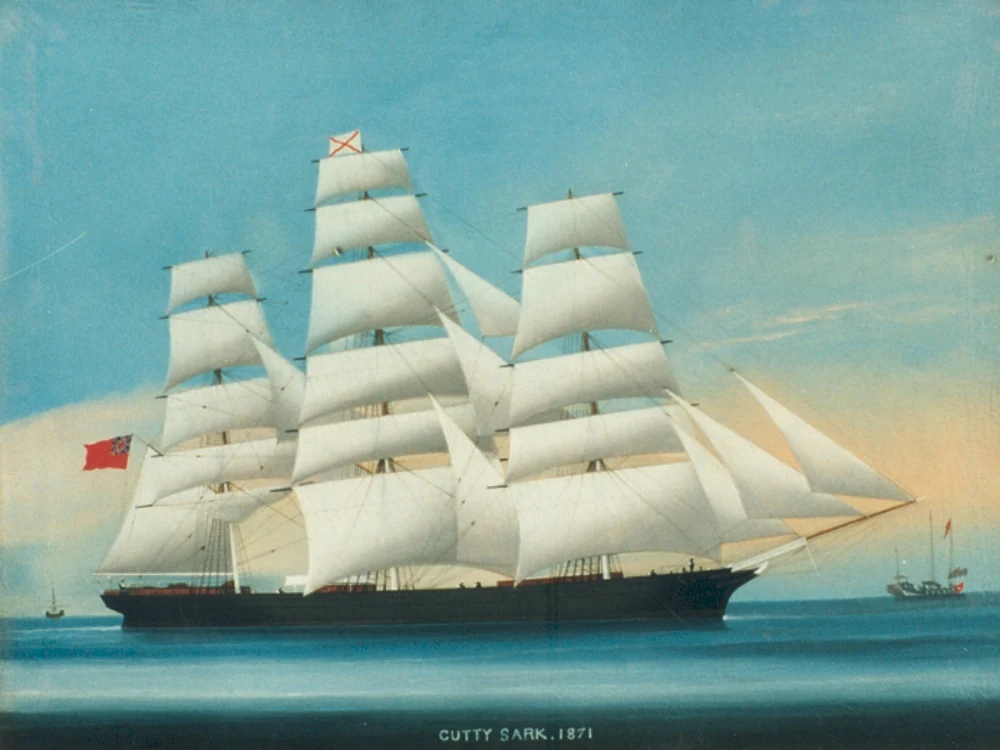
Cutty Sark was launched at Dumbarton on 22 November 1869. Her ambitions were international, but her origins were firmly Scottish. This was a merchant vessel, built to earn money carrying cargo, rather than a warship or a royal yacht.
In 1870 she sailed from London to Shanghai on her first voyage. The return cargo included about 1.3 million pounds of tea. Even at the beginning, the contrast was striking: a beautiful silhouette above the water, and an enormous practical task below it.
The anatomy of speed
Wind, wood, iron, skill.
A clipper was a fast sailing cargo ship. Cutty Sark’s narrow, sharp-ended hull reduced resistance, while tall masts carried a large spread of canvas. Her composite construction joined wooden planking to an iron framework. The hull’s protective metal sheathing helped defend it against marine growth and wood-boring organisms.
Those parts worked together. A powerful sail plan was useful only if the hull could bear its loads, and an efficient hull still needed sailors who could manage the canvas and choose a course. The ship was a system of materials, weather and judgment.
The drawing below is a guide to that system. It simplifies the rig so the main relationships are easy to see; it is not a measured shipbuilder’s plan.
- Maximum recorded speed
- 17½ knots
- Sail area
- 32,000 sq ft
- Hull length
- 64.8 metres
- 1 / Canvas A large sail area catches the wind.
- 2 / Fine bow A narrow entrance helps the hull move through water.
- 3 / Composite hull Wooden planking and an iron frame work together.
China to London · 1870–1877
The race for the tea table.
Tea had become a mass-market habit in Britain. Merchants wanted the new season’s cargo quickly, and a fast passage could mean prestige and better returns. Cutty Sark was built to compete in that business.
But the Suez Canal opened in 1869, the same year the ship was launched. Steamships could use a shorter route between Europe and Asia. Unhelpful winds and the economics of canal passage made it a poor option for sailing clippers. A ship could improve its performance and still lose its commercial advantage.
After eight tea voyages, Cutty Sark moved on. Her story offers a concrete lesson about invention: the best answer to yesterday’s problem can face a new problem before its first voyage is over.
The tea trade also belonged to a wider history of force. Britain’s Opium Wars had compelled China to open ports, helping create the trading conditions in which ships like Cutty Sark operated. Recognizing that background does not tell us every cargo this particular ship carried. It does mean that a history of speed and commerce should also ask how access to markets was obtained.
The encounter of 1872
A lost rudder. An enduring reputation.
In 1872, Cutty Sark and her rival Thermopylae left Shanghai for Britain. Their passages became the ship’s most famous head-to-head contest. Cutty Sark made strong early progress, then lost her rudder in heavy weather.
Without a working rudder, speed was no longer the immediate problem. The crew had to restore control. They fashioned replacement steering equipment at sea, drawing on the ship’s available materials and their own practical skills.
Thermopylae reached Britain first; Cutty Sark arrived roughly a week later. The race matters because of what the crew managed after the damage. A record of defeat can also be a record of seamanship. Retelling it as a victory would miss the more interesting achievement.
Read the sources: 04
Australia · From 1883
A second wind.
Cutty Sark found a more successful role bringing Australian wool to Britain. She entered the trade in 1883; Richard Woodget took command in 1885. In 1886, he brought her from Sydney to London in 73 days.
The homeward route used powerful southern winds and rounded Cape Horn. Woodget pushed into demanding conditions, where icebergs and violent seas accompanied the opportunity for a fast passage. The celebrated times depended on difficult decisions and the labor of the crew.
Read the sources: 05
Two cargoes, different journeys
Tea from China
- Shanghai
- Indian Ocean
- Cape of Good Hope
- London
Wool from Australia
- Sydney
- Southern Ocean
- Cape Horn
- London
Life on board
The people behind the canvas.
Crew size varied by voyage, often numbering around two dozen. The master directed navigation, cargo operations and the ship’s overall running. The first and second mates formed the next levels of command. Able seamen handled the practical work of steering and sail handling, with ordinary seamen carrying out essential supporting tasks.
Specialists kept the voyage possible. A carpenter repaired the ship; a sailmaker repaired damaged canvas; the boatswain organized maintenance. The cook fed everyone, while the steward attended to the officers. Apprentices learned a demanding occupation, sometimes beginning as young as fourteen.
Accommodation reflected rank. The master occupied the more comfortable quarters aft, while other crew lived in much tighter spaces. Looking only at the captain’s passage time can hide this collective effort. Every mile depended on people cooking, mending, cleaning, steering and working aloft.
Read the sources: 06
Under the Portuguese flag · 1895–1922
The long life of Ferreira.
In 1895 the ship was sold to Portuguese owners and renamed Ferreira. She continued carrying general cargo for decades. The famous tea clipper was now earning her living wherever useful freight could be found.
During the First World War she survived another major blow: a dismasting in 1916. She was subsequently rerigged as a barquentine, with a different arrangement of sails from her original full ship rig. There was also a brief final Portuguese name, Maria do Amparo, before her return to British ownership.
These years deserve space in the story. They were not an interval between the glamorous voyages and the museum. They were a substantial part of a working life, shaped by repairs, changing owners and the need to keep cargo moving.
Falmouth · The 1920s and 1930s
Two people saw a future.
In 1922, retired captain Wilfred Dowman recognized the old ship when she came to Falmouth for repairs. He and his wife Catharine set out to save her. Catharine’s financial resources were crucial to the purchase and restoration; this was a shared undertaking.
By 1924, the restored Cutty Sark was serving as a cadet training vessel and welcoming visitors. Preserving the ship gave her another useful role. The skills associated with sail could be taught aboard the vessel that had once depended on them.
After Wilfred died in 1936, Catharine worked to secure the ship’s future. In 1938 she transferred her to the Thames Nautical Training College at Greenhithe for a nominal sum and provided money for upkeep. Her contribution belongs alongside the captains’ names in any account of why Cutty Sark still exists.
Read the sources: 08
A permanent berth · 1954–1957
From working ship to shared inheritance.
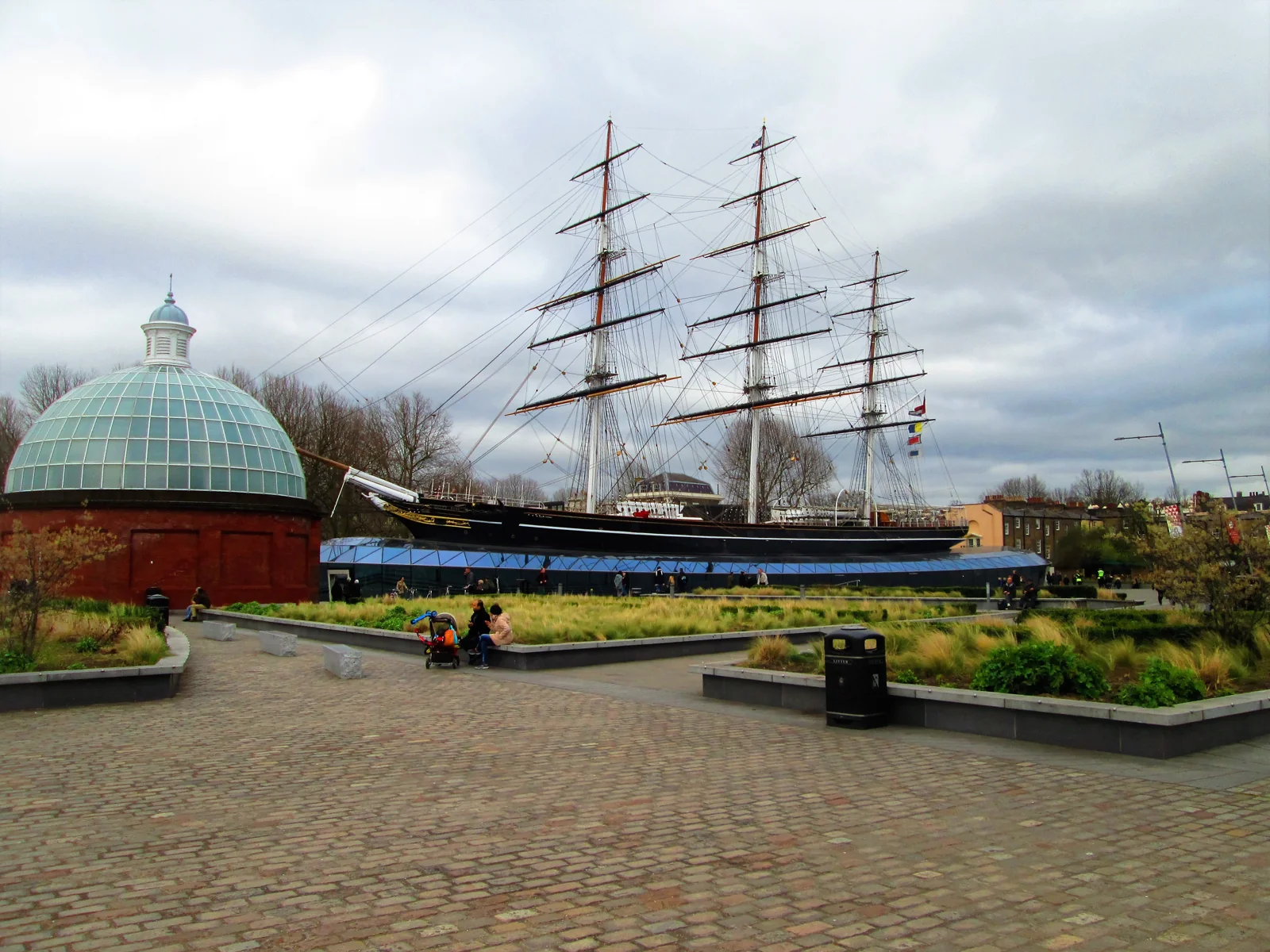
Training eventually gave way to preservation. The Cutty Sark Preservation Society worked to secure a permanent home, with public fundraising and support for restoration. In 1954 the ship entered a specially built dry berth at Greenwich. Queen Elizabeth II opened her to the public in 1957.
A preserved ship is never simply frozen in time. Timbers deteriorate, metal corrodes, and new ways of supporting a hull can change what visitors see. Cutty Sark’s museum life became another demanding engineering project, this time focused on survival rather than speed.
Read the sources: 09

Conservation · 2006–2012 and beyond
Still here.
A major conservation project began in 2006. Then, in May 2007, fire swept through the ship. The images looked catastrophic, but much original material had already been removed for treatment and storage. That timing helped preserve far more of the historic vessel than the photographs of the blaze suggested.
The project repaired and conserved the structure, changed its supports, and protected the lower hull beneath a glass canopy. Cutty Sark reopened in 2012. Visitors can now walk beneath the hull and see the shape that once moved through the water.
The ship at Greenwich contains substantial original fabric alongside replacements and modern conservation work. Its survival depends on continuing care. A vessel once maintained by a working crew is now maintained so that others can understand their world.
Read the sources: 10
The name ashore · Since 1923
The ship
on the
yellow label.
London, 1923: the name takes another voyage.
Cutty Sark whisky was created in 1923 by the London wine and spirits merchant Berry Bros. & Rudd. In the company’s account, Francis Berry and Hugh Rudd discussed a lighter blended whisky with Scottish artist James McBey at No. 3 St James’s Street. McBey suggested naming it after the clipper and supplied the ship illustration for its label.
The two histories meet in the name and the image. The whisky came decades after the ship’s launch; it was not the cargo for which the tea clipper had been built. A vessel known for crossing oceans became an emblem for a drink intended to reach international markets.
The yellow label and the American story.
According to the brand’s own history, the label’s intended cream color emerged from the printer as bright yellow, and the color stayed. That is an origin anecdote supplied by the producer, rather than a reason to treat every detail of later advertising as independently verified history.
The American market was an early ambition, even though the whisky appeared during Prohibition. Berry Bros. & Rudd associates it with the maritime liquor trade of Captain William McCoy. After repeal in 1933, legal sales grew. The brand’s seafaring identity could now combine the nineteenth-century clipper with twentieth-century stories of Atlantic trade.
What is in the bottle?
Cutty Sark is blended Scotch whisky, bringing together malt and grain whiskies. The brand describes its Original expression in terms of citrus, floral notes and vanilla. These are the producer’s tasting descriptions, not a tasting conducted for this page. Other expressions include Prohibition and age-stated blends, each presenting a different version of the house style.
Ownership has also changed. La Martiniquaise-Bardinet acquired the brand from Edrington in a deal announced in late 2018. The sailing ship remains the visual link across those changes: a recognizable silhouette carrying a name from Scottish literature into a worldwide commercial identity.
The voyage at a glance
One name.
Many lives.
Follow a date back to its chapter.
For the curious
Keep exploring.
Ship history draws on museum and maritime heritage records. The whisky’s own promotional history is identified as such. The namesake statement comes from Kutty Stauder. Illustrations simplify the subjects they explain.
- 01Royal Museums Greenwich: Nannie, the figurehead ↗
- 02Royal Museums Greenwich: a history in ten pictures ↗
- 03Royal Museums Greenwich: Cutty Sark and the tea trade ↗
- 04Lloyd’s Register Foundation: the 1872 clipper tea race ↗
- 05Royal Museums Greenwich: history of Cutty Sark ↗
- 06Royal Museums Greenwich: crew on Cutty Sark ↗
- 07Royal Museums Greenwich: ten things to know ↗
- 08Royal Museums Greenwich: Catharine Dowman and preservation ↗
- 09National Historic Ships: Cutty Sark, register 438 ↗
- 10Royal Museums Greenwich: the fire and conservation ↗
- 11Berry Bros. & Rudd: a bottled history of spirits ↗
- 12Cutty Sark whisky: the brand’s own timeline ↗
- 13Cutty Sark whisky: the expressions ↗
- 14La Martiniquaise-Bardinet: the Cutty Sark acquisition ↗
- 15Royal Museums Greenwich: ship facts pack ↗
Historical painting: unknown artist, Cutty Sark, 1871, via Wikimedia Commons, public domain. Greenwich photograph: PetraDraha, 2017, CC BY-SA 4.0; full credit appears below the photograph. Ship, route and bottle drawings created for this page.
History and source links reviewed September 2026.
Another horizon