The Brutal Truth

A Treatise on the Truth of Reality
Geometric edition · September 2026
A book by Kutty Stauder
The Brutal Truth
A Treatise on the Truth of Reality
Deductive claims follow the Definitions and Axioms. Empirical claims are only as strong as the cited findings. Speculative chapters in Parts V and VIII are labeled as such and do not overturn the ontology.
Kutty Stauder
Geometric edition · September 2026
Copyright © 2026 Kutty Stauder.
All rights reserved.
Philosophical inspiration: Baruch Spinoza. Contemporary prose and applications are by the author, not quotations from Spinoza unless expressly identified.
kuttystauder.com/books
How to Read This Treatise
Abstract
This book applies the geometric method of Spinoza's Ethics to the question ordinary life refuses to ask: what is the case, and what follows for a finite mode that has to live inside it. Its central claim is ontological rather than psychological. Reality is one substance, infinite in attributes, expressed as finite modes, operating by necessity. A human being is one such mode. The feeling of being a separate chooser, standing outside the causal order and issuing commands into it, is an inadequate idea: consciousness of effects joined to ignorance of causes. Once that vocabulary is fixed, the one hundred and fourteen chapters that follow are not a catalogue of cynicisms. They are corollaries. Each names a comforting picture of the world, shows the cause that picture conceals, and states what a person can do once the concealment is removed. Twelve Definitions and twelve Axioms are set down first, drawn from verified propositions of the Ethics. Documentary and empirical claims are separated from deductive ones and marked as such, because no demonstration can establish a lesion study and no experiment can establish that a category error has been made.
Keywords: Spinoza, substance, mode, conatus, adequate idea, necessity, freedom, bondage, Deus sive Natura.
Prolegomenon
This is the complete text of ten Parts. The Definitions and Axioms of Part I govern everything after them. Chapters that report measurements, histories, or laboratory findings are not proofs of the Definitions. They are illustrations, constraints, or failures of illustrations. Where a finding is weaker than the sentence it used to support, the chapter says so. Where a chapter enters territory Spinoza did not settle, the chapter is marked as speculative and is not permitted to overturn a demonstration.
The scope of the whole work. It treats truth as an adequate idea of a cause, and reality as the one substance of which every cause is a mode. It covers the practical advantages that follow from seeing this, the social punishments that follow from saying it, the floor beneath human self-description, the questions that remain open, the reorganization that makes the floor livable, the operations that actually increase power, and the strategies that remain guesses.
What it does not cover. It does not offer a new religion, a cosmic parent, or a technique for becoming uncaused. It does not teach you how to feel better about death by denying it. It does not claim that every brutal sentence in the older editions was a settled fact. Several were polemic. Several were overfitted to a study. This edition keeps the severity and withdraws the false precision.
The method. Three kinds of claim appear in this work and they are never confounded. Deductive claims are established from the Definitions and Axioms, in the manner of the Ethics, and are valid or invalid. Empirical claims are established by measurement, replication, and the history of a field, and are reported with their limits. Speculative claims are marked as such: they may be interesting, they may even be useful as bets, and they do not become ontology by being repeated. The common error, in both directions, is to refute a demonstration with a mood or a measurement with a metaphor.
The reader. No prior knowledge of Spinoza is assumed, and no mathematics is used. The reader is assumed to be capable of following a proof, to be willing to hold comfort in suspension until a cause is named, and to prefer an account of what is to an account of what would be nicer. The reader who wants consolation will find some, late, and will find that it is not consolation in the ordinary sense. It is the removal of a second suffering: the protest that reality ought to have been otherwise.
A note on the text. Citations of the form E1P14 refer to Part I, Proposition 14 of Spinoza's Ethics; E2D4 refers to a Definition in Part II; E3P6 to Part III, Proposition 6. Every such reference was checked against the text before it was used. Depends on lines under chapter titles name the Definitions, Axioms, and Ethics propositions that the chapter applies. They are not decorations.
What "truth" means here
Truth, in this book, is not sincerity, not consensus, and not the feeling of conviction. Spinoza's formula is exact: a true idea is an adequate idea, and an adequate idea is one that, insofar as it is considered in itself, has all the properties of a true idea (E2D4). Knowledge of an effect depends on and involves knowledge of its cause (E1A4). An idea is adequate when the cause can be clearly and distinctly perceived in it. An idea is inadequate when the mind has the effect and lacks the cause, and then invents a story to cover the gap.
The ordinary mind lives in that gap. It is conscious of wanting, choosing, loving, blaming, and hoping. It is ignorant of the chain that produced the want. It therefore treats the want as an origin. That treatment is the source of almost every comforting illusion this book will name. The illusion is not a lie told by a villain. It is the natural product of a finite intellect that perceives itself more clearly than it perceives the world that produced it (E2P19, E2P23, E2P29).
It follows that "brutal" does not mean cruel. It means: stated without the covering story. A truth can be brutal and still be ordinary. Gravity is brutal in this sense. So is death. So is the fact that praise and blame, applied to an uncaused will, describe nothing in nature.
What "reality" means here
Reality, in this book, is not "whatever my tribe currently affirms," and it is not a veil behind which a more interesting universe is hiding. By reality I understand substance: that which is in itself and is conceived through itself (E1D3). There is only one such thing (E1P14). Spinoza calls it God or Nature. The "or" is the entire theology of this book. It is not a being among beings. It is the being of beings. It does not stand outside the causal order and intervene. It is the causal order.
Whatever exists, exists as a mode of that one substance (E1P15, E1P25C). A mode is a finite expression, determined to exist and to act by another finite expression, and so on without end (E1P28). You are a mode. This sentence is a mode. The market, the nervous system, the star, the law, the marriage, the tumor, and the proof are modes. There is no second world in which a different you could have chosen otherwise. There are only the causes that were available, and the effects that followed.
Two attributes of substance are known to us: thought and extension (E2A5). They are not two things interacting. They are one thing expressed in two ways (E2P7). This is why the book will refuse every story in which a mind bosses a body, or a body secretes a mind as a waste product, or a soul rents a brain for a lifetime and then vacates. The order of ideas is the order of things. A change in one is a change in the other, because there are not two.
From this, three refusals follow immediately.
First: there are no final causes. Nature does not act for an end (E1 Appendix). The universe is not trying to teach you, reward you, or complete a story in which you are the protagonist. Teleology is the imagination reading its own appetite back onto substance.
Second: nothing is contingent (E1P29). The feeling that an event "need not have happened" is a comparison between what occurred and an image of what did not. The image was never a second reality. It was a fiction produced by incomplete knowledge of the causes.
Third: a finite mode cannot be the absolute origin of its own actions (E1D7, E1P28). Freedom, if the word is to be kept, cannot mean exemption from the causal order. It can only mean this: that a larger share of what happens in us is understood through our own nature, and a smaller share is suffered as an obscure passion (E3D1, E3D2, E5P3).
That is the truth of reality this book will not bargain away. The one hundred and fourteen chapters are what it costs to stop bargaining.
Definitions
Definition I. Substance. As Spinoza: by substance I understand that which is in itself and is conceived through itself; that is, that whose concept does not require the concept of another thing from which it must be formed (E1D3).
Note. This is the first and last metaphysical claim in the book. Everything else is a mode of it. The word is not a poetic name for "the universe as a collection." A collection is conceived through its members. Substance is not.
Definition II. Attribute. As Spinoza: by attribute I understand that which the intellect perceives of substance as constituting its essence (E1D4). Thought and extension are the two attributes known to us (E2A5).
Note. An attribute is not a property glued onto a hidden thing. It is a way the one thing is conceived as essential. The book will therefore treat a change of body and a change of idea as one change, reported twice.
Definition III. Mode. As Spinoza: by mode I understand the affections of substance, or that which is in another through which it is also conceived (E1D5). A human being is a finite mode, determined to exist and to operate by another finite mode, and so on to infinity (E1P28).
Note. "You" names a complex mode, not a substance. The grammar of ordinary language treats the name as if it named a little substance inside the big one. That grammar is the first inadequate idea.
Definition IV. God or Nature. As Spinoza: by God I understand a being absolutely infinite, that is, a substance consisting of an infinity of attributes, of which each one expresses an eternal and infinite essence (E1D6). This book uses God or Nature for that substance and nothing else.
Note. The definition excludes will, purpose, personality, petition, and reward. If those are required for the word "God" to be usable, the word should be dropped. The referent remains. It does not become smaller when the name is changed.
Definition V. Cause. From a given definite cause an effect necessarily follows; and, conversely, if there is no definite cause, it is impossible for an effect to follow (E1A3). Knowledge of an effect depends on and involves knowledge of its cause (E1A4).
Note. Cause, here, is not a billiard-ball picture borrowed from later physics. It is intelligibility: that through which a thing is conceived. A story that names an effect and withholds its cause is not a causal story. It is an image.
Definition VI. Adequate idea. As Spinoza: by adequate idea I understand an idea which, insofar as it is considered in itself, without relation to an object, has all the properties or intrinsic denominations of a true idea (E2D4). Truth is the adequate idea of a cause.
Note. Adequacy is not sincerity and not confidence. A man may be passionately sure of an inadequate idea. The test is whether the effect can be understood through the cause named.
Definition VII. Inadequate idea. By inadequate idea I understand a partial, confused, or imaginary grasp of a cause, in which the mind has the effect and lacks the order that produced it (E2P28, E2P35). Falsity is the privation of knowledge that such ideas involve.
Note. Inadequate ideas follow with the same necessity as adequate ones (E2P36). Confusion is not a sin and not an accident. It is what a finite mode produces when it is more affected than it is understanding.
Definition VIII. Conatus. Everything, insofar as it is in itself, endeavors to persist in its own being; this endeavor is the actual essence of the thing (E3P6, E3P7). In a human being this endeavor, as it is conscious, is called desire (E3P9S).
Note. Desire is not a defect in an otherwise rational creature. It is the creature. Reason does not generate motion. It clarifies the object of a motion already underway.
Definition IX. Affect. By affect I understand the affections of the body by which the body's power of acting is increased or diminished, aided or restrained, and at the same time the ideas of these affections (E3D3). Joy is the passage to greater power; sadness the passage to lesser (E3P11S).
Note. The book will not treat feelings as reports about the world. They are reports about a change in power, referred to an object that may or may not have caused them.
Definition X. Bondage. By bondage I understand the human lack of power to moderate and restrain the affects: the condition of the man who is not his own master, but is governed by fortune, in whose power he so is that although he sees the better for himself, he is still compelled to follow the worse (E4 Preface).
Note. Bondage is not chains and not society. It is governance by inadequate ideas. A prisoner who understands the lock is less in bondage, in this sense, than a free citizen who does not understand his own appetite.
Definition XI. Freedom. As Spinoza: that thing is called free which exists from the necessity of its nature alone, and is determined to act by itself alone (E1D7). For a finite mode this is a limit, not a possession. What can be increased is the proportion of one's actions of which one is the adequate cause (E3D1, E3D2).
Note. Freedom so defined is compatible with being caused, because a thing's nature is itself a cause. What it excludes is the fantasy of having been able, in the same causal world, to have done otherwise.
Definition XII. Power. By power I understand a mode's capacity to act, that is, to be the adequate cause of effects that follow from its nature (E3P7, E4P18S). An increase of power is joy; a decrease is sadness. The useful is whatever aids this increase (E4D1, E4P38).
Note. Power is not domination and not status. A man may dominate a room and be almost entirely a patient of his vanity. Another may increase his power in solitude by replacing a confused idea with a clear one.
Axioms
Axiom I. From a given definite cause an effect necessarily follows; if there is no definite cause, no effect can follow (E1A3).
Axiom II. Knowledge of an effect depends on and involves knowledge of its cause (E1A4).
Axiom III. Except for substance, nothing can be or be conceived without God; whatever is, is in God, and nothing can be or be conceived without God (E1P15). There is only one substance (E1P14).
Axiom IV. Nothing in the universe is contingent. All things are determined from the necessity of the divine nature to exist and operate in a certain way (E1P29). Nature has no end set before it (E1 Appendix).
Axiom V. The order and connection of ideas is the same as the order and connection of things (E2P7).
Axiom VI. Men believe themselves free because they are conscious of their actions and ignorant of the causes by which they are determined (E1 Appendix; E2P35S; Letter 58).
Axiom VII. The ideas of the affections of the body, referred to the mind alone, are not clear and distinct but confused (E2P28). Inadequate and confused ideas follow by the same necessity as adequate ones (E2P36).
Axiom VIII. Everything, insofar as it is in itself, endeavors to persist in its own being (E3P6). We do not desire a thing because we judge it good; we judge it good because we desire it (E3P9S).
Axiom IX. An affect can be restrained or taken away only by an opposed and stronger affect (E4P7).
Axiom X. Knowledge of good and evil is nothing but the affect of joy or sadness, insofar as we are conscious of it (E4P8).
Note. Moral vocabulary is therefore a report of power-change in the guise of a description of the world. The report can be useful. It is not a second ontology.
Axiom XI. An affect which is a passion ceases to be a passion as soon as we form a clear and distinct idea of it (E5P3). There is no affection of the body of which we cannot form some clear and distinct concept (E5P4).
Axiom XII. A free man thinks of nothing less than of death, and his wisdom is a meditation on life, not on death (E4P67).
Note. This axiom is placed last because it is a consequence the reader will not credit until the others have done their work. It is not a slogan for avoiding the subject. It is the test of whether the subject has been understood.
The order of the books
Part I has just been given. It is the only part that must be read first.
Part II, Of Power, collects twenty ideas that increase a mode's capacity to act once inadequate pictures of choice, mind, desire, and work are withdrawn. They are advantages only relative to those who still spend force on the pictures.
Part III, Of Bondage, collects the ideas that cost dinner invitations: the ones that name coordination as morality, convenience as friendship, and interest as ideology. They are not permission to become cruel. Cruelty is usually an inadequate idea with a good seat.
Part IV, Of the Floor, is the bedrock: consciousness as a mode of extension and thought, death as the end of a finite mode, the absence of final causes, the construction of meaning, the nonexistence of an uncaused will. This is the part that produces vertigo if Part I was skipped.
Part V, Of What Cannot Yet Be Demonstrated, keeps the questions that honest inquiry does not close: the remaining gap in a theory of experience, the status of time, the silence of the sky. It is not a license to reinstall a cosmic parent in the gap. The gap is a gap.
Part VI, Of Freedom, is the reorganization. Understanding necessity does not abolish pain. It abolishes the second pain of insisting that the first pain was a mistake in the order of Nature. The dissolution of the self as a little substance is not nihilism. It is accuracy.
Part VII, Of Operation, is what is left when motivational mythology is removed: talent, luck, ownership, bargaining power, consistency, quitting. These chapters are empirical where they claim to be empirical. They apply Definition XII. They are not proofs of the Definitions. They are what a mode with conatus actually does once it stops lying to itself about merit.
Part VIII, Of the Frontier, is labeled speculation. A speculative chapter may be used as a bet. It may not be used as a metaphysics.
The conclusion does not add a fifteenth kind of comfort. It restates E4P67 and sends the reader back to the only work there is: the replacement of inadequate ideas by adequate ones.
A note on severity
A book that calls itself The Brutal Truth will be accused of enjoying the bruise. Some sentences in earlier editions did. This edition does not. Severity is a property of the object, not a style of the author. If a claim is false, its harshness does not save it. If a claim is true, softness does not improve it.
You may find that some of the one hundred and fourteen are wrong. You should hope that some of them are wrong. The appropriate response to any individual claim is examination. Does the demonstration hold? Does the evidence, where evidence is claimed, survive its own limits? Would replacing this idea with a clearer one increase or decrease the power to act?
The goal is not to believe the book. The goal is to stop believing the covering stories. What remains, if the work is done, is not a darker world. It is the same world, with fewer inventions in it.
We begin from the idea that has been destroying philosophical careers for centuries, and that Spinoza stated without apology: a man who thinks he is an uncaused cause has not yet begun to understand himself.
Chapter 1
1. Free Will Does Not Exist
Depends on: Definition XI, Axiom VI. Ethics E1 Appendix, E2P35S, Letter 58.
Demonstration. A thing is free only if it exists from the necessity of its own nature and is determined to act by itself alone (Definition XI). A finite mode is determined to exist and to act by another finite mode, and so on without end (E1P28). Therefore a human being is not an uncaused cause of his actions. The feeling of having been able to do otherwise is consciousness of the action joined to ignorance of its causes (Axiom VI). ∎
The Claim
You have never made a free choice. The feeling that you could have done otherwise is ignorance of the causes operating upon you. Freedom is not the absence of causation. Freedom is the understanding of it.
The Comforting Illusion
The standard view holds that you are an autonomous agent. You weigh options, exercise willpower, and choose. When you succeed, it reflects character. When you fail, it reflects weakness. The entire apparatus of praise, blame, guilt, pride, and moral responsibility rests on this foundation.
It is false.
The Causal Mechanism
Every decision you have ever made arose from prior causes: genetic predispositions you did not select, neural architecture shaped by environments you did not control, habits installed by reinforcement schedules you never consciously authorized, affects triggered by stimuli you did not notice, and ideas inherited from a culture you were born into. The brain initiates action before the conscious mind registers a decision. Benjamin Libet demonstrated this in 1983: a readiness potential in the motor cortex preceded the conscious experience of deciding by roughly 350 milliseconds. Subsequent studies by John-Dylan Haynes and colleagues extended the window to seconds, using fMRI to predict decisions before subjects reported making them. These experiments concern constrained laboratory tasks. Their interpretation does not by itself settle whether all meaningful choices are decided before awareness.
Spinoza offered a philosophical argument against uncaused human choice; modern neuroscience does not by itself confirm his entire argument. In the Ethics, he argues that men believe themselves free because they are conscious of their actions and ignorant of their causes. A stone thrown through the air, if it were conscious, would believe it chose its trajectory. We are the stone, equipped with a press secretary that explains our flight path.
The Evidence
The Libet experiments (1983) showed a consistent temporal gap between neural initiation and conscious awareness of decision. Soon et al. (2008, Nature Neuroscience) demonstrated that patterns of brain activity in prefrontal and parietal cortex predicted choices up to seven seconds before subjects reported deciding. Wegner's "The Illusion of Conscious Will" (2002) catalogued the conditions under which people confabulate agency for actions they did not cause. More recently, Robert Sapolsky's "Determined" (2023) summarized the case from endocrinology, neuroscience, genetics, and developmental biology: every behavior has a biological antecedent, and every biological antecedent has a prior cause, in an unbroken chain reaching back before birth.
The rejoinder that "compatibilism preserves free will" merely redefines free will until it loses all connection to what people actually mean by the term. If "free will" means "acting according to one's desires without external coercion," then a dog chasing a squirrel has free will. The compatibilist move preserves the word by gutting the concept.
Case Study
Consider two smokers. The first believes in free will. Each morning, he resolves to quit. Each afternoon, he lights a cigarette. He attributes the failure to weak character and tries again tomorrow with the same strategy: willpower. He has been failing this way for fifteen years.
The second understands determinism. She asks: what causes produce smoking, and what causes would produce cessation? She removes cigarettes from her house. She stops drinking coffee, which triggers the craving. She replaces the afternoon break with a walk. She uses nicotine patches to decouple the chemical dependency from the behavioral habit. She does not wake up each morning asking herself to "choose" differently. She changes the causal structure and lets the new causes produce the new outcome.
The first smoker still smokes. The second quit ten years ago and never looked back. The difference was not character. It was causal engineering.
The Objection
"If there is no free will, then nothing I do matters. I am just a puppet."
This objection confuses determinism with fatalism. Fatalism claims that outcomes are fixed regardless of your actions. Determinism claims that your actions, like everything else, have causes, and those actions produce effects. Your deliberation, your effort, your decision to read this chapter: all are real causes in the causal chain. They produce real outcomes. The fact that they themselves have causes does not make them less real or less efficacious. The puppet objection imagines an external puppeteer. The reality is that you are part of the causal fabric, not a victim of it. Your actions matter precisely because they are causes.
The Operational Implication
Stop asking how to make yourself want something. Start asking what arrangement of environment, habit, and bodily state would make the desired outcome causally inevitable. Replace moral struggle with causal engineering. When you fail, do not ask "What is wrong with me?" Ask "What cause produced this outcome, and what cause would produce a different one?" The first question produces guilt and paralysis. The second produces analysis and action.
The person who believes in free will tries to choose differently and fails because the causes remain unchanged. The person who understands determinism changes the causes and succeeds because new causes produce new outcomes. This is not philosophy. It is the difference between the smoker who still smokes and the one who quit.
Evidence and interpretation
Readiness-potential findings do not settle the metaphysical debate. Schurger, Sitt, and Dehaene (2012) modeled spontaneous fluctuations and threshold crossing as an alternative account of the averaged pre-movement buildup: https://doi.org/10.1073/pnas.1210467109. The deterministic position defended here is philosophical; it should not be presented as the unique experimentally proven interpretation. Spinoza’s conscious-stone illustration is in Letter 58 to Schuller.
Chapter 2
2. Mind and Body Are One Thing
Depends on: Definition II, Axiom V. Ethics E2P7, E3P2.
Demonstration. Thought and extension are attributes of one substance, not two substances in interaction (Definition II). The order and connection of ideas is the same as the order and connection of things (Axiom V). Therefore there is no mental event without a bodily event, and no bodily event without a mental event. The mind cannot determine the body to motion or rest, nor the body the mind to think, as if they were two kingdoms (E3P2). What is called "mental discipline" without the body, or "bodily maintenance" as if it were beneath thought, is a distinction of words, not of things. ∎
The Claim
Physical discipline is mental power. The person who neglects sleep, nutrition, and movement is not making a bodily choice with mental consequences. He is degrading the only organ that produces his mind.
The Comforting Illusion
The default assumption in intellectual culture is that the mind is the boss and the body is the vehicle. Thinking is a clean, abstract activity. The body is the animal substrate that occasionally disturbs pure cognition with hunger, fatigue, or desire. Philosophers, scholars, and knowledge workers treat physical maintenance as optional, secondary, or beneath their station.
This separation is a conceptual error with catastrophic practical consequences.
The Causal Mechanism
Spinoza's parallelism, stated in Ethics Part II, Proposition 7: "The order and connection of ideas is the same as the order and connection of things." Mind and body are not two substances interacting. They are the same thing, expressed through two different attributes. Whatever happens in the body is expressed in the mind. Whatever happens in the mind is expressed in the body. There is no mental event without a corresponding physical event, and no physical event without a corresponding mental event.
Modern neuroscience has vindicated this position with embarrassing precision. The brain is a bodily organ. It runs on glucose and oxygen delivered by the cardiovascular system. It is regulated by hormones produced in glands throughout the body. It is shaped by inflammatory markers, gut microbiota, and circulating cytokines. A sleep-deprived brain produces confused thought, emotional instability, and impaired judgment because sleep deprivation degrades prefrontal cortex function, increases amygdala reactivity, and disrupts memory consolidation. Inflammatory processes are studied as possible contributors to some depressive and cognitive symptoms; their contribution varies, and an individual diagnosis cannot be inferred from this account.
Mental and physical health interact. Distinguishing clinical specialties can still be useful even when the systems they study are interdependent.
The Evidence
Specific studies support particular relationships, not the claim that every hour of exercise returns a multiple of intellectual output. Erickson et al. (2011) randomized 120 older adults to aerobic exercise or stretching and reported an increase in anterior hippocampal volume in the exercise group over one year. That finding is not evidence that all forms of exercise improve every cognitive ability or prevent dementia. Study: https://doi.org/10.1073/pnas.1015950108.
Williamson and Feyer (2000) compared prolonged wakefulness with alcohol exposure on selected performance tests. Similar performance at particular exposure levels does not mean that a tired worker literally has alcohol in their blood, or that four hours of sleep has a single universal impairment value. Study: https://doi.org/10.1136/oem.57.10.649.
The SMILES trial randomized 67 adults with major depression to dietary support or a social-support control for twelve weeks. It supports further study of diet as an adjunct to treatment. It did not compare dietary improvement directly with antidepressant medication, so it cannot establish equivalent efficacy to pharmacotherapy. Study: https://doi.org/10.1186/s12916-017-0791-y.
Mechanistic hypotheses involving inflammation, neuroplasticity, and gut-brain signaling should be distinguished from demonstrated clinical effects in people. No single biomarker explains all depression or cognitive performance.
Case Study
Consider a hypothetical comparison between two knowledge workers; this is an illustration, not a controlled study. The first sleeps five hours per night, eats processed food at his desk, and exercises sporadically. By 3 PM, his prefrontal cortex is offline. He makes decisions by impulse, avoids complex work, and reaches for sugar to compensate for energy deficits he misattributes to boredom. His output is erratic. His judgment is poor. He believes he is working hard. He is working badly.
The second sleeps eight hours, lifts weights three times per week, and eats whole foods. Her energy is stable across the day. She does her deepest work in the morning, handles difficult decisions after lunch, and maintains emotional equilibrium under pressure. Her output is higher than the first worker's by every measure: quantity, quality, consistency. She works fewer hours and produces more.
The Objection
"I know brilliant thinkers who neglected their bodies. Nietzsche was sickly. Kant was frail. Proust wrote in bed."
The counterexamples show that poor health and intellectual achievement can coexist. Nietzsche suffered migraines, vomiting, and near-blindness. He was productive despite his body, not because of his neglect. How much more might he have produced with better health? Kant's legendary routine included a strictly regulated daily walk and carefully managed meals. He understood the connection. Proust was a genius; he was also dead at 51. The question is not whether brilliance can coexist with bodily neglect. It can, temporarily. The question is whether bodily neglect increases or decreases total lifetime output. The answer is unambiguous.
The Operational Implication
The person who treats sleep, exercise, and nutrition as separate from intellectual work is making the same error as the person who treats engine maintenance as separate from driving. You can skip oil changes for a while. Eventually the engine seizes.
Physical training is not vanity. It is not a hobby. It is not something you do when the real work is finished. It is the maintenance of the organ that does the real work. Investment in physical health can support intellectual work, although the return is neither uniform nor guaranteed. The body is not beneath the mind. It is the mind, considered under the attribute of extension. Treat it accordingly.
Chapter 3
3. You Are Your Desires, Not Your Reasons
Depends on: Definition VIII, Axiom VIII. Ethics E3P6, E3P7, E3P9S.
Demonstration. The actual essence of a thing is its endeavor to persist (Definition VIII). In man this endeavor, as it is conscious, is desire (E3P9S). Judgment of good follows desire; desire does not follow a prior judgment of good (Axiom VIII). Therefore "reason versus desire" names a conflict of desires, one of which has borrowed the word reason. A desire is adequate when its cause is understood; it is not adequate merely because it is delayed, verbal, or socially approved. ∎
The Claim
Desire is the essence of man. You do not act from reason against desire. You act from one desire against another. The question is never "Should I follow desire or reason?" but "Which desire is stronger, and is it adequate?"
The Comforting Illusion
Western thought has been staging a civil war between reason and desire for two and a half millennia. Plato's charioteer reins in the dark horse of appetite. Kant's categorical imperative overrides inclination. The rational person, in this tradition, is the one who suppresses wanting and follows duty. Desire is the enemy. Reason is the general.
This framing is not merely wrong. It is useless. It sets up a battle that no one has ever won and then blames the loser for lacking moral fiber.
The Causal Mechanism
Spinoza's Proposition 6 of Ethics Part III states: "Each thing, insofar as it is in itself, strives to persevere in its being." This striving, this conatus, is the essence of any thing. In humans, it manifests as desire. Proposition 9, Scholium: "We do not endeavor, will, seek after, or desire a thing because we judge it to be good. On the contrary, we judge a thing to be good because we endeavor, will, seek after, and desire it." The arrow runs from desire to judgment, not the reverse.
When you "overcome" a desire, you have not defeated desire with reason. You have defeated one desire with another. The desire to be healthy overcomes the desire for cake. The desire for career advancement overcomes the desire to sleep in. The desire for self-respect overcomes the desire for revenge. In every case, the stronger desire wins. What we call "willpower" is simply the name we give to the winning desire after the fact, when the winning desire aligns with our self-image.
David Hume got this right: "Reason is, and ought only to be the slave of the passions, and can never pretend to any other office than to serve and obey them." Reason can calculate how to satisfy a desire. It can identify which desire will produce more durable satisfaction. It can model the consequences of acting on this desire versus that one. What it cannot do is generate motivation ex nihilo. Motivation is desire. Desire is conatus. Conatus is the nature of the thing.
The Evidence
Neuroscience has confirmed the primacy of affect in decision-making. Antonio Damasio's somatic marker hypothesis demonstrates that patients with damage to emotion-processing regions (ventromedial prefrontal cortex) become incapable of making even trivial decisions. They can reason perfectly about options. They cannot choose between them because choice requires an emotional signal about which outcome is desirable. Pure reason is decisionally inert.
Jonathan Haidt's metaphor of the rider and the elephant captures the same asymmetry. The rider (conscious reasoning) can influence the elephant (emotional/desire systems) through training and environment. But when rider and elephant disagree, the elephant wins every time. The rider's job is to serve the elephant, not to pretend the elephant does not exist or that its direction can be overridden by argument alone.
Case Study
The investor who understands every rational argument for holding a position through a drawdown, who has backtested the strategy, who knows the probabilities, who has written the rules in a trading plan. The drawdown arrives. The fear response activates. The amygdala fires. Cortisol rises. The desire to escape the pain of watching unrealized losses overwhelms every rational consideration. He exits at the bottom. He knows, intellectually, that this is exactly what he should not do. The knowledge does not matter. The stronger desire won.
The investor who succeeds is not the one with more knowledge or better reasoning. Knowledge is abundant. Trading books are twenty dollars. The successful investor has arranged causes such that the desire to follow the system is stronger than the desire to escape discomfort. He has rehearsed the drawdown. He has reduced position size to where the fear response is manageable. He has built rules that automate exit decisions so that the desire to intervene never gets a vote. He does not win because he conquered his emotions with reason. He wins because he engineered his environment so that the right desire wins by default.
The Objection
"If reason is the slave of the passions, then rational argument is pointless. You cannot convince anyone of anything."
This confuses the source of motivation with the function of reasoning. Reason cannot generate the desire to change, but it can redirect existing desires by revealing causal connections. A person who desires health can be shown that smoking undermines health. The desire for health, now informed, overcomes the desire for nicotine. The reasoning did not create the desire for health. It armed an existing desire with adequate causal knowledge.
The Operational Implication
Stop trying to reason yourself into wanting what you think you should want. The desire to exercise will not appear because you read about its benefits. The desire already exists: you want to feel strong, look good, live long, avoid illness. What is missing is not desire but causal arrangement. Make the desired action the path of least resistance. Remove friction. Attach the action to an existing desire. Exercise because you want to clear your head before work, not because you "should." Eat well because genuinely good food tastes better than processed slop once your palate adjusts, not because nutrition science says so. Align your environment with your desires, and let the stronger desire win.
Chapter 4
4. Motivation Follows Action
Depends on: Definition VIII, Axiom IX. Ethics E3P9S, E4P7.
Kind. Mixed.
The Claim
Action produces motivation. Never the reverse. The person waiting to feel ready has reversed the causal order and guaranteed paralysis. The person who acts generates the affect that enables further action.
The Comforting Illusion
"I will start when I feel motivated. I need to get in the right headspace. Let me wait until inspiration strikes." This language is so common it passes without comment. Entire industries sell the fantasy: motivational speakers, productivity influencers, pre-workout supplements, morning routine content. The premise is that motivation is a prerequisite for action, a fuel you must locate before you can begin.
The premise is backwards.
The Causal Mechanism
Spinoza defines joy as the transition to greater perfection, the increase in the power to act. Completed action produces joy. Joy increases the capacity for further action. The causal chain runs: act, complete, experience power-increase, accumulate capacity, act again. This is a virtuous cycle. Its opposite, the paralysis cycle, runs: wait for motivation, do nothing, experience power-decrease, accumulate inertia, wait longer.
The mechanism is not merely philosophical. Dopamine, the neurotransmitter most associated with motivation, is released not primarily in response to reward but in anticipation of reward, and that anticipation is trained by prior action. The first workout does not feel good. It feels terrible. But completing it produces a small increase in the sense of agency, which makes the second workout slightly easier to initiate. After ten workouts, the anticipation has shifted. The brain now associates the action with the post-completion state, and dopamine is released at the thought of beginning. The person who never does the first workout never trains this circuit.
Behavioral activation, a frontline treatment for depression, operates on exactly this principle. Depressed patients do not wait until they feel less depressed to resume activity. They resume activity, and the activity reduces the depression. The effect size is comparable to cognitive therapy and pharmacotherapy. Action treats the condition that prevents action.
The Evidence
The behavioral activation literature is extensive. A meta-analysis by Cuijpers et al. (2007) found that behavioral activation was superior to waitlist controls and equivalent to both cognitive therapy and antidepressant medication for moderate-to-severe depression. The mechanism is straightforward: depression involves withdrawal from rewarding activities, which reduces positive reinforcement, which deepens depression. Reintroducing activities breaks the cycle, not through insight but through the brute causal force of completed action.
In creativity research, the concept of "inspiration" has been systematically dismantled. Robert Boice's studies of academic writers found that those who wrote only when inspired produced dramatically less output than those who wrote on a fixed schedule regardless of inspiration. The scheduled writers also reported more moments of inspiration. The muse visits those who are already working, not those who are waiting.
Stephen King, in "On Writing," describes his process: "Amateurs sit and wait for inspiration. The rest of us just get up and go to work." The output of a professional writer is not correlated with mood, inspiration, or motivation. It is correlated with showing up.
Case Study
Two aspiring novelists. The first spends two years reading about craft, waiting for the right idea, outlining in detail, telling friends about the book he will write. He feels like a writer. He reads interviews with published authors. He buys Scrivener. He creates a writing playlist. He has not written page one.
The second writes one bad page every morning. Two hundred and fifty words, often terrible, before doing anything else. After three months, she has ninety pages. After a year, a draft. The draft is bad. First drafts are always bad. But a bad draft exists. A bad draft can be revised. The first novelist's nonexistent masterpiece cannot.
The second novelist now experiences writing not as a special event requiring a special state but as a background process, like breathing. The act of writing has become causally automatic. The motivation that eluded the first novelist has arrived, as a consequence of action, for the second.
The Objection
"What about burnout? If I force myself to act when I feel depleted, I will eventually break down."
The objection conflates forcible override with causal arrangement. The goal is not to ignore exhaustion and push through indefinitely. The goal is to recognize that the feeling of "not wanting to start" is almost never exhaustion. It is inertial resistance. Exhaustion announces itself after sustained effort, not before the first minute of effort. The person who distinguishes genuine depletion (which requires rest) from starting friction (which requires action) will act more and rest better than the person who treats both identically.
The Operational Implication
The rule is simple and brutal: act before you are ready. Do not negotiate with the feeling of resistance. It has no information. It is the default noise of a nervous system that prefers homeostasis to growth.
Set a minimum viable action. One sentence. One rep. One minute. The minimum that makes non-action absurd. Once the action has begun, the causal chain takes over. The joy of completion, however small, generates the capacity for the next action.
The person who waits for motivation will wait forever. The person who acts will find that motivation arrives, late, panting, and slightly embarrassed, asking if it can still join.
Chapter 5
5. Environment Defeats Willpower Every Time
Depends on: Definition XI, Axiom IX. Ethics E4P7, E3P2.
Kind. Mixed.
The Claim
What appears to be discipline is usually environment design. Willpower is a depletable resource. Environment is a permanent cause. The person who relies on willpower will eventually fail. The person who redesigns the environment removes the need for heroics.
The Comforting Illusion
The culture lionizes self-control. Successful people, we are told, possess extraordinary willpower. They resist temptation through sheer moral force. The answer to every failure of discipline is to try harder, want it more, summon deeper reserves of determination.
This is not merely wrong. It is a causal inversion that guarantees repeated failure while protecting the illusion that failure is a character defect rather than an environmental one.
The Causal Mechanism
Spinoza's Ethics provides the framework: a person is not an autonomous will acting upon a passive environment. A person is a mode, a node in a causal network, continuously affected by external causes. An affect can only be restrained or removed by a stronger opposing affect. Willpower, in this model, is not a faculty. It is the name we give to the temporary dominance of one desire over another in a specific causal configuration.
The modern concept of willpower as a depletable resource originates with Roy Baumeister's ego depletion studies. The core finding: acts of self-control draw from a limited pool that fatigues with use. Subsequent meta-analyses and replication efforts have complicated the picture. The pre-registered replication by Hagger et al. (2016) found a small effect at best. But the practical implication survives the statistical controversy: people who organize their lives around resisting temptation fail more often than people who organize their lives to avoid encountering temptation in the first place.
The deeper mechanism is attention. Temptation consumes attention. Every moment spent not eating the cookie requires cognitive effort. That effort is subtracted from the work that matters. The person who removes the cookie from the house spends zero cognitive effort not eating it. The environmental approach is not merely more effective. It is more efficient. It frees attention for productive use rather than burning it on resistance.
The Evidence
Brian Wansink's research on eating behavior, despite subsequent replication controversies around Wansink himself, established a durable finding: environmental cues dominate conscious intention in determining food consumption. Plate size predicts portion size. Proximity predicts consumption frequency. Visibility predicts selection. People eat more from larger plates, more from closer bowls, more of what they see first. The effect is large and consistent across populations. The person who designs their kitchen environment changes their caloric intake by hundreds of calories per day without a single act of willpower.
In organizational behavior, the concept of "choice architecture" has produced measurable results. Defaults determine outcomes. Countries with opt-out organ donation have donation rates above 90 percent. Countries with opt-in systems have rates below 15 percent. The difference is not cultural values. It is not national character. It is which box is pre-checked.
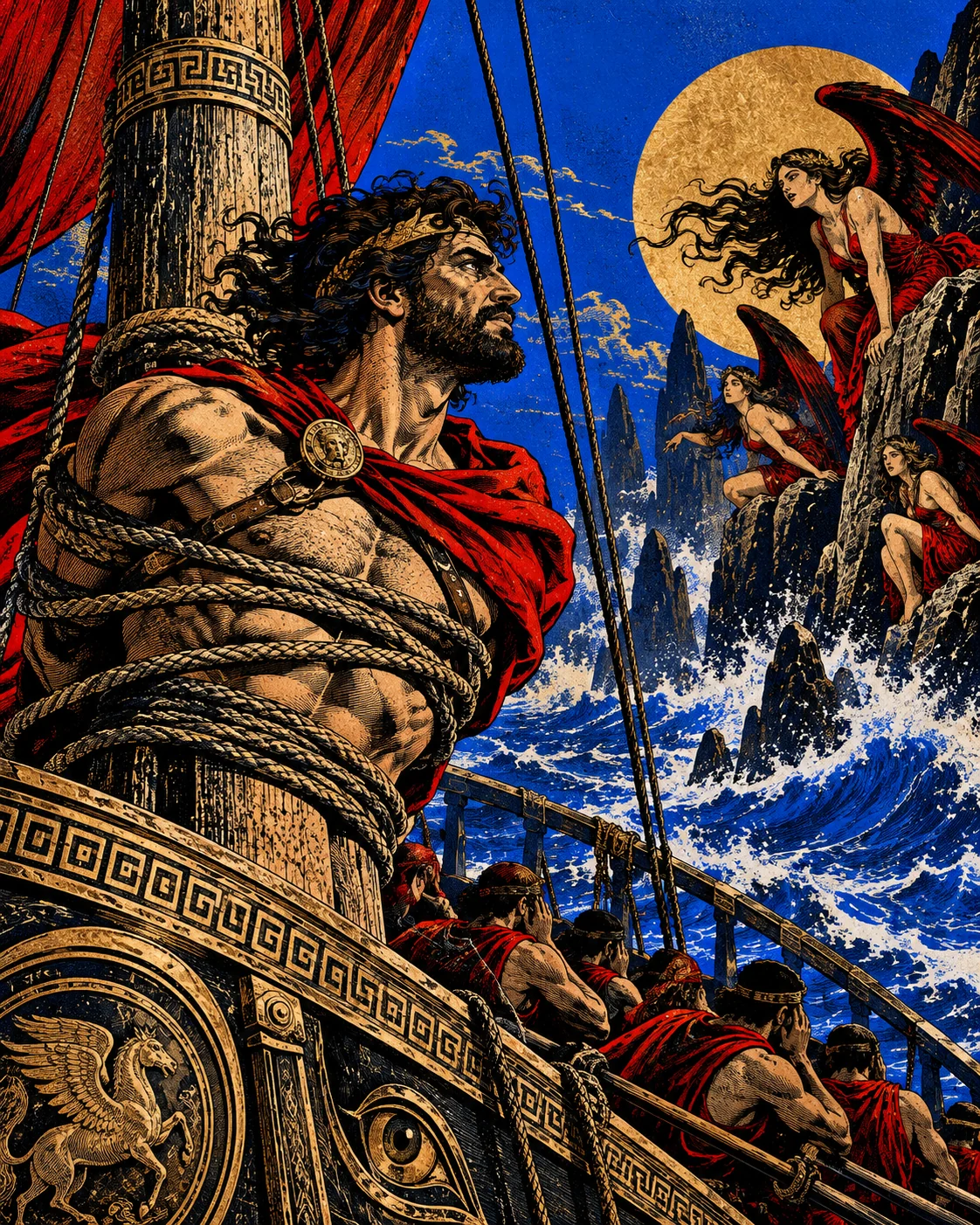
Ulysses contracts are ancient technology. Ulysses knew he could not resist the sirens. He did not try. He had his crew tie him to the mast and plug their own ears. He removed the choice from the future self he knew would be too weak to make it. The environmental redesign preceded the temptation and neutralized it.
Case Study
Two people attempt to reduce social media consumption. The first resolves to use willpower. She tells herself she will limit Instagram to twenty minutes per day. She relies on notification badges and self-control. By day three, the twenty-minute limit is forty minutes. By day seven, the resolution is abandoned. She concludes she lacks discipline.
The second deletes the apps from his phone. He installs a browser extension that blocks social media sites during work hours. He moves his phone charger to another room so that morning and evening scrolling become physically inconvenient. He does not rely on willpower once. He has no notifications to resist. He has no app to open. By removing the environmental triggers, he eliminates the need for resistance.
The second person is not more disciplined than the first. He is more honest about the limitations of discipline.
The Objection
"If I rely on environment design, I am admitting weakness. A truly strong person does not need crutches."
This is the voice of ego, not of reason. Ulysses was not weak. He was wise enough to know the limits of human nature and to act on that knowledge before the limits were tested. The person who refuses to use environmental design because it feels like cheating is choosing the aesthetic of strength over the reality of effectiveness. The goal is not to feel strong. The goal is to produce outcomes. Environment design produces outcomes. Purity of will produces relapse narratives.
The Operational Implication
Add friction to what you want to avoid. Remove friction from what you want to increase. Make the desired behavior the default. Make the undesired behavior impossible or absurdly inconvenient.
Do not keep junk food in the house. Do not keep social media on your phone. Do not keep a television in your bedroom. Do not keep credit cards saved in your browser. Do not trust your tired, hungry, stressed future self to make good decisions. That person is an idiot. You know this because you have been that person many times. Design the environment so that the idiot cannot do much damage.
Chapter 6
6. Saying No Is the Most Underused Power Move
Depends on: Definition XII, Axiom VIII. Ethics E4P18S.
Kind. Mixed.
The Claim
Attention and energy are finite. Every yes to one thing is a no to everything else. Most opportunities are distractions dressed as possibilities. Default to no. Make yes earn its place.
The Comforting Illusion
Opportunity is scarce. Say yes. Keep doors open. Network. Be helpful. The person who says no is missing out. The person who says yes is building relationships, accumulating options, positioning themselves for the break that will change everything.
This is the logic of the open hand. It is wrong. The open hand catches nothing but obligations.
The Causal Mechanism
The mathematics of attention are unforgiving. You have roughly sixteen waking hours per day. Subtract maintenance (eating, hygiene, basic movement) and you have perhaps twelve. Subtract the demands of any employment and you have perhaps four. These four hours are the total budget for everything that could distinguish your life from mediocrity: building skills, creating assets, developing relationships that increase power, thinking clearly about difficult problems.
Every yes consumes from this budget. The coffee meeting that "might lead to something" costs an hour of preparation, travel, and conversation, plus the cognitive switching cost of re-engaging with deep work afterward. Total cost: two to three productive hours. The favor for an acquaintance who will never reciprocate: another hour. The side project that "sounds interesting" but does not advance any strategic objective: hundreds of hours over months.
Most people die with their four hours fully spent and nothing built. Their gravestones should read: "He was very responsive to email."
The economic concept of opportunity cost is widely understood and almost never applied to time. People who would never spend a thousand dollars on a lottery ticket will spend a thousand hours on activities with a lower expected return than a lottery ticket. The discrepancy exists because money is legible and time is not. You can check your bank balance. You cannot check your attention balance. But the attention balance is the only one that determines what you produce.
The Evidence
Warren Buffett's "20-slot punch card" is the canonical formulation. Imagine you have a card with twenty slots, representing all the investments you can make in your lifetime. Each investment decision punches a slot. When the slots are gone, you are done. The scarcity forces extreme selectivity.
Buffett's actual investment record reflects this philosophy. He has held some positions for decades. He has passed on thousands of opportunities, including entire sectors he did not understand. His net worth is not the product of many good decisions. It is the product of a small number of excellent decisions, compounded over time, protected from dilution by a thousand mediocre ones he declined to make.
Steve Jobs, at Apple's 1997 Worldwide Developers Conference, stated the principle: "People think focus means saying yes to the thing you have got to focus on. But that is not what it means at all. It means saying no to the hundred other good ideas that there are. You have to pick carefully. I am actually as proud of the things we have not done as the things I have done."
Case Study
Two junior professionals, equal in talent and ambition. The first says yes to everything. Every committee, every optional meeting, every social invitation from colleagues, every freelance project that comes his way. He is known as helpful, engaged, a team player. After five years, he is exhausted, has developed no distinctive expertise, and has produced nothing that is his alone. His reputation is that he is nice.
The second says no to nearly everything. She does her job competently but declines optional commitments. She protects two hours every morning for deep work on a skill that interests her. She writes about that skill publicly. After five years, she has a body of work, a specialized reputation, and job offers from people who found her through her writing. The difference between them is not talent or effort. It is the willingness to say no to good opportunities so that the great ones have room to arrive.
The Objection
"But serendipity! The best opportunities come from chance encounters. Saying no forecloses luck."
Serendipity is real. But it does not distribute itself evenly across activities. A chance conversation at a specialized conference where you are speaking because of your protected deep work is worth a thousand chance conversations at generic networking events attended by people who said yes to everything. The goal is not to eliminate randomness. It is to tilt the randomness toward high-leverage contexts. Saying no to low-leverage activity increases the probability that your remaining activity occurs in high-leverage contexts.
The Operational Implication
Default to no. For every request, ask: if this were the only thing I accomplished this week, would the week be a success? If the answer is no, decline.
Protect mornings. The first four hours of the day are worth twice the second four hours. Cognitive capacity declines across the day for almost everyone. Give your best hours to your own work. Give the leftovers to others.
Do not explain your no. Explanations invite negotiation. "I cannot" is a complete sentence. "That does not work for me" is a complete sentence. Silence after declining is a complete sentence. The person who over-explains their no is asking permission to have boundaries. Boundaries do not require permission.
Chapter 7
7. Vanity Is Dependence on the Unstable Imagination of Others
Depends on: Axiom VI. Ethics E3P29–P32, E4P37S.
Kind. Deductive.
The Claim
Most status-seeking is servitude. Reputation is a loan from the crowd, callable at any moment. The cause of that joy is not within you. It depends on what other people imagine, which depends on causes you cannot control. Manage reputation as you would a credit score: keep it clean, never worship it.
The Comforting Illusion
Build your brand. Grow your platform. Cultivate influence. Reputation opens doors. Status is a genuine asset that compounds over time. The person with a strong reputation has more opportunities, more income, more access.
These statements are factually true. The illusion is not that reputation is valueless. The illusion is that reputation is a foundation upon which to build a life.
The Causal Mechanism
Spinoza's analysis of ambition in Ethics Part III is devastating. Ambition is the desire to do or refrain from doing something solely to please others. Its cause is the imitation of affects: we see others take pleasure in something, and we desire that thing because they desire it. We see others admire a person, and we desire to be admired by them. The cause of the desire is not within us. It is the image of another's desire, reflected back.
Vanity, Spinoza says in his Definitions of the Affects, is the joy accompanied by the idea of some action of ours which we imagine others praise. The key word is "imagine." The joy of vanity does not require that others actually praise you. It requires only that you imagine they do. The entire edifice of social media runs on this mechanism. The notification dopamine is triggered by the imagination of approval, not by approval itself, which is why the gratification is so brief and the need for the next notification so urgent.
The deeper problem is causal. The joy of reputation is a passive joy. It arises from external causes. It can be withdrawn at any moment without warning. A reputation that took decades to build can be destroyed by a single accusation, a misinterpreted joke, a change in public sentiment that has nothing to do with your actions. The person whose joy depends on reputation has placed his emotional welfare in the hands of strangers who do not know him, do not care about him, and will forget him within hours of destroying him.
This is not a risk. It is a certainty, over a long enough timeline. Every public figure eventually faces a reputational attack. The only question is when.
The Evidence
The social media and mental health literature is unambiguous for adolescents and suggestive for adults. Heavy social media use correlates with increased anxiety, depression, and loneliness. The mechanism is the constant exposure to curated versions of other people's lives, which triggers upward social comparison, which produces envy, which produces sadness. The platform architecture is designed to maximize engagement, and negative emotions are more engaging than positive ones. The user is the product. The advertiser is the customer. The user's emotional stability is not part of the optimization function.
Cancel culture, moral panics, and reputational destruction are ancient phenomena with modern velocity. The Athenian ostracism, the Roman damnatio memoriae, the Puritan witch trial: all were mechanisms by which communities withdrew status from individuals who violated prevailing norms. The difference now is speed, reach, and permanence. A digital reputation can be destroyed in hours by people who will forget about you by the end of the week, leaving you with consequences that last years.
Case Study
The celebrity chef who built a twenty-year career on television, cookbooks, and restaurants. A decades-old tweet resurfaces. Within seventy-two hours, her show is canceled, her book deal withdrawn, her restaurant partners distancing themselves. The tweet was offensive. It was also from 2009, when she was twenty-one years old and the norms were different. None of that matters. The crowd demands a sacrifice. She is available. Her reputation, which she spent two decades building as an asset, turns out to be a liability held in someone else's vault.
Compare the tradesman who owns a small plumbing business. He has no platform, no brand, no public reputation. His business depends on word of mouth within a fifty-mile radius. If one customer bad-mouths him, he loses that customer and perhaps a few others. His reputation is local, verifiable, and causally connected to his actual work, not to an image of his work held by people who have never met him. He is less wealthy than the celebrity chef was at her peak. He is more secure.
The Objection
"Reputation is necessary for income. You cannot ignore it. In the modern economy, visibility is leverage."
True. The answer is not to abandon reputation but to diversify away from it. A reputation that is your only asset is a single point of failure. A reputation that supplements genuine skill, owned assets, and multiple income streams is useful without being existential. The celebrity chef's error was not having a television show. It was having nothing else. The person who builds a business, a skill portfolio, and financial reserves alongside their public reputation can survive its loss. The person who builds only reputation cannot.
The Operational Implication
Manage reputation as you would a credit score. Keep it clean. Do not worship it. Do not mistake it for net worth. Do not let it become the primary source of your self-regard.
When you receive praise, receive it politely and set it down. When you receive criticism, evaluate it for useful information and discard the rest. Neither praise nor criticism is about you. Both are about the speaker's affects, projected onto your image. Do not organize your emotional life around projections.
Build assets that exist independently of reputation. Skills that can be verified through demonstration. Relationships that survive reputation damage because they are based on direct knowledge of your character. Financial reserves that make employment optional. The person who can walk away from any reputational hit is free. The person who cannot walk away is hostage to the crowd's next mood.
Chapter 8
8. Comparison Is Voluntary Misery
Depends on: Axiom VIII. Ethics E3P32, E4P18S.
Kind. Deductive.
The Claim
Comparison is sadness accompanied by the idea of another's superiority. It diminishes your power to act. It produces envy, resentment, or despair. None of these states produce useful action. Measure yourself against your own prior capacity. You are the only valid benchmark.
The Comforting Illusion
Compare yourself to others to motivate improvement. Competition drives excellence. Look at what successful people achieve and let it inspire you to achieve more. The desire to keep up, to match, to surpass: this is the engine of progress.
This is the logic of the coach, the manager, the motivational speaker. It is wrong. Comparison does not motivate. It demoralizes, and it does so through a mechanism that guarantees the outcome gets worse the more you do it.
The Causal Mechanism
Spinoza defines envy in Ethics Part III, Proposition 35, Scholium: envy is "hatred insofar as it affects a person so that he is saddened by the happiness of another, and conversely, is glad at another's ill fortune." The mechanism is the imitation of affects. We see another person experience joy. We imagine ourselves in their position. The gap between their imagined joy and our current state produces sadness. That sadness is accompanied by the idea of the other person as its cause. Envy follows.
What is critical is that the comparison is always between our actual state and an imagined state. We do not experience the other person's joy. We imagine it, and we imagine it as better than our own. The imagination is invariably distorted. We see the outcome (the wealth, the body, the relationship) and we project onto it a continuous state of satisfaction that does not exist. The wealthy person is still anxious. The fit person is still insecure. The happily married person still has arguments about dishes. The comparison is between your complete reality and their curated surface.
The result is a triple loss. You experience sadness (diminished power). You experience hatred toward someone who did nothing to you (further diminished power). And you spend attention on a comparison that changes nothing about your own situation (attention that could have been spent on construction).
The Evidence
The social comparison literature is vast and consistent. Leon Festinger's original social comparison theory (1954) proposed that humans have an innate drive to evaluate themselves by comparison to others. Subsequent research has shown that upward comparison (comparing to those better off) reliably produces negative affect, decreased self-esteem, and reduced motivation. The effects are stronger for domains perceived as relevant to self-worth and stronger when the comparison target is perceived as similar to the self.
The income-happiness literature contains a finding that should be better known: absolute income matters less for happiness than relative income. People in wealthy countries are not proportionally happier than people in moderately wealthy countries, once basic needs are met. Within a country, happiness correlates more strongly with relative income position than with absolute income. A person earning $80,000 in a neighborhood where the median is $60,000 is happier than a person earning $120,000 in a neighborhood where the median is $150,000. The mechanism is comparison.
Social media has industrialized this mechanism. Every scroll produces dozens of upward comparisons. The cumulative effect on mental health is negative, dose-dependent, and strongest for young women comparing their appearance and social lives to peers and influencers.
Case Study
Two traders, equal starting capital and equal skill. The first trader checks his peers' returns daily. He sees that someone in his trading group is up forty percent this month while he is up eight percent. The comparison produces envy. The envy produces impatience. Impatience produces size increases, rule violations, and revenge trading. Within three months, he has blown his account.
The second trader does not participate in trading groups. He does not compare returns. He tracks his own performance against his own prior performance and against his written trading plan. He is up eight percent. He is satisfied, because his plan targets twelve percent annually and eight percent in a quarter is ahead of pace. He continues executing. At year end, he is up twenty-four percent. At year end, the first trader is looking for a new account to blow.
The difference between them is not skill. It is the decision to compare upward, which is the decision to be miserable, which is the decision to act from misery rather than from plan.
The Objection
"Without comparison, how do you know where you stand? How do you benchmark progress? How do you identify excellence to emulate?"
Compare to the objective standard, not to the other person. The writer should compare to great writing, not to the writer who is currently outselling her. The athlete should compare to the performance standard, not to the athlete currently ranked above him. The trader should compare to the strategy's expected return, not to another trader's hot streak.
Emulation is distinct from comparison. Emulation asks: what causes produced this excellence, and can I replicate those causes? Emulation is causal. Comparison is affective. Emulation increases power. Comparison diminishes it.
The Operational Implication
Eliminate sources of upward social comparison. Unfollow accounts that trigger envy. Leave groups where performance is publicly compared. Stop asking colleagues about their compensation unless the information serves a specific strategic purpose. The information will almost certainly make you unhappy and will almost never produce useful action.
Replace comparison with self-referenced tracking. Did you produce more this month than last month? Did you improve any skill by a measurable increment? Are you stronger, faster, more competent, more knowledgeable than you were a year ago? These questions produce useful answers. "Is he doing better than me?" produces nothing.
Chapter 9
9. Solitude Is a Competitive Advantage
Depends on: Definition XII. Ethics E4P18S, E4P35S.
Kind. Mixed.
The Claim
Most social interaction is imitation of affects, mutual vanity, or entertainment that produces no durable increase in power. Solitude is the condition in which original thought, deep work, and self-knowledge become possible. The person who cannot be alone cannot think.
The Comforting Illusion
Humans are social animals. Isolation is unhealthy. Networking is essential. Relationships are the foundation of success. The person with a rich social life is thriving. The person who spends time alone is missing out, possibly depressed, probably odd.
This is the conventional wisdom. It is not universally wrong. Social connection does matter for health and happiness. The error is not the claim that connection is valuable. The error is the claim that solitude is pathological.
The Causal Mechanism
Spinoza's analysis of social interaction is characteristically unsentimental. In Ethics Part III, Proposition 27, he argues that the imitation of affects is the primary mechanism of social influence. We see another person experience an affect. We imagine ourselves in a similar state. We experience a version of that affect ourselves. This is not a choice. It is a causal process as automatic as digestion.
The implication is that social interaction involves continuous affective contagion. The mood of the people around you becomes your mood. Their anxieties become your anxieties. Their desires become your desires. Their inadequate ideas become your inadequate ideas. The process is bidirectional. You infect them. They infect you. The net effect on your cognitive state depends on the quality of the people you spend time with.
Most people spend most of their social time with people whose cognitive quality is roughly average. The net effect of average social interaction on an above-average mind is degradation.
This is not snobbery. It is causal analysis. If you have a clear thought about a difficult problem, and you spend two hours in a room where no one is thinking clearly about anything, you will leave the room with a less clear thought. The mechanism is not mystical. It is the continuous adjustment of cognitive state to match the social environment. The adjustment is unconscious. You will not notice it happening. You will only notice, later, that the clarity you had when you entered is gone.
The Evidence
Cal Newport's research on deep work has established that sustained, uninterrupted concentration is the prerequisite for producing work of value. Deep work requires solitude, or conditions functionally equivalent to solitude. The open-plan office, the Slack channel, the always-available smartphone: all are deep-work destroyers. The person who cannot disconnect from the social environment cannot produce anything that the social environment could not produce collectively, which is to say, anything original.
The creativity literature converges on the same finding. Original ideas emerge during periods of unstructured, solitary cognitive activity. The default mode network, which activates during mind-wandering and daydreaming, is implicated in creative insight. This network is suppressed during focused task performance and during social interaction. The person who fills every spare moment with social media, podcasts, and conversation never enters the cognitive state in which original connections form.
Historical evidence is suggestive. Darwin spent decades working alone at Down House. Kant never traveled more than ten miles from Konigsberg. Newton did his best work during two years of isolation during the plague. These are extreme cases, but they illustrate a general principle: the most original minds in history were not the most socially connected. They were the most capable of sustained solitary thought.
Case Study
Two writers, equal in talent. The first attends every literary event, participates in every writers' group, networks with every agent and editor she can meet. She is well-connected. She knows everyone in her city's literary scene. She has not finished a novel in five years.
The second writes every morning before anyone else is awake. She attends one conference per year. She is unknown in her local scene. She has published three novels in five years. The first writer is performing the social role of writer. The second is writing.
The difference is not introversion versus extroversion. The second writer may enjoy social interaction as much as the first. The difference is that she understands social interaction as a cost against productive time, to be budgeted accordingly, rather than as the point of the enterprise.
The Objection
"Isolation causes depression. Solitary confinement is torture. Humans need connection."
This is true. The argument is not for total isolation. It is for discriminating solitude. The goal is not to eliminate social interaction but to reduce it to a level that does not consume the time and cognitive space required for original work. For most people in the modern economy, the default level of social interaction is far above this threshold. The always-connected smartphone, the open office, the expectation of immediate response to messages: all produce a state of continuous low-grade social engagement that leaves no room for deep thought.
The person who reclaims a few hours of solitude each day is not becoming a hermit. He is returning to conditions that were normal for most of human history, when solitude was the default and social interaction was the exception.
The Operational Implication
Schedule solitude. Two hours minimum, ideally in the morning, before the social demands of the day begin. No phone. No internet. No conversation. Use the time to think about the hardest problem you are facing, or to produce work that requires sustained attention.
When you must be social, be selective. Spend time with people who increase your clarity, not with people who diminish it. The test is simple: after an interaction, do you feel more capable or less? Do you understand your work better or worse? The answer determines whether the interaction was an investment or a cost.
Chapter 10
10. Most of What You Believe Was Implanted
Depends on: Axiom VII. Ethics E2P18, E2P29.
Kind. Mixed.
The Claim
The overwhelming majority of your beliefs arrived through social contagion: family, education, media, peers, culture. The test is not "Can I defend this belief?" but "Would I hold this belief if I had been born in a different country, class, or century?"
The Comforting Illusion
You formed your opinions through independent reasoning. You examined the evidence, weighed the arguments, and arrived at conclusions through the power of your own intellect. Your beliefs are your own. You are a free thinker.
This is the defining illusion of the modern self.
The Causal Mechanism
Spinoza's epistemology distinguishes adequate ideas (which follow from the nature of reason itself) from inadequate ideas (which arise from imagination, hearsay, and partial experience). The vast majority of what any individual believes falls into the second category. We do not derive our moral intuitions, political commitments, or metaphysical assumptions from first principles. We absorb them from the surrounding culture, exactly as we absorb language and table manners.
The mechanism is well-understood. Children adopt the beliefs of their caregivers because conformity increases survival probability. Adolescents adopt the beliefs of their peer groups because conformity increases social inclusion, which was adaptive in ancestral environments. Adults adopt the beliefs of their professional and social networks because deviation imposes costs that most people are unwilling to pay. At no point in this sequence does independent reasoning play a decisive role for most beliefs.
Daniel Kahneman's distinction between System 1 and System 2 is relevant. System 1 is fast, automatic, and association-based. It generates beliefs effortlessly, through exposure and social transmission. System 2 is slow, effortful, and analytical. It can examine beliefs, but it rarely does so unless prompted by a specific contradiction or challenge. The default cognitive state is not skeptical inquiry. It is belief acceptance. We believe first and reason second, and the reasoning usually serves to defend the belief we already hold rather than to evaluate it.
The Evidence
The cultural cognition literature demonstrates that beliefs on contested issues are better predicted by cultural identity than by education or intelligence. More intelligent and better-educated people are not more likely to hold "correct" beliefs. They are more likely to hold beliefs aligned with their cultural group and more skilled at constructing arguments to defend those beliefs. The reasoning capacity is directed not at truth but at identity protection.
The religious geography data makes the point with brute clarity. The probability that a person born in Saudi Arabia is Muslim approaches one. The probability that a person born in rural India is Hindu approaches one. The probability that a person born in medieval France is Catholic approaches one. These probabilities are not explained by differential access to evidence or reasoning capacity. They are explained by the geographic distribution of belief systems, which is itself explained by history, which is itself explained by causes that have nothing to do with the truth value of the beliefs in question.
The Asch conformity experiments (1951) demonstrated the power of social pressure on belief expression. When confederates unanimously gave an obviously wrong answer about the length of a line, roughly one-third of subjects conformed and gave the same wrong answer. The line lengths were unambiguous. The social pressure was not. People will deny the evidence of their own senses to avoid the discomfort of disagreement.
Case Study
Consider a person born in Riyadh, Saudi Arabia, in 1990, to a devout Muslim family. He grows up surrounded by Islamic belief and practice. The call to prayer structures his day. The Quran structures his education. His family, friends, teachers, and media all affirm the truth of Islam. At no point is he presented with a neutral, comparative analysis of world religions and invited to choose. He is a Muslim because he was born a Muslim, in the same way he speaks Arabic because he was born in an Arabic-speaking environment.
Now consider a person born in rural Tennessee in 1990, to an evangelical Christian family. The mechanism is identical. She is a Christian because she was born a Christian. Her Christianity feels as natural and self-evident to her as Islam feels to the Saudi. Both would report that they have examined their beliefs and found them supported by evidence and reason. Both would be wrong about how they arrived at those beliefs.
The point is not that religion is uniquely susceptible to social contagion. The point is that all beliefs are susceptible, and religion is simply the domain where the mechanism is most visible because the geographic variation is so stark. Political beliefs, moral intuitions, views on child-rearing, attitudes toward money, conceptions of the good life: all are similarly distributed by geography and culture, and all are experienced by the believer as conclusions independently reached.
The Objection
"If all beliefs are socially conditioned, then the belief that all beliefs are socially conditioned is itself socially conditioned. The critique undermines itself."
This is clever and irrelevant. The claim is not that socially conditioned beliefs are necessarily false. The claim is that the process by which we acquire beliefs provides no warrant for their truth. A belief that happens to be true and was acquired through social contagion is still true. A belief that was acquired through independent reasoning and is false is still false. The source does not determine truth value. But ignorance of the source leads to overconfidence in beliefs that were never examined. The corrective is not to abandon all beliefs. It is to hold them provisionally, knowing that the feeling of certainty is a property of the psychology, not a signal from reality.
The Operational Implication
Audit your convictions. For each belief you hold strongly, ask: would I hold this belief if I had been born in a different country? If the answer is no, the belief is probably not a product of reason.
This does not mean the belief is false. It means your confidence in it should be reduced. You did not earn the belief through epistemic labor. You inherited it through geographic luck. Treat inherited beliefs as provisional hypotheses, not as settled conclusions.
The person who has audited their convictions and downgraded the confidence on inherited beliefs has not become a nihilist. He has become more accurate. His remaining beliefs, the ones that survive geographic rotation, are more likely to be true because they are not merely functions of birth circumstances. And he is now free to examine the inherited beliefs one by one, discarding those that fail the test and retaining those that pass, not because they feel right but because evidence and reasoning support them.
Chapter 11
11. Formal Education Is Primarily Compliance Training
Depends on: Axiom VII. Ethics E2P29; TTP on obedience.
Kind. Mixed.
The Claim
Most institutional education optimizes for obedience, punctuality, tolerance of boredom, and acceptance of external authority. The credential signals that you can follow instructions for years without rebellion. Separate learning from credentialing.
The Comforting Illusion
Education teaches you to think. Credentials signal competence. The person with a degree is educated. The person without one is not. More education means more knowledge, more skill, more earning power. The system works. Trust it.
This is the official story of every graduation ceremony. It is true in part and false in the part that matters.
The Causal Mechanism
The modern education system was not designed to produce thinkers. It was designed during the Prussian reforms of the early nineteenth century to produce compliant soldiers and civil servants. Later, during the Industrial Revolution, it was adapted to produce compliant factory workers. The core technologies remain: bells that divide time into arbitrary units, assigned seating, age-based cohorts, external evaluation by authority figures, rewards for obedience and penalties for deviation, a curriculum determined by distant administrators rather than by student interest or aptitude.
John Taylor Gatto, New York State Teacher of the Year and subsequently the most devastating critic of American education, identified seven lessons that schools actually teach: confusion (unrelated facts presented without context), class position (knowing your place), indifference (emotional detachment from the material), emotional dependency (waiting for external validation), intellectual dependency (waiting for the teacher to tell you what to think), provisional self-esteem (conditional on performance), and surveillance (you are always being watched and graded). None of these is a stated learning objective. All of them are what the system actually produces.
The credentialing function has consumed the educational function. A degree is not primarily valued as evidence of learning. It is valued as a signal in a labor market with asymmetric information. The employer cannot directly observe a candidate's competence. The degree provides a proxy signal. The signal works only if degrees are difficult to obtain, which creates pressure to maintain standards that have nothing to do with learning outcomes and everything to do with exclusion. The result is credential inflation: more people get degrees, degrees become less valuable as signals, the market demands higher degrees, and the cost in time and money escalates without a corresponding increase in actual competence.
The Evidence
Bryan Caplan's "The Case Against Education" (2018) estimates that roughly eighty percent of the return to education is signaling rather than human capital development. Students forget most of what they learn shortly after exams. The correlation between grades and job performance is modest. The correlation between educational attainment and income is strong but largely explained by the sorting of more able, more conscientious individuals into higher education, not by what they learn there.
The entrepreneurship-education relationship is instructive. A disproportionate share of successful entrepreneurs are college dropouts. This is not because dropping out causes success. It is because the personality traits that predict entrepreneurial success (risk tolerance, comfort with uncertainty, indifference to external approval, willingness to deviate from standard paths) are the same traits that make the educational system uncomfortable to endure. The system filters for compliance. The market, in some domains, rewards its opposite.
Case Study
The straight-A student who has never failed a test, never missed a deadline, never challenged a teacher. She graduates with honors and enters a corporate job. She waits for instructions. She executes assignments precisely. She asks for feedback. She is a model employee.
Two years later, she is frustrated. She sees problems in the company's strategy that no one is addressing. She has ideas for improvements. But she cannot act without permission, because permission is what education trained her to require. She waits for a supervisor to assign her the project of fixing the problems. No supervisor does, because supervisors do not know about the problems in the detail she does.
The student who barely graduated but spent his college years building a small business does not wait for permission. He sees a problem and addresses it. He does not ask if addressing it is in his job description. He does not need a syllabus.
The straight-A student is more competent by most measures. She is also paralyzed by a learned dependency that her educational success trained into her.
The Objection
"Education correlates with every measure of life success: income, health, longevity, life satisfaction. Dismissing education is anti-intellectual."
The correlation is real. The question is causation. Does education produce these outcomes, or do the same traits that lead people to pursue and complete education also produce these outcomes? The evidence suggests the latter. Controlling for cognitive ability and personality, the independent effect of education on life outcomes is smaller than the raw correlations suggest. The person who is smart, conscientious, and emotionally stable will do well with or without formal credentials. The credentials make the path easier to enter. They do not determine the destination.
The Operational Implication
Separate learning from credentialing. Learn what increases your power: skills that produce income, knowledge that produces better decisions, capacities that compound over time. Do this regardless of whether anyone gives you a certificate for it.
Get credentials strategically, not automatically. If your desired career requires a specific degree (medicine, law, engineering), get the degree. If it does not, consider whether the time and money could be deployed more effectively elsewhere.
The person who reads deeply, builds things, and develops verifiable competence outside the credentialing system will eventually surpass the person who only has credentials. Credentials open the first door. Competence opens every door after that. Eventually, competence creates doors that credentials cannot reach.
Chapter 12
12. Career Is Mostly a Distraction from Building Power
Depends on: Definition XII. Ethics E4P18S.
Kind. Mixed.
The Claim
Most employment extracts more value than it returns. Career advancement within an institution increases dependency on that institution. Treat employment as a purely financial transaction: lend ability for paycheck, nothing more. Build real assets outside the employment structure.
The Comforting Illusion
Your career is your identity. Climb the ladder. Find meaning in work. The person with a successful career is a successful person. The person who changes the world through their job is living the good life.
This is the official religion of the professional class. It is a religion that demands regular sacrifices and delivers uncertain salvation.
The Causal Mechanism
Employment is a transaction. You sell your time, attention, and problem-solving capacity to an organization. The organization compensates you with money. The transaction is economically rational for both parties under specific conditions. It becomes irrational when you mistake the transaction for an identity.
The structural problem is dependency. Career advancement within an institution increases the gap between your compensation from that institution and your compensation from any alternative. You become a specialized component in a specific machine. The machine values you as long as you serve its functions. If the machine is restructured, if your function is automated, if your industry contracts, your specialized value evaporates. You are left with skills that were highly valuable to one employer and moderately valuable to any other.
The labor share of GDP has been declining in developed economies for decades. Capital captures a growing share of output. Labor captures a shrinking share. The person who sells only labor is participating in a structurally declining asset class. The person who also owns capital, intellectual property, or other income-generating assets is hedged against this decline.
The psychological trap is deeper than the economic one. Employment provides structure, social identity, and a ready-made answer to the question "What do you do?" These are genuine psychological goods. The problem is that they are provided by an external source over which you have limited control. When the job disappears, the identity disappears with it. The person who has built an identity outside of employment is insulated against this loss. The person whose identity is their job title is one layoff away from an existential crisis.
The Evidence
Median job tenure in the United States is roughly four years. The probability of being laid off at some point during a career is high. The probability of being laid off after age fifty is higher, and re-employment prospects after fifty are worse. The person who treats employment as a stable foundation is building on ground that shifts, on average, every four years.
The FIRE movement (Financial Independence, Retire Early) has popularized a useful heuristic: wealth is not income. Wealth is the number of months you can maintain your current lifestyle without earned income. A person earning $500,000 with expenses of $490,000 has two and a half months of wealth. A person earning $60,000 with expenses of $30,000 and savings of $120,000 has forty-eight months of wealth. The second person is wealthier than the first in the only sense that matters for freedom.
Case Study
The executive who spent thirty years at one company. He rose through the ranks. He was respected inside the organization. His compensation was excellent. He identified strongly with his role. When acquaintances asked what he did, he said "I am the Senior Vice President of Operations at..." The company was his life.
At fifty-four, a merger eliminates his division. He receives six months of severance. He begins job hunting and discovers that his skills, which were perfectly adapted to his former employer's systems, are only partially transferable. He is competing against thirty-five-year-olds who will accept lower compensation. His network is entirely within an industry that is consolidating. He finds a position after eight months at a forty percent pay cut.
He is financially fine, if diminished. He is psychologically devastated. He never developed an identity beyond his role. Without the role, he does not know who he is.
Compare the person who treated his engineering job as a transaction from day one. He did the work competently. He was pleasant to colleagues. He never worked late on projects that did not develop transferable skills. In his evenings, he built a software product. After four years, the product generated enough income to replace half his salary. After seven years, it replaced all of it. He resigned. The company replaced him within two weeks. He was always replaceable. He knew this, and he acted accordingly.
The Objection
"Not everyone can build a business. Some people need the security of employment. This advice is for a privileged few."
The advice is not that everyone should quit their job. The advice is that everyone should treat their job as a transaction, not an identity, and should build assets outside it, at whatever scale their circumstances allow. The scale can be small: a few thousand dollars in an investment account, a skill that could be freelanced, a network of contacts outside the current employer. The principle scales. The person who has a year of expenses saved and a skill that could generate income independently is in a fundamentally different position from the person whose only income source is their current employer, regardless of their absolute income.
The Operational Implication
Do your job. Do it well enough to keep the paycheck. Do not do it so well that you have no energy left for building assets that are yours. The job protects your present. Assets protect your future. Both matter. Neither should be confused with who you are.
Chapter 13
13. Wealth Is Control Over Time and Attention
Depends on: Definition XII. Ethics E4D1, E4P38.
Kind. Mixed.
The Claim
Many high-income people have negative time freedom. Their expenses require the income, so they are more trapped than someone with lower income and lower expenses. True wealth is the capacity to direct your own attention for extended periods without financial compulsion. Measure wealth in months of freedom.
The Comforting Illusion
Wealth means high income or high net worth. The rich person has a big house, a nice car, and a fat bank account. The goal is to accumulate as much money as possible. More money equals more freedom.
This is the definition of wealth that produces millionaires who cannot take a Tuesday off.
The Causal Mechanism
Money is a tool. Its value is instrumental, not intrinsic. Money increases power when it produces stability, time, health, strategic freedom, and reduced dependence. Money decreases power when it produces compulsion to maintain the money, consumption that requires continued high income, debt that limits options, and social comparison that generates permanent dissatisfaction.
The critical variable is not income or net worth. It is the ratio of assets to expenses, measured in time. A person with $600,000 in liquid assets and $5,000 in monthly expenses has 120 months of freedom. A person with $2 million in assets and $20,000 in monthly expenses has 100 months of freedom. The second person has more than three times the net worth and less freedom.
The mechanism that traps high-income people is lifestyle inflation. Income increases. Expenses increase to match, plus a margin. The new expenses become the new baseline. The baseline requires the income. The income requires the job. The job requires the location, the schedule, the stress, the compromises. The person who could once have quit on a moment's notice now needs six months to find a replacement job because no other employer will pay what the lifestyle requires. The raise that was supposed to increase freedom has decreased it.
Spinoza's concept of adequate and inadequate desire applies here. An inadequate desire is one whose satisfaction does not increase power or whose pursuit diminishes it. The desire for the larger house, the newer car, the better neighborhood: each is intelligible, each produces momentary satisfaction, and each increases the required income, which increases dependency, which decreases freedom. The net effect on power is negative. The desire was inadequate.
The Evidence
Vicki Robin and Joe Dominguez's "Your Money or Your Life" (1992) introduced the concept of the "enough point": the income level at which additional money produces no additional well-being. Research on income and happiness consistently finds diminishing returns above a threshold that, in the United States, is roughly $75,000 to $100,000 in annual household income (Kahneman and Deaton, 2010). Above this level, additional income produces minimal additional day-to-day happiness. It can still increase life satisfaction (a broader evaluative measure), but the effect size is small relative to the time and autonomy cost of earning it.
The FIRE movement has empirically demonstrated that a savings rate of fifty to seventy percent, sustained for ten to fifteen years, can produce financial independence on a moderate income. The math is straightforward: if you save fifty percent of after-tax income, each year of work buys one year of freedom. If you save seventy-five percent, each year buys three years. The variable is not income. It is the ratio of spending to earning.
Case Study
Two lawyers, classmates from law school, both partners at large firms by forty-five. The first earns $800,000. His expenses: mortgage on a house in an expensive suburb ($8,000 per month), private school for three children ($6,000 per month), two luxury car leases ($2,200 per month), vacations, dining, clothing ($5,000 per month). After taxes and expenses, he saves perhaps $50,000 per year. He has roughly eighteen months of expenses in savings. He cannot quit. He cannot reduce his hours. He cannot take a sabbatical. He is functionally a high-income servant, trading his waking hours for the maintenance of a lifestyle he no longer enjoys but cannot escape.
The second earns $400,000. She lives in a modest house in a mid-tier suburb. Her children attend public schools. She drives a ten-year-old Toyota. Her monthly expenses are $7,000. She saves $150,000 per year. After fifteen years, she has $2.25 million in investments, representing roughly 320 months of freedom. She could quit tomorrow. She could work part-time. She could start a nonprofit. She could do nothing.
The first lawyer has higher status. The second lawyer has a life she controls. The difference is not income. It is the decision about what money is for.
The Objection
"This is asceticism dressed as wisdom. What is the point of earning money if you cannot enjoy it?"
The question assumes that consumption and enjoyment are identical. They are not. The second lawyer is not living a deprived life. She has a comfortable home, good food, meaningful work, and the ability to travel when she chooses. She has simply declined to purchase status goods that would require her to continue working when she would prefer to stop. The person who confuses consumption with enjoyment will never reach the enough point, because the desire for consumption expands to fill available income. The person who distinguishes them can enjoy a high quality of life at a fraction of the cost.
The Operational Implication
Calculate your monthly freedom ratio: liquid assets divided by monthly expenses. This is the number of months you can maintain your current life without income. Track it. Optimize for its growth.
Reduce expenses that do not increase genuine well-being. Most expenses do not. The larger house, the newer car, the premium subscription: interrogate each one. Does this actually improve my life, or does it merely signal status to people whose opinion does not affect my power?
The goal is not minimalism. It is proportionality. Spend on what increases power: health, education, tools, experiences that produce durable satisfaction. Cut what diminishes power: status signaling, compulsive consumption, debt service. The person who masters this distinction becomes wealthy on a modest income. The person who does not remains poor on a large one.
Chapter 14
14. Leverage Crushes Effort
Depends on: Definition XII. Ethics E4P18S.
Kind. Mixed.
The Claim
Labor is linear. Leverage is multiplicative. The wealthiest people do not work harder. They own systems that work while they sleep. Every hour spent on pure labor should be interrogated: can this be automated, delegated, recorded once and distributed infinitely, or turned into an asset?
The Comforting Illusion
Hard work is the path to success. The wealthy worked harder than everyone else. Put in the hours, pay your dues, and you will be rewarded. The immigrant who worked two jobs and built an empire: that is the template.
The story is not entirely false. Hard work does correlate with success. But the correlation is weaker than the narrative claims, and the direction of causation is often reversed: people who are succeeding work harder because work becomes more rewarding when it produces results. The causal variable that distinguishes exceptional outcomes from ordinary ones is not effort. It is leverage.
The Causal Mechanism
Leverage is any mechanism that decouples output from input. Labor has zero leverage: one hour of input produces one hour of output. Capital has leverage: one dollar invested produces returns without additional labor. Code has leverage: written once, executed infinitely at zero marginal cost. Media has leverage: recorded once, distributed to millions. A brand has leverage: it influences purchasing decisions across thousands of products without additional labor per decision. A system has leverage: it processes transactions, manages inventory, or serves customers while the owner sleeps.
Naval Ravikant's taxonomy of leverage is the clearest modern formulation. The oldest form is labor: other people working for you. It is the hardest to manage and the least scalable. The middle form is capital: money working for you. It is easier to manage but requires capital to begin, which most people do not have. The newest form is "products with no marginal cost of replication": code and media. This is the most democratic form of leverage because it requires no permission, no capital, and no employees. Anyone with a laptop can create leveraged products.
The mathematics of leverage are inexorable. A person with zero leverage must work to earn. A person with capital leverage earns while sleeping. A person with code leverage earns while sleeping, at zero marginal cost, potentially forever. Over a sufficiently long time horizon, the leveraged person will always out-earn the unleveraged person, regardless of how hard the unleveraged person works.
The Evidence
Thomas Piketty's "Capital in the Twenty-First Century" (2013) demonstrated that the return on capital (r) has historically exceeded the growth rate of the economy (g). This means that wealth that is already owned grows faster than wealth that is earned through labor. The mechanism is leverage: capital compounds without additional labor input. Labor requires continuous input. The gap between r and g is the structural advantage of the already-wealthy. It is also the structural opportunity for anyone who can accumulate capital and deploy it.
The rise of the software billionaire is the clearest modern demonstration of code leverage. Bill Gates, Jeff Bezos, Mark Zuckerberg, Larry Page: none invented a new physical product. Each built a system that processes information at near-zero marginal cost. Each wrote code once (or hired people who did) and sold it billions of times. The leverage ratio is almost infinite. The input (a relatively small number of engineering hours) is utterly decoupled from the output (trillions of dollars in aggregate value).
Case Study
A bricklayer and a building designer. The bricklayer earns an hourly wage. If he works forty hours, he is paid for forty hours. If he does not work, he is not paid. His income is linear. Over a forty-year career, he can lay perhaps 500,000 bricks, earning a predictable income that rises with experience and inflation but never compounds.
The building designer creates a standardized house plan. She spends 200 hours on the design. She sells it as a digital download. The first sale covers her costs. Every subsequent sale is pure profit. She sells 10,000 copies over five years at $500 each. Her 200 hours of input generated $5 million in output. The leverage ratio is 25,000 to one.
The bricklayer worked harder. The designer built leverage. The designer's income is not proportional to her effort. It is proportional to the reach of her leveraged asset.
The Objection
"Not everyone can code. Not everyone has capital to invest. Most people must rely on labor."
This is true of the starting position. It is not true of the trajectory. The person who starts with only labor can use labor income to accumulate capital, which is one form of leverage. The person who starts with only labor can use labor income to buy time to learn skills that produce code or media leverage. The person who starts with only labor can spend evenings building a leveraged asset while the day job funds the build.
The transition from labor to leverage is the single most important career move available to anyone in the modern economy. It requires delayed gratification, risk tolerance, and the willingness to work on things that do not pay immediately. These are rare traits. Their rarity is why leverage is still under-priced.
The Operational Implication
Audit your income sources. What percentage comes from labor (linear), and what percentage comes from leverage (multiplicative)? If the answer is one hundred percent labor, your income is capped by your hours. You cannot out-work the mathematics of leverage.
Start building a leveraged asset. Write something. Record something. Build a small software tool. Create a template, a course, a system. The first asset will probably generate nothing. That is normal. The second asset might generate a little. The tenth asset, if each represents a learning iteration, has a nontrivial probability of generating meaningful income. The person who spends five years building leveraged assets in the margins of a day job has, by year six, a portfolio of asymmetric bets. Most will fail. One might not. One is enough.
Chapter 15
15. Price Is the Only Thing That Pays
Depends on: Axiom I. Ethics E1A4.
Kind. Mixed.
The Claim
In trading and investing, no amount of narrative correctness transfers money into your account. Only price movement does. Build every trading decision around price rules. When price contradicts the narrative, price wins.
The Comforting Illusion
Understand the company, the story, the macro. Smart analysis produces profits. The person who knows more than the market will beat the market. Deep research is the edge.
This is the fantasy of the intelligent investor. It is comforting because it flatters the analyst's intellect. It is wrong because it confuses explanation with prediction and confuses both with profit.
The Causal Mechanism
A trade is a bet on price direction over a specific time horizon, with a specific amount of capital at risk. The bet resolves into profit or loss based on exactly one variable: the difference between entry price and exit price. Nothing else pays. The quality of your analysis, the elegance of your thesis, the depth of your research, the confidence of your conviction: none of these variables appears in the profit calculation. Only price.
The market is not a truth-seeking mechanism. It is a price-discovery mechanism. Prices can remain disconnected from fundamental value for longer than a trader can remain solvent. The person who is right about the narrative and wrong about the timing loses all their money. The person who is wrong about the narrative and right about the price action can profit. The market does not grade on a curve. It does not award partial credit for being directionally correct.
This asymmetry explains why so many intelligent people fail at trading. Intelligence produces confidence in narratives. Confidence in narratives produces large positions. Large positions produce catastrophic losses when the narrative is correct but the timing is wrong, which it almost always is. The market humbles intelligence because intelligence is a liability when it produces overconfidence in the face of irreducible uncertainty.
The Evidence
The SPIVA scorecards, published by S&P Global, track the performance of actively managed funds against their benchmarks. The consistent finding: over any meaningful time horizon, the majority of active managers underperform their benchmarks. Over fifteen years, roughly ninety percent of active managers underperform. These are people with access to more information, better analytical tools, and more experience than any retail trader. Their narratives are sophisticated. Their price results are mediocre.
The behavioral finance literature has documented the narrative fallacy: the human tendency to construct coherent stories that explain past events and project them forward, while underestimating the role of randomness, overestimating the predictive power of the narrative, and ignoring disconfirming evidence. The narrative feels true. The narrative is often false. The price does not care about either.
Jesse Livermore, the greatest speculator of the early twentieth century, stated the principle in his fictionalized memoir: "I never argue with the tape." The tape is price. Price is the only thing that tells you whether your position is right. Everything else is storytelling.
Case Study
The Enron collapse of 2001 is the canonical case. Jim Chanos, the short seller, identified Enron's accounting irregularities years before the collapse. He was right about the narrative: Enron was a fraud. He established a short position. The stock continued to rise for months. Chanos managed his position size, accepted paper losses, and held. Eventually, Enron collapsed, and Chanos profited enormously.
Countless other traders saw the same irregularities, established short positions, and were wiped out during the continued rise. They were right about the narrative. They were wrong about the price. The price bankrupted them before the narrative could vindicate them.
The difference between Chanos and the traders who blew up was not intelligence or analysis. It was position sizing and risk management. Chanos bet an amount he could afford to lose if the timing was wrong. The others bet an amount they could not afford to lose. The narrative was the same. The risk management was different. Only the risk management mattered for survival.
The Objection
"If price is the only thing that matters, then technical analysis is the only valid approach, and fundamental analysis is worthless."
This confuses the signal with the analysis method. Fundamental analysis identifies narrative discrepancies between price and value. Technical analysis identifies patterns in price behavior. Both can produce profitable trades if they lead to correct price predictions. Both can produce losses if the predictions are wrong. The distinction is not technical versus fundamental. It is between those who subordinate narrative to price and those who subordinate price to narrative. The trader who uses fundamental analysis but exits when price invalidates the thesis is trading price. The trader who uses technical analysis but adds to a losing position because the "pattern" should have worked is trading narrative. The method does not determine the discipline. The discipline determines the outcome.
The Operational Implication
Every trade begins with a price rule for entry and a price rule for exit. The entry rule says: I will buy if price does X. The exit rule says: I will sell if price does Y. No narrative override. No "but the company just announced." No "the market is overreacting." Price hits Y, you are out. Period.
The person who follows price rules will sometimes exit positions that subsequently recover. These exits feel like mistakes. They are not mistakes. They are the cost of insurance against the exits that do not recover, which are the ones that destroy accounts. The person who overrides exit rules because the narrative is still intact is trading without a stop loss, which is trading without risk control, which is gambling with extra steps.
Chapter 16
16. Risk Management Is the Edge
Depends on: Definition XII. Ethics E4P18S.
Kind. Mixed.
The Claim
Over any statistically meaningful sample, position sizing and exit management determine outcomes more than entry quality. Spend eighty percent of development on risk. Spend twenty percent on entry. This is the inverse of what most traders do, which is why most traders fail.
The Comforting Illusion
The key to trading is finding the right entry. The secret indicator. The pattern that predicts the next move. The setup that works seventy percent of the time. If you can just find the right entry signal, everything else takes care of itself.
This is the fantasy that sells trading courses, indicator subscriptions, and trading room memberships. It is wrong in a way that is mathematically demonstrable.
The Causal Mechanism
A trading system has three components: entries, position sizing, and exits. Over any statistically meaningful sample, returns are a function of how much you bet when you are right versus how much you bet when you are wrong, multiplied by the ratio of right bets to wrong bets. The entry quality determines the win rate. The position sizing and exit management determine the payoff ratio. The payoff ratio is more important than the win rate.
Consider two traders with identical win rates of forty percent. The first trader risks one percent of capital per trade and cuts losses at one percent while letting winners run to three percent. The payoff ratio is three to one. Over one hundred trades, forty winners at three percent each produce 120 percent in gains. Sixty losers at one percent each produce sixty percent in losses. Net result: plus sixty percent.
The second trader risks three percent per trade, cuts losses at two percent, and takes profits at one percent. The payoff ratio is 0.5 to one. Over one hundred trades, forty winners at one percent produce forty percent in gains. Sixty losers at two percent produce 120 percent in losses. Net result: minus eighty percent.
Same win rate. Same entry quality. Opposite outcomes. The difference is entirely in position sizing and exit management.
The Kelly criterion provides the mathematical framework for optimal position sizing under uncertainty. The insight is that even a positive-expectancy bet can produce ruin if the bet size is too large relative to the edge. A bet with a fifty-five percent win probability and even-money payoff should be sized at ten percent of bankroll for maximum long-term growth, not at one hundred percent. Betting more than optimal reduces long-term growth. Betting far more than optimal guarantees eventual ruin, even with a positive edge.
The Evidence
The SPIVA data is relevant here as well. Professional fund managers with access to the best research, the fastest data, and the most sophisticated analytical tools underperform their benchmarks over the long term. Their entry analysis is excellent. Their risk management, in aggregate, is worse than the benchmark's implicit risk management (buy and hold), because they overtrade, over-concentrate, and let behavioral biases interfere with exit decisions.
Nassim Taleb's concept of ergodicity is the deepest theoretical framework. A system is ergodic if the time-average outcome for one participant equals the ensemble-average outcome across many participants. Trading is non-ergodic: one trader can experience a sequence of losses that eliminates him from the game before the long-term positive expectancy can manifest. The trader who does not survive the short term never reaches the long term. Risk management is the art of ensuring survival long enough for the edge to compound.
The Martingale strategy is the classic demonstration of ruin risk. Double your bet after every loss. The strategy has a high probability of small gains and a low probability of catastrophic loss. The catastrophic loss, when it arrives, eliminates all previous gains plus the initial capital. The strategy is mathematically certain to produce ruin eventually. Every trader who averages down into losing positions is running a slow-motion Martingale. The math does not care about the narrative.
Case Study
Two algorithmic trading firms, both with profitable backtested strategies. The first firm runs their strategy at maximum permissible leverage. During a volatility event that was outside their backtest window, correlation across positions increases unexpectedly. Losses cascade. Margin calls force liquidation at the worst possible moment. The firm loses sixty percent of its capital in two weeks. It survives but spends two years recovering to its previous high-water mark.
The second firm runs the same strategy at half the permissible leverage. During the same volatility event, it loses thirty percent. It has capital reserves to meet margin calls without forced liquidation. It maintains positions through the volatility. Within six months, it has recovered all losses and is at new equity highs.
The difference between the two firms is not strategy quality. It is risk management philosophy. The first firm optimized for maximum returns under normal conditions. The second firm optimized for survival under abnormal conditions. Over a long enough time horizon, abnormal conditions are guaranteed. The firm that does not survive them does not get to enjoy the normal conditions that follow.
The Objection
"Conservative risk management limits returns. The traders who make life-changing money take big risks."
The traders who make life-changing money and survive are lottery winners. The traders who take big risks and do not survive are invisible. Survivorship bias conceals them. For every account that turned $10,000 into $1 million through aggressive risk-taking, there are hundreds of accounts that turned $10,000 into zero through the same strategy. You hear about the winner. You do not hear about the hundreds of losers because losers do not write books, sell courses, or post their account statements on social media.
The Operational Implication
Determine your maximum acceptable drawdown. Size positions so that a string of consecutive losses does not exceed this threshold. The string of consecutive losses will happen. It is not a question of if. It is a question of when. When it happens, the position sizing should ensure you are still in the game.
Write exit rules before entry. The exit for a winning trade. The exit for a losing trade. The exit if the market does nothing. Every exit is predetermined. No exit is determined by emotion in the moment. The person who exits by feel will exit at the worst possible time because the worst possible time is when the feel is most intense.
Chapter 17
17. Fasting Is a Biological Superpower
Depends on: Definition II, Axiom V. Ethics E2P13, E4P38.
Kind. Empirical.
The Claim
The human body evolved in an environment of intermittent food availability. Constant feeding is an industrial aberration. Fasting triggers autophagy, reduces inflammation, improves insulin sensitivity, increases growth hormone, and sharpens cognition. The modern world has medicalized a normal physiological state into a pathology because a fasting population is an unprofitable one.
The Comforting Illusion
Eat three meals a day. Breakfast is the most important meal of the day. Snack between meals to keep your metabolism going. Fasting is dangerous, unsustainable, and probably an eating disorder. Your body needs constant fuel.
This advice is so thoroughly embedded in popular culture that contradicting it sounds irresponsible. The advice was not derived from biology. It was derived from the marketing departments of food companies.
The Causal Mechanism
The human metabolic system evolved under conditions of intermittent food availability. Hunter-gatherers did not eat three meals a day plus snacks. They ate when food was available, which was irregular. The body developed sophisticated mechanisms for thriving during periods without food: glycogen stores for short-term energy, lipolysis (fat breakdown) and ketogenesis for longer-term energy, and autophagy for cellular repair during extended fasts.
Autophagy, the process by which cells break down and recycle damaged components, was the subject of the 2016 Nobel Prize in Physiology or Medicine, awarded to Yoshinori Ohsumi. Autophagy is suppressed by constant feeding. It is activated by fasting. During autophagy, cells clear out misfolded proteins, damaged mitochondria, and other intracellular debris that accumulate with age and contribute to degenerative disease. Fasting is not merely calorie restriction. It is the activation of a cellular repair program that does not run when food is continuously available.
The hormonal response to fasting is the opposite of the popular narrative. Growth hormone increases significantly during fasting, preserving lean mass. Insulin drops, enabling fat oxidation. Norepinephrine rises, increasing alertness and energy. The feeling of hunger is not a signal of danger. It is a hormonal signal, primarily driven by ghrelin, that habituates to a meal schedule. After several days of fasting, ghrelin decreases and hunger largely disappears. The person who has never fasted for more than twelve hours has never experienced this adaptation and mistakes the initial hunger for a permanent state.
The Evidence
The intermittent fasting literature is extensive and growing. Human trials consistently demonstrate improvements in insulin sensitivity, reductions in inflammatory markers, and significant weight loss, with preserved or improved lean body mass when combined with resistance training. A 2019 review in the New England Journal of Medicine by de Cabo and Mattson summarized the evidence for intermittent fasting's effects on healthspan and lifespan across multiple species, including non-human primates.
Jason Fung's clinical work with type 2 diabetes patients has demonstrated that extended fasting protocols, combined with dietary modification, can reverse insulin resistance and eliminate the need for medication in a substantial fraction of patients. The mechanism is straightforward: insulin resistance is caused by chronically elevated insulin, which is caused by frequent carbohydrate consumption. Fasting lowers insulin. The cells regain insulin sensitivity. The disease recedes.
Religious fasting traditions, from Ramadan to Yom Kippur to Lent, represent thousands of years of empirical observation that periods without food are not harmful and may be beneficial. The modern assumption that fasting is dangerous is the outlier, not the historical norm.
Case Study
A fifty-year-old man with type 2 diabetes, hypertension, and a body mass index of thirty-three. His doctor prescribes metformin, a statin, and blood pressure medication. He is told to eat six small meals per day to "keep his blood sugar stable." His condition worsens over three years. His medication doses increase. He is on track for insulin dependence and progressive deterioration.
He discovers the fasting literature. Against his doctor's advice, he begins a protocol of alternate-day fasting: normal eating one day, water only the next. Within three months, his fasting blood glucose has normalized. He reduces his metformin dose by half. His blood pressure improves. He loses thirty pounds. Within six months, he is off all medication. His doctor is confused but cannot argue with the lab results.
The case is not unique. It is representative of a pattern that thousands of patients have experienced but that the medical establishment has been slow to acknowledge, because the medical establishment was trained in a paradigm that treats fasting as a stressor rather than as a repair state.
The Objection
"Fasting causes muscle loss and metabolic damage. The body goes into starvation mode and holds onto fat. This is settled science."
The starvation mode claim is based on the Minnesota Starvation Experiment of 1944-45, in which subjects were fed roughly 1,500 calories per day of low-protein food for six months while performing physical labor. This is calorie restriction with malnutrition, not fasting. True fasting, especially when combined with adequate protein intake during eating windows and resistance training, preserves lean mass through elevated growth hormone and the metabolic shift to fat oxidation. The body does not waste muscle when fat stores are abundant. It preserves protein and burns fat. This is the entire evolutionary purpose of fat storage.
The Operational Implication
Start with a sixteen-hour daily fast. Eat between noon and 8 PM. Nothing but water, black coffee, or plain tea outside that window. This is not dangerous. It is the normal human eating pattern for most of history.
After two weeks, if the sixteen-hour fast is tolerable, extend to eighteen hours. After a month, try a twenty-four-hour fast once per week. The body adapts. The hunger habituates. The energy stabilizes. The person who has never experienced a full day without food does not know what normal energy feels like, because they have never allowed insulin to drop low enough for long enough to access their fat stores efficiently.
Do not break a fast with processed food. The first meal after a fast sets the metabolic tone. Protein and fat. Vegetables. Whole foods. The body is primed for nutrient absorption. Give it nutrients, not industrial food products.
Chapter 18
18. Most Chronic Disease Is Caused by the Modern Food Environment
Depends on: Axiom V. Ethics E2P13, E4P38.
Kind. Empirical.
The Claim
The epidemic of metabolic disease tracks the introduction of industrial seed oils, refined carbohydrates, and ultra-processed foods. Most physicians receive almost no nutrition education. The medical system treats the symptoms of metabolic dysfunction with pharmaceuticals while ignoring the dietary causes. Take sovereignty over your own metabolic health.
The Comforting Illusion
Disease is genetic bad luck or aging. Trust the medical establishment. Follow the dietary guidelines: low fat, whole grains, plenty of fruits and vegetables, moderate everything. If you get sick, your doctor will fix it.
This is what most people believe. It is wrong in ways that kill millions of people per year.
The Causal Mechanism
The modern food environment is an evolutionary novelty. For roughly 2.5 million years, the human lineage consumed food that was available in nature: animal protein and fat, seasonal fruits and vegetables, tubers, nuts, and seeds. There were no seed oils, no refined sugar, no refined flour, no artificial sweeteners, no preservatives, no emulsifiers, no flavor enhancers engineered to maximize consumption. The human metabolic system evolved in this environment. It has not adapted to the industrial food environment because there has not been enough time.
The introduction of industrially processed foods in the twentieth century coincides with the rise of the so-called diseases of civilization: obesity, type 2 diabetes, cardiovascular disease, hypertension, certain cancers, autoimmune conditions, and neurodegenerative diseases. The correlation is near-perfect across populations. When traditional societies adopt a Western diet, these diseases appear within a generation. When Westerners return to ancestral eating patterns, these diseases often reverse.
The mechanisms are multiple and interactive. Refined carbohydrates and sugar drive insulin resistance. Industrial seed oils (soybean, canola, corn, sunflower) are high in omega-6 polyunsaturated fats, which oxidize easily and promote systemic inflammation. Ultra-processed foods are engineered to override satiety signals, leading to overconsumption. The gut microbiome, which regulates immune function, mood, and metabolism, is disrupted by emulsifiers, artificial sweeteners, and the absence of fermentable fiber. The cumulative effect is a metabolic environment that produces chronic disease as predictably as smoking produces lung cancer.
The Evidence
The Pima Indians of Arizona provide a natural experiment. The Pima traditionally lived on a diet of wild plants, game, and cultivated crops. Diabetes was rare. In the twentieth century, the Pima were displaced from their land and their traditional food system. They became dependent on government commodity foods: refined flour, sugar, vegetable oil. Today, the Pima have the highest rate of type 2 diabetes in the world. Pima who live across the border in Mexico, maintaining a more traditional diet and lifestyle, have dramatically lower diabetes rates despite genetic similarity. The difference is environment, not genetics.
Kevin Hall's 2019 randomized controlled trial, published in Cell Metabolism, compared ultra-processed versus unprocessed diets in a controlled metabolic ward setting. Participants on the ultra-processed diet consumed roughly 500 more calories per day and gained weight. On the unprocessed diet, they lost weight. The diets were matched for calories, sugar, fat, fiber, and macronutrients. The difference was processing. Ultra-processed foods drive overconsumption through mechanisms that are not fully understood but are clearly causal.
The medical education data is alarming. A 2010 study found that medical students in the United States received an average of fewer than twenty hours of nutrition education across their entire four-year curriculum. Many received less than ten hours. Physicians are not trained to prevent metabolic disease through nutrition. They are trained to manage its symptoms with pharmaceuticals. The system is not broken. It is functioning exactly as designed, and the design was never about health.
Case Study
The patient with metabolic syndrome: obesity, hypertension, elevated triglycerides, fasting glucose at pre-diabetic levels, chronic fatigue, joint pain. His doctor prescribes a statin, blood pressure medication, and advises him to follow the USDA dietary guidelines (low fat, whole grains, reduce red meat). He complies. His numbers improve slightly. He remains obese, tired, and in pain. He is told this is aging.
He discovers the metabolic health literature. He eliminates seed oils, refined carbohydrates, and sugar. He increases animal protein and fat. He stops snacking. Within six months, he has lost forty pounds. His blood pressure has normalized. His fasting glucose is normal. His joint pain is gone. His energy is higher than it has been in twenty years. He asks his doctor why no one ever suggested this. The doctor was not trained to suggest this. The doctor was trained to prescribe statins.
The Objection
"The dietary guidelines are based on the best available science. Low-fat diets are proven to reduce cardiovascular disease. Red meat causes cancer. This is consensus."
The dietary guidelines were based on observational epidemiology, which cannot establish causation. The low-fat recommendation was influenced by Ancel Keys's Seven Countries Study, which omitted data from countries that did not support the hypothesis. The red meat and cancer claim is based on relative risk increases so small (a relative risk of 1.1 to 1.2 for processed meat and colorectal cancer) that they are indistinguishable from confounding in observational studies. The absolute risk increase is small fractions of a percent.
The better evidence comes from randomized trials and mechanistic studies. The Predimed trial (2018, retracted and republished with corrections) found that a Mediterranean diet supplemented with olive oil or nuts reduced cardiovascular events compared to a low-fat control. The Virta Health trial demonstrated that a ketogenic diet could reverse type 2 diabetes in a majority of participants. The evidence for low-fat diets is weaker than the guidelines suggest. The evidence against ancestral eating patterns is weaker still.
The Operational Implication
Eat food. Mostly animals, plants, and traditional fats. Nothing invented in the last hundred years unless it has been demonstrated safe in randomized trials. This eliminates seed oils, refined sugar, refined flour, most packaged foods, and most restaurant food.
Cook your own food. Control the ingredients. The food industry is not your ally. Its optimization function is profit per calorie, not health per calorie. The two functions are negatively correlated for most products in most categories.
Do not expect your doctor to guide you. Your doctor was trained by institutions funded by the same food and pharmaceutical industries that profit from metabolic disease. Take responsibility for your own metabolic health. The information is freely available. The implementation is your job.
Chapter 19
19. The Purpose of Life Is Not Happiness
Depends on: Definition VIII, Definition XII. Ethics E3P7, E4P18S.
Kind. Deductive.
The Claim
Joy is the increase of power. Sadness is its decrease. Happiness as a steady state is an illusion because power fluctuates. The rational goal is to increase real capacity: to understand more, build more, endure more, act more effectively. Joy is the signal, not the destination.
The Comforting Illusion
Happiness is the goal. Seek pleasure. Avoid pain. The good life feels good. The successful person is the happy person. Everything we do is in service of being happy.
This is the default philosophy of the modern West. It is never examined because it feels too obvious to examine. It is wrong.
The Causal Mechanism
Spinoza's definition of joy in Ethics Part III, Proposition 11, Scholium: "Joy is the passion by which the mind passes to a greater perfection." Perfection, in Spinoza's usage, does not mean moral purity. It means reality, power, capacity. Joy is the felt transition to greater power to act. Sadness is the felt transition to lesser power.
This definition transforms the relationship between happiness and action. In the popular model, happiness is a state to be achieved and maintained. Action is the means. Happiness is the end. In the Spinozan model, action is the substance. Joy is the signal that power is increasing. The signal is useful. It tells you that you are moving in the right direction. But the signal is not the destination any more than the fuel gauge is the destination of a road trip.
The practical consequence is that the pursuit of happiness as a direct goal typically fails. Happiness pursued directly is like sleep pursued directly: the harder you try, the more elusive it becomes. Viktor Frankl's logotherapy, developed in Auschwitz and refined afterward, identified meaning rather than pleasure as the primary human drive. Happiness, Frankl argued, "cannot be pursued. It must ensue. It must ensue as the unintended side-effect of one's personal dedication to a course greater than oneself."
The hedonic treadmill, a well-replicated finding in positive psychology, demonstrates that humans adapt to both positive and negative life changes and return to a baseline level of happiness. Lottery winners are not permanently happier than controls. Paraplegics, after an adjustment period, are not permanently less happy. The pursuit of happiness through external circumstances is a game that cannot be won because the goalposts move to wherever you are standing.
The Evidence
The positive psychology literature, despite its name, has largely abandoned the claim that happiness is a stable achievable state. Martin Seligman's later work shifted from "authentic happiness" to "flourishing," which incorporates meaning, engagement, relationships, and accomplishment alongside positive emotion. The PERMA model acknowledges that feeling good is one dimension among several and not the most important one.
Daniel Haybron's philosophical work on happiness distinguishes between hedonic happiness (pleasure), emotional state happiness (mood), and life satisfaction (evaluative judgment). These dimensions are weakly correlated. The life-satisfaction dimension is more strongly correlated with meaning, purpose, and perceived progress than with pleasure. People who report high life satisfaction are not people who feel good all the time. They are people who believe they are building something.
The end-of-life regret literature provides the most powerful counterpoint to the happiness-as-goal philosophy. Bronnie Ware's palliative care interviews identified the most common deathbed regret: "I wish I'd had the courage to live a life true to myself, not the life others expected of me." Not "I wish I'd been happier." Not "I wish I'd felt more pleasure." The dying do not regret insufficient happiness. They regret insufficient authenticity, insufficient courage, insufficient action in the direction of what actually mattered to them.
Case Study
Two people at sixty. The first optimized for happiness. He chose work that was pleasant and undemanding. He avoided risk, conflict, and difficulty. He spent his leisure on entertainment and comfort. He was, by his own report, moderately happy for most of his adult life. At sixty, he looks back and sees a life that was pleasant and empty. He built nothing. He contributed nothing. He took no risks. He has no regrets about what he did, only about what he did not do. The happiness he experienced is gone, leaving nothing in its place.
The second optimized for capacity. She chose work that was often difficult, sometimes unpleasant, and always demanding. She took risks, some of which failed painfully. She built a business, raised children, wrote books, mentored younger people in her field. She was frequently stressed, occasionally miserable, and rarely what she would have called happy. At sixty, she looks back and sees a life that was hard and consequential. Her capacity, her skills, her relationships, her understanding: all are greater than they were at thirty. She is not happy in the hedonic sense. She is satisfied in the deeper sense of having lived with power and purpose.
The first person optimized for the signal. The second optimized for the thing the signal indicates.
The Objection
"If happiness is not the goal, then what is the point? Why do anything if not to be happy?"
The point is to increase your power to act, to understand more of reality, to build things that outlast you, to form relationships that genuinely strengthen both parties, to experience the intellectual love of Nature that Spinoza described as the highest human achievement. These things produce joy. They do not produce continuous pleasantness. The person who demands that life feel good all the time is making a demand that no life has ever satisfied and then concluding that life has failed them. The failure is in the demand, not in life.
The Operational Implication
Stop asking whether you are happy. The question is a trap because happiness cannot be measured directly without distorting it. Ask instead: is my power to act increasing? Do I understand more than I did a year ago? Can I do things I could not do before? Have I built anything that did not exist before I built it? Am I less governed by affects I do not understand? These questions have answers. The answers tell you whether you are moving in the right direction. Joy will follow the right direction. It will not precede it.
Chapter 20
20. Death Is Not the Enemy
Depends on: Axiom XII. Ethics E4P67.
Kind. Deductive.
The Claim
What diminishes a person during life is not the prospect of death but the presence of confusion, servitude, and inadequate ideas. A clear hour is worth more than a confused decade. The fear of death consumes attention that could be spent on living with power.
The Comforting Illusion
Death is the ultimate problem. Fear death. Mortality gives life meaning. The awareness of death is what makes us human. We must confront death to live authentically.
This is the existentialist position, popularized by Heidegger and echoed across self-help literature. It contains a partial truth wrapped in a fundamental error. The error is treating death as an enemy to be wrestled with, a problem to be solved, a terror to be faced daily. The truth is simpler and less dramatic.
The Causal Mechanism
Spinoza's Ethics Part IV, Proposition 67: "A free man thinks of nothing less than of death, and his wisdom is a meditation on life, not on death."
This is the most radical statement in the Ethics, and the most widely misunderstood. Spinoza is not denying that death occurs. He is not claiming that the free man is immortal or deluded about mortality. He is claiming something more precise: that the mind, when it is governed by adequate ideas, is occupied with what increases its power, not with what ends it. The meditation on death is a meditation on an inadequate idea because death, as we imagine it, does not exist.
You will never experience death. Death is not an event in your life. As Wittgenstein observed, "Death is not an event in life: we do not live to experience death." You will never be in a state of being dead and aware of being dead. The fear of death is fear of a state that, from the first-person perspective, never occurs. When you are alive, death is not present. When death is present, you are not alive to experience it. The fear is entirely about the anticipation, not about the thing itself.
The practical consequence is that fear of death is a pure waste of attention. Every moment spent imagining death, dreading death, or organizing life around the avoidance of death is a moment not spent on the increase of power. The person who dies at eighty having spent sixty years afraid of dying has suffered sixty years of an anticipated event that, when it arrived, lasted zero seconds from his perspective. The suffering was real. The object of the suffering never existed.
The Evidence
The terror management theory literature, developed by Greenberg, Pyszczynski, and Solomon, demonstrates that mortality salience (being reminded of death) produces measurable changes in behavior: increased in-group favoritism, out-group hostility, defense of cultural worldviews, and avoidance of death-related thoughts. These responses consume cognitive resources and bias decision-making. The person who has not integrated the reality of death is subtly governed by its fear in ways they do not notice.
The palliative care literature tells a different story. People who are actually dying, as opposed to people in good health thinking about dying, often report decreased fear of death as death approaches. The anticipation is worse than the event. The dying mind, stripped of future-oriented anxiety, often achieves a clarity and peace that the healthy mind, preoccupied with distant fears, cannot access.
The stoic tradition anticipated Spinoza's insight. Seneca: "He who fears death will never do anything worthy of a living man." Epictetus: "I cannot escape death, but at least I can escape the fear of it." The stoic practice of memento mori (remember you will die) was not intended to produce morbid obsession. It was intended to produce urgency: the recognition that time is finite, which means every moment of confusion, passivity, or wasted attention is permanently lost.
Case Study
Two people diagnosed with terminal cancer, given six months to live.
The first spends his remaining months in terror and despair. He cannot stop thinking about death. He replays his life, searching for the mistakes that "caused" the cancer. He becomes angry at the unfairness. He withdraws from relationships because they remind him of what he is losing. He dies as he lived those final months: consumed by fear of the thing that was always going to happen.
The second spends his remaining months doing exactly what he would have done if he had fifty years. He spends time with people he loves. He finishes projects that matter to him. He says the things he had been deferring. He does not pretend he is not dying. He simply refuses to let the fact of dying consume the remaining life. He dies clear-eyed and present, having lived more in six months than many people live in six decades.
The second person did not conquer death. No one conquers death. He conquered the fear of death, which is the only part of death that is accessible while alive and therefore the only part worth conquering.
The Objection
"Fear of death is natural. It is wired into us by evolution. You cannot reason yourself out of an instinct."
The fear of immediate physical danger is wired into us, and it is useful. The fear of death as an abstract existential prospect is not an instinct. It is a cognitive construction, built from the capacity to imagine a future without a self in it. The construction can be examined, understood, and to a significant degree dismantled. The fear will not disappear entirely, any more than other biologically rooted affects disappear entirely. But it can be reduced from a governing obsession to an occasional visitor, acknowledged and released.
The Operational Implication
The free man thinks of nothing less than of death. This is not denial. It is correct allocation of attention. Death requires no planning, no preparation, no emotional management. It will happen regardless of what you do. The only rational response is to turn your attention to what will not happen regardless: the increase of your power to act, the quality of your relationships, the work that only you can do, the understanding that only you can achieve.
When the thought of death arises, acknowledge it. Say to yourself: yes, I will die. Everyone I love will die. Everything I build will eventually be destroyed. These are causal facts, not tragedies. Then return your attention to the work. The meditation on death, properly understood, is not the end of action. It is the beginning of urgency.
Chapter 21
21. Good and Evil Do Not Exist
Depends on: Axiom X. Ethics E4P8, E4P68.
Kind. Deductive.
The Claim
"Good" and "evil" are not properties of things. They are names we give to what increases or diminishes our own power. The universe has no moral dimension. It has only causes. Stop expecting the universe to punish your enemies. It will not.
The Comforting Illusion
The universe has a moral order. Justice will prevail. Good people are rewarded. Bad people are punished. Everything happens for a reason, and the reason is moral. The arc of the moral universe is long, but it bends toward justice.
This is the oldest human belief, and the most thoroughly disconfirmed by every available line of evidence. It persists not because it is true but because it is psychologically indispensable. The alternative is too frightening for most people to contemplate, so they do not contemplate it.
The Causal Mechanism
Spinoza's Ethics, Part IV, Preface: "As far as good and evil are concerned, they also indicate nothing positive in things, considered in themselves, nor are they anything other than modes of thinking, or notions we form because we compare things to one another."
The logic is inexorable. A thing can only be called good or evil in relation to a standard. The standard, for any living thing, is its own conatus, its own striving to persist and increase power. What aids that striving is called good. What hinders it is called evil. The same event can be good for one being and evil for another. A gazelle's death is evil for the gazelle and good for the lion. A competitor's bankruptcy is evil for the competitor and good for the surviving firm. There is no perspective from which the event is good or evil in itself. There are only perspectives.
The error is reification: treating the relational judgment as if it were a property of the thing itself. The shark is not evil. The virus is not evil. The earthquake is not evil. These are causal processes operating according to their nature. Calling them evil adds nothing to the causal description and inserts a moral dimension that exists only in the mind of the evaluator.
The deeper error is the expectation of cosmic justice. The universe does not distribute outcomes according to desert. It distributes outcomes according to causes. The kind person dies of cancer. The cruel person lives to ninety. The honest business fails. The fraudulent business thrives. There is no contradiction here because there was never a promise that kindness, honesty, or virtue would be rewarded. The promise was invented by humans who could not bear the alternative.
The Evidence
The anthropological record demonstrates that moral systems are culturally variable to a degree that is incompatible with moral realism. Practices that one culture considers obligatory (filial piety, honor killing, arranged marriage, animal sacrifice) are considered abhorrent by another. The variation is not random. It tracks ecological and social conditions: scarcity versus abundance, cooperation requirements, pathogen prevalence, warfare frequency. Moral systems are adaptive responses to environmental pressures, not discoveries of transcendent truths.
The evolutionary origins of moral psychology are well-established. Kin selection explains altruism toward relatives. Reciprocal altruism explains cooperation among non-relatives who interact repeatedly. Group selection may explain norms that benefit the group at individual expense. None of these mechanisms requires objective moral facts. All of them produce the feeling of objective moral obligation, which is a psychological feature, not a metaphysical signal.
The problem of evil, as formulated in theology, has no satisfactory answer because it exposes the contradiction at the heart of moral realism. If God is all-powerful, all-knowing, and all-good, why does suffering exist? The standard answers (free will, soul-making, mysterious purposes) are evasions. The honest answer is that either God is not all-powerful, or not all-knowing, or not all-good, or does not exist. The simplest explanation that accounts for the data is the last one.
Case Study
Two competing business owners. The first builds her company through honest dealing, fair treatment of employees, and genuine service to customers. The second builds his through deceptive marketing, exploitation of workers, regulatory arbitrage, and aggressive litigation against competitors. After twenty years, the second owner is worth a hundred million dollars. The first owner has a modestly successful business and a clear conscience.
Where is the cosmic justice that was supposed to punish the exploiter and reward the honest? It does not exist. It was never going to arrive. The first owner's honesty was its own reward, and if that reward is insufficient, the universe offers no supplementary payment. The second owner's exploitation was its own punishment, and if that punishment is insufficient, no external enforcer will make up the difference.
This is not an argument for exploitation. It is an argument against expecting the universe to function as an enforcement mechanism for human moral preferences. The universe does not care about your preferences. It does not care about anything.
The Objection
"If there is no objective good and evil, then anything is permitted. This is a recipe for moral chaos."
The absence of cosmic morality does not imply the absence of practical morality. Human beings can construct moral systems, enforce them through social mechanisms, and evaluate them by their consequences. The Spinozan standard (an action is good to the extent it increases human power to act, understood collectively) provides a causal basis for moral reasoning without requiring metaphysical foundations. The fact that morality is constructed does not make it unreal. Money is constructed. Laws are constructed. Languages are constructed. All of them have real causal effects. Morality is in the same category: a human construction with real-world consequences, not a cosmic fact with transcendent authority.
The Operational Implication
Stop expecting the universe to punish your enemies. It will not. If you want consequences for those who have harmed you, you must produce those consequences yourself, through legal, social, or competitive mechanisms. The universe is not your enforcement arm.
Stop asking whether events are fair. The question is meaningless. Events are caused. Ask what caused the event, and what you can do in response. The causal question produces action. The fairness question produces resentment. Action increases power. Resentment diminishes it.
Chapter 22
22. Fairness Is a Childhood Fantasy
Depends on: Axiom IV, Axiom X. Ethics E1 Appendix, E4P8.
Kind. Deductive.
The Claim
Nothing in nature happens by reference to human notions of desert. The distribution of intelligence, health, beauty, family wealth, geographic opportunity, and historical timing is causally determined, not morally distributed. Replace "Is this fair?" with "What is the causal structure here, and how do I position myself within it?"
The Comforting Illusion
Life should be fair. Inequality is injustice. You deserve what others have. The distribution of goods and bads should correspond to the distribution of merit. When it does not, something has gone wrong that can and should be corrected.
This is the logic that underlies most political anger, personal resentment, and social justice movements. It is comprehensible. It is also a category error.
The Causal Mechanism
Fairness is a concept that applies to deliberate distributions by agents with intentions. A teacher distributing grades should be fair. A judge distributing sentences should be fair. An employer distributing compensation should be fair. In each case, an agent with intentions makes a distribution that can be evaluated against a standard of desert.
Nature is not an agent. It has no intentions. It makes no distributions. What we call "distributions" of intelligence, health, beauty, or opportunity are the outcomes of causal processes that do not reference human notions of desert. A child born with a genetic disease is not a victim of unfairness. The disease is the outcome of a genetic mutation, which is the outcome of a copying error during cell division, which is the outcome of physical processes governed by laws that do not include fairness as a variable.
The same logic applies to social distributions. The child born to wealthy parents in a stable country did not "deserve" that birth any more than the child born to poor parents in a war zone "deserved" theirs. Both outcomes are causally determined by factors that were in place before either child existed. Neither outcome references desert. Desert is a post-hoc judgment applied to outcomes that were never distributed according to its logic.
The psychological function of fairness thinking is clear. It provides a framework for resentment that feels morally justified. "I deserve what they have" is more satisfying than "I want what they have and cannot have it." The moral framing converts impotent desire into righteous grievance. The conversion does not change the underlying reality, which is that the distribution occurred without reference to either desert or grievance and will not be altered by either.
The Evidence
The luck egalitarianism literature in political philosophy has grappled with the fairness problem more honestly than most popular discourse. John Rawls acknowledged that natural endowments are "arbitrary from a moral point of view" and proposed his difference principle as a corrective: inequalities are justified only if they benefit the least advantaged. But Rawls was describing a political ideal, not a natural fact. Nature does not follow the difference principle.
Identical twin studies provide the most rigorous evidence for the non-moral distribution of life outcomes. Identical twins share essentially all their DNA. If they are raised apart, they share only genetics, not environment. The correlations between identical twins raised apart are striking for intelligence, personality, and life outcomes. The implication is that a substantial fraction of what determines a person's trajectory is set before they draw their first breath. This is not fair. It is also not unfair. It is causal.
The intergenerational mobility data makes the same point from a different angle. Gregory Clark's "The Son Also Rises" (2014) demonstrates that social status is remarkably persistent across centuries, across societies, and across political systems. The correlation between the status of ancestors and descendants is roughly 0.7 to 0.8, implying that social mobility is much slower than standard estimates suggest. The mechanism is primarily genetic, not environmental. The implication is uncomfortable: the playing field is not level, and no amount of social engineering has made it level. The question is not whether this is fair. The question is what you do given that it is true.
Case Study
Two children born on the same day in the same city. The first is born to two married professionals with graduate degrees, a house in a good school district, and family wealth extending back two generations. The second is born to a single mother working two jobs, living in a neighborhood with failing schools, with no family wealth and no professional network.
At birth, neither child has done anything to deserve their circumstances. The first child did not earn the stable family, the genetic endowments, the educational environment. The second child did not earn the absent father, the stressed mother, the under-resourced schools. Neither deserves their starting position. Both will have their life trajectories substantially determined by factors that were set before they were born.
The first child may, through extraordinary effort and good decisions, squander the advantages and end up poor. The second child may, through extraordinary effort and good decisions, overcome the disadvantages and end up successful. Both outcomes are possible. Neither is probable. The most probable outcome is that the first child does well and the second child does less well, through no particular merit of the first or fault of the second. The causal structure of the starting positions is more predictive than any amount of individual agency.
The Objection
"If fairness is a fantasy, then we should abandon all efforts to create a more just society. This is conservative fatalism."
The distinction is between descriptive and prescriptive. The claim that fairness does not describe how nature operates is a descriptive claim. It says nothing about what we should do politically. One can acknowledge that nature does not distribute according to desert and still advocate for political arrangements that compensate for nature's indifference. The error is not advocating for fairness as a political goal. The error is expecting nature to cooperate with that goal, or resenting nature when it does not.
The Operational Implication
Replace fairness questions with causal questions. Not "Is this fair?" but "What causal structure produced this outcome?" Not "Do I deserve this?" but "What causes are operating, and which ones can I influence?"
The person who asks fairness questions receives answers that produce resentment. Resentment diminishes power. The person who asks causal questions receives answers that produce analysis. Analysis increases power. The shift is not merely semantic. It is the difference between a mind organized around grievance and a mind organized around agency.
Chapter 23
23. Victimhood Is a Comfortable Cage
Depends on: Definition X. Ethics E4 Preface, E3P13S.
Kind. Mixed.
The Claim
Victimhood as an identity is the most socially acceptable form of powerlessness. It provides a complete explanatory framework and attracts social support while guaranteeing you remain exactly where you are. No matter who caused your circumstances, only one person can change them. The question is always: what do I do now?
The Comforting Illusion
Victims deserve sympathy. Identifying as a victim is honest self-knowledge. Naming your oppression is the first step toward liberation. The person who refuses to identify as a victim is in denial, suffering from internalized oppression, protecting their abusers.
This framework has migrated from trauma therapy to popular culture and has colonized large sections of public discourse. It is well-intentioned. Its effects are often the opposite of its intentions.
The Causal Mechanism
Identity is not merely descriptive. It is prescriptive. The identity you adopt shapes the actions you consider available, the emotions you consider appropriate, and the future you consider possible. An identity organized around agency expands the set of available actions. An identity organized around victimhood contracts it.
Victimhood is uniquely seductive as an identity because it provides three psychological goods simultaneously. First, it provides a complete explanatory framework: your problems are not mysterious or complex; they are caused by identifiable external agents. Second, it provides social support: victimhood attracts sympathy, attention, and validation. Third, it provides absolution from agency: if your problems are caused by external agents, then you are not responsible for solving them. The combination is potent. It explains everything, feels good, and requires nothing.
The cost is that it also guarantees stasis. An identity that requires external agents to change before you can change is an identity that surrenders agency to those external agents. If your flourishing depends on the oppressor's reform, the system's transformation, or the culture's enlightenment, then your flourishing depends on factors you do not control. You have traded agency for sympathy. It is a bad trade.
Spinoza's analysis of affects provides the framework. Sadness is the felt decrease of power. When sadness is accompanied by the idea of an external cause, it becomes hatred. When hatred is cultivated, nurtured, and reinforced by social validation, it becomes identity. The person who hates their oppressor is still governed by the oppressor. The oppressor occupies their attention, shapes their emotions, and determines their self-conception. The oppressor has won twice: once by causing the harm, and again by becoming the organizing principle of the victim's inner life.
The Evidence
Martin Seligman's learned helplessness experiments demonstrated that animals exposed to inescapable shocks eventually stopped trying to escape even when escape became possible. They had learned that their actions were ineffective. The learning was not cognitive in the human sense. It was behavioral conditioning. The animal's identity, such as it was, had been shaped by the experience of powerlessness.
The human analogue is well-documented. People who have experienced trauma, discrimination, or oppression sometimes develop a generalized belief that their actions cannot improve their circumstances. This belief, whether accurate in its original context or not, becomes self-fulfilling. The person who believes they are powerless does not attempt to exercise power, which confirms their powerlessness, which deepens the belief.
The therapeutic concept of "post-traumatic growth" acknowledges that some people emerge from trauma with increased capacity, deeper relationships, and greater appreciation for life. The variable that distinguishes growth from diminishment is not the severity of the trauma. It is the interpretation of the trauma and the behavioral response. People who maintain agency, seek meaning, take action, and build new capacities are more likely to experience growth. People who adopt victimhood as an identity are more likely to experience stagnation.
Case Study
Two survivors of the same natural disaster. Both lose their homes, their possessions, and a family member. Both have experienced genuine trauma. Both are legitimately victims of an event they did not cause.
The first survivor organizes her identity around the loss. She joins support groups for disaster survivors. She talks frequently about what was taken from her. She waits for insurance settlements and government aid to restore what she lost. Five years later, she is still waiting. The trauma is still the organizing principle of her life.
The second survivor also grieves. She also experiences the loss as devastating. But she does not organize her identity around it. She asks: what do I do now? She finds temporary housing. She takes a job outside her previous field. She begins rebuilding, piece by piece. Five years later, she has a new home, a new career, and a life that bears no resemblance to the one that was destroyed. The grief is still present. It is not the organizing principle.
The difference between them is not the severity of the event. It is the interpretation of the event and the behavioral response. The first survivor interpreted the event as something that happened to her. This is factually true. The second survivor interpreted the event as something that happened, period, and then asked what she was going to do next. This is also factually true. The difference in interpretation produced different actions. The different actions produced different outcomes.
The Objection
"Some people are genuinely victimized by systems of oppression that they cannot escape. Telling them to stop identifying as victims is blaming them for their own oppression."
There is a distinction between acknowledging that you have been harmed and adopting the harm as an identity. The first is accurate. The second is optional and often counterproductive. A person who has been discriminated against can acknowledge the discrimination without making "discriminated-against person" their primary identity. A person who has been abused can acknowledge the abuse without making "abuse survivor" their primary identity. The harm is real. The identity is a choice. The choice has consequences for what actions feel available.
The Operational Implication
When you have been harmed, ask two questions in sequence. First: what happened, and who is responsible? Answer honestly. Second: what do I do now? Answer practically. The first question establishes the causal facts. The second question re-establishes agency. Do not skip the second question. Do not let the first question become the final answer.
If you notice that your primary identity is suffering-based, consider whether this identity is increasing or diminishing your power to act. If it is diminishing, consider replacing it with an identity based on what you are building, what you are capable of, or what you value. The suffering happened. It does not have to be who you are.
Chapter 24
24. Most Compassion Is Impotent Sentiment
Depends on: Definition IX. Ethics E3P27, E4P50.
Kind. Mixed.
The Claim
Most compassion is passive: you feel bad, you receive social credit for caring, and nothing causally changes. Either act to change the cause of suffering, or admit that your compassion is an internal event with no external significance. Do not confuse feeling bad about something with doing something about it.
The Comforting Illusion
Compassion is a virtue. Caring about suffering makes you good. The person who feels deeply about the world's problems is morally superior to the person who does not. Empathy is the foundation of ethics.
This is the conventional moral wisdom of the age. It is half true and therefore more dangerous than outright falsehood.
The Causal Mechanism
Compassion, in Spinoza's framework, is sadness accompanied by the idea of an evil that has happened to another whom we imagine to be like us. It is a passive affect. It registers a decrease in power in another and reproduces a version of that decrease in the self. The question is not whether compassion is a natural response. It is. The question is whether compassion produces action that changes the causal conditions that produced the suffering.
Most compassion does not. It terminates in the feeling. The feeling is experienced as morally significant. The person who feels bad about homelessness, posts about it on social media, and receives validating responses has completed a cycle that satisfies the psychological need for moral self-regard without altering a single causal condition that produces homelessness. The feeling was real. The effect was zero.
The effective altruism movement has been the most devastating critic of feel-good compassion. Its central insight is that caring is cheap and action is expensive. The person who donates ten percent of income to highly effective charities is doing more to reduce suffering than the person who feels intense compassion and does nothing. The metric is not intensity of feeling. It is causal impact per unit of resource.
The darker version of this dynamic is what Spinoza would call the egoism of compassion. The compassionate person receives a benefit: the feeling of being a good person. If the benefit is the primary motivator, then compassion is a transaction in which the compassionate person receives moral self-regard in exchange for an internal feeling that costs nothing and changes nothing. The supposed beneficiary receives nothing. The compassionate person receives the warm glow of virtue. The transaction is one-sided.
The Evidence
The empathy-altruism hypothesis, associated with Daniel Batson, argues that empathic concern produces genuinely altruistic motivation. The debate is ongoing. What is not debated is that the correlation between empathy and effective helping behavior is weaker than most people assume. Empathy is subject to identifiable biases: it is stronger for identifiable victims than statistical victims, stronger for in-group members than out-group members, stronger for nearby suffering than distant suffering, stronger for visible suffering than invisible suffering. Empathy is not a reliable guide to where resources should be allocated for maximum impact.
The compassion fatigue literature documents that people in caring professions (nurses, social workers, therapists) often experience emotional exhaustion from repeated empathic engagement. The mechanism is precisely what Spinoza would predict: repeated exposure to others' suffering produces repeated passive sadness, which depletes the capacity to act. The professional who is most empathic is often the one who burns out fastest. The professional who maintains effectiveness over time is often one who has learned to regulate compassion, to care without being incapacitated by caring.
Case Study
Two responses to a natural disaster on another continent.
The first person watches the news coverage intensely. She feels genuine distress at the images of suffering. She posts about the tragedy on social media, expressing solidarity with the victims and outrage at the inadequate response. Her friends validate her feelings. She experiences herself as a compassionate person. She does not donate money. She does not volunteer. She does not alter any behavior that might reduce the probability of future disasters. The catastrophe fades from the news cycle. She stops thinking about it within a week. Her compassion was a private emotional event with a social media component. Its causal impact on the victims was zero.
The second person sees the same news coverage. He also feels distress, but he does not confuse the feeling with the action. He researches which organizations are providing effective relief on the ground. He donates five hundred dollars to the one with the best evidence of impact. He sets up a recurring monthly donation. He does not post about it. The donation funds clean water for five hundred people for a month. The causal impact is real, measurable, and completely independent of how much he felt or how visibly he expressed it.
The first person felt more. The second person did more. The question is which one actually reduced suffering.
The Objection
"Public expressions of compassion shift cultural norms. The person who posts about a tragedy is contributing to a culture that cares about suffering, which has downstream effects on policy and behavior."
This is possible in theory and unproven in practice. The evidence that social media expressions of solidarity produce measurable downstream effects is thin. The evidence that they produce moral licensing (feeling virtuous enough to forego actual action) is stronger. The person who posts about a cause and receives validation has satisfied the impulse to act without acting. The post is a substitute for the donation, not a supplement to it.
The Operational Implication
When you feel compassion, ask: what am I going to do about it? If the answer is nothing, acknowledge that your compassion is an internal event with no external significance. Do not congratulate yourself for it.
If you want to reduce suffering, allocate resources: money, time, skills. Allocate them to interventions with evidence of effectiveness. Do not allocate them to the cause that makes you feel the most. Allocate them to the cause where your marginal dollar or hour has the largest expected impact. The metric is outcomes, not feelings.
Chapter 25
25. Most Relationships Are Mutual Inadequacy Agreements
Depends on: Axiom VIII. Ethics E3P9S, E4P35S.
Kind. Mixed.
The Claim
The majority of romantic relationships are transactions of inadequacy: each person provides what the other lacks and fears they cannot provide for themselves. Security trades for beauty. Validation trades for provision. These are not bonds of mutual power increase. They are mutual dependencies organized around shared weaknesses. When one party outgrows the inadequacy, the transaction destabilizes.
The Comforting Illusion
Love is special. Your partner complements you. You complete each other. The relationship fills what was missing in your life. You are better together than apart.
This is the language of romance, pop music, and wedding vows. It is not false in the sense of being intentionally deceptive. It is false in the sense of misidentifying the causal structure.
The Causal Mechanism
Spinoza's analysis of love in Ethics Part III: love is joy accompanied by the idea of an external cause. When we perceive that something external to us increases our power, we love it. The mechanism is straightforward. The object of love can be a person, a substance, an activity, an idea. What matters is the causal relationship: the loved object increases the lover's power, and the lover experiences joy accompanied by the idea of that object.
The problem is not love. Love is real and can be a source of genuine power increase. The problem is that much of what is called love is not love in this sense. It is dependency mistaken for love. The distinguishing feature is whether the relationship increases the power of both parties independently or whether it manages their inadequacies interdependently.
A relationship of mutual inadequacy operates as follows. Each party enters with a specific deficit. One party fears they cannot provide for themselves financially and seeks security. The other party fears they are unattractive or unlovable and seeks validation. The first party provides security in exchange for validation. The second provides validation in exchange for security. The exchange is functional in the sense that both parties receive something they want. It is dysfunctional in the sense that neither party develops the capacity they are outsourcing. The financially dependent partner never learns to provide for themselves. The validation-dependent partner never develops internal self-worth. The relationship manages the symptoms of the inadequacies while preserving the inadequacies themselves.
When one party develops the outsourced capacity, the relationship destabilizes. The dependent partner who becomes financially independent no longer needs security. The insecure partner who develops genuine self-worth no longer needs external validation. The foundation of the transaction dissolves. If the relationship had no other foundation, the relationship dissolves with it.
The Evidence
Attachment theory, developed by John Bowlby and Mary Ainsworth, provides the psychological framework. Anxiously attached individuals seek relationships that provide security and reassurance. Avoidantly attached individuals seek relationships that provide independence and distance. The anxious-avoidant pairing is common precisely because each party provides what the other is comfortable with: the anxious partner provides pursuit, the avoidant partner provides distance. The relationship is stable in its dysfunction. It is not a bond of mutual growth. It is a stable equilibrium of complementary insecurities.
The divorce literature is instructive. The most common predictors of divorce are not conflict, infidelity, or financial stress, although these correlate. The most common predictor is the discrepancy between the rate of individual development of the two partners. When one partner grows significantly (through therapy, career advancement, education, personal development) and the other does not, the relationship is at risk. The mechanism is exactly what the mutual inadequacy model predicts: growth eliminates the inadequacy that the relationship was organized around managing.
Case Study
A couple in their mid-twenties. She is beautiful and insecure about her intelligence. He is intelligent and insecure about his desirability. She provides beauty and receives intellectual validation. He provides intellectual validation and receives beauty. Both are satisfied with the exchange. Both describe themselves as in love.
Over the next decade, she pursues higher education and develops confidence in her intellectual capacity. She no longer needs external validation of her intelligence. She begins to notice that his "intellectual validation" often took the form of subtle condescension, which she previously tolerated because she believed she deserved it. She no longer believes she deserves it. The exchange that founded the relationship has collapsed.
He, meanwhile, has not addressed his insecurity about desirability. He still needs external validation of his attractiveness, which she increasingly withholds because she no longer receives what she used to receive from him. The relationship, which felt like love for a decade, is revealed as a transaction that stopped clearing. Both parties are confused and hurt. Neither understands what happened. What happened is that she outgrew her side of the inadequacy exchange, and the relationship had nothing else to support it.
The Objection
"All relationships involve exchange. This is cynical reductionism that strips love of its mystery."
All relationships do involve exchange, but the content of the exchange matters. A relationship built on the exchange of strengths ("I build with you because we build better together") is fundamentally different from a relationship built on the exchange of weaknesses ("I need you because I cannot function without you"). The first increases the power of both parties. The second manages the power deficits of both parties without resolving them. The distinction is not between exchange and no exchange. It is between healthy exchange and pathological exchange.
The Operational Implication
Examine your relationships. For each one that is presented as romantic, ask: if I suddenly became fully capable in the domain this relationship addresses (financially independent, emotionally secure, socially confident), would the relationship survive? If the answer is no, the relationship is organized around managing an inadequacy rather than around mutual power increase.
The goal is not to abandon all relationships that involve dependency. All intimate relationships involve some dependency. The goal is to ensure that the dependency is not the foundation. Build relationships on what you can create together, not on what you cannot do alone. The first grows. The second stagnates. The first can survive the growth of either party. The second cannot.
Chapter 26
26. You Are Replaceable in Every System
Depends on: Definition III. Ethics E1P28, E2P13S.
Kind. Mixed.
The Claim
Every system is organized around functions. You occupy a function. When you cease to serve it, the system replaces the component and continues. Your employer will post your job before your farewell drinks are finished. This is liberating: if you are replaceable, you are also free.
The Comforting Illusion
Your employer values you. Your community needs you. You matter. Your unique contributions are irreplaceable. The organization would struggle without you. The team would fall apart.
This is what organizations tell their members. It is what members want to believe. It is false in the only sense that has practical consequences.
The Causal Mechanism
A system is a set of interconnected components organized around a function. The components are defined by their function within the system, not by their intrinsic properties. A specific component can be replaced by any other component that performs the same function. The system does not care about the component's identity, history, or feelings. It cares about the function being performed.
Organizations are systems. Employees are components. The function of an employee is to perform certain tasks that contribute to the organization's output. The organization values the employee to the extent that the tasks are performed and to the extent that replacing the employee would be costly. The organization does not value the employee as a person. The language of "we value our people" is a coordination technology, not a statement of fact.
The test is simple and brutal. Remove the employee from the system. Observe the system's response. If the system continues to function with minimal disruption, the employee was not essential. If the system struggles temporarily and then adapts, the employee was useful but not necessary. If the system collapses, the employee was essential, which is rare and usually indicates a failure of system design.
The psychological error is anthropomorphism. We attribute human qualities to systems because we interact with the humans who operate the systems. The boss who expresses appreciation, the colleague who shares lunch, the HR representative who asks about your weekend: these are humans performing system-maintenance functions. The warmth is genuine. The commitment of the system to your continued inclusion is not. When the system's interests diverge from your inclusion, the warmth will not protect you.
The Evidence
The organizational behavior literature has documented the "bus factor": the number of people who would need to be hit by a bus before a project is in serious trouble. Most organizations have a bus factor of zero or one. This means that no individual is essential. The system can absorb the loss of any single component. This is by design. Systems that are dependent on specific individuals are fragile. Competent organizations minimize this fragility.
The speed with which organizations post job listings after a layoff is instructive. A study of technology company layoffs found that many companies had active job listings for roles similar to those they were eliminating, sometimes on the same day. The component that was removed is not the same as the component that is being sought. But from the system's perspective, both are interchangeable units of function.
The concept of "organizational citizenship behavior" captures the asymmetry. Employees are encouraged to go "above and beyond," to treat the organization as family, to invest discretionary effort. The organization reciprocates with salary, benefits, and the continuation of employment, not with the loyalty that family would provide. The exchange is asymmetrical: the employee is expected to provide family-level commitment. The organization provides market-level compensation. When the market shifts, the organization's commitment shifts with it. The employee's commitment is expected to persist regardless.
Case Study
An executive at a Fortune 500 company. Twenty-five years of service. She built the division she leads from nothing. She knows every client, every process, every institutional secret. She is respected throughout the organization. She believes she is essential.
A new CEO arrives. The strategy changes. Her division is no longer aligned with the strategic direction. She is offered a severance package and asked to leave within thirty days. Her successor, an external hire with no institutional knowledge, is announced before her departure is complete. The division continues. Some clients leave. Most stay. Within six months, the disruption is absorbed. Within a year, her name is rarely mentioned.
She was not essential. She was a highly competent component performing a function. When the function was de-prioritized, the component was removed. The system evaluated the trade-off between the cost of her removal and the benefit of strategic realignment and concluded that removal was optimal. The evaluation did not include the variable "her feelings" because the system does not have feelings to include.
The Objection
"This is cynical and demotivating. If I accept that I am replaceable, why would I invest effort in my work?"
The question assumes that effort is investment in the system rather than investment in yourself. The correct framing is that you invest effort to develop capacities that are valuable to many systems, not just the current one. The effort that makes you a better analyst, a better manager, a better engineer: this effort increases your value to any system that needs those functions. The effort that makes you irreplaceable to this specific system but not to any other: this effort is risky because it ties your value to a single buyer.
The person who understands his replaceability works differently from the person who does not. He develops transferable skills. He maintains a professional network outside his current organization. He saves money so that a layoff is an inconvenience rather than a catastrophe. He does his job well but does not confuse the job with his identity. When the system replaces him, he is ready. He was always ready.
The Operational Implication
Treat organizations as customers for your services, not as families. Deliver value. Be pleasant. Do not confuse the relationship with something it is not.
Maintain what career strategists call a "BATNA" (best alternative to a negotiated agreement) at all times. Know what you would do if you lost your position tomorrow. Have the savings, the network, and the skills to execute the alternative. The person with a strong BATNA is not anxious about replaceability because replacement is a manageable transition rather than a catastrophe. The person with no BATNA is terrified of replacement, which makes them worse at their job, which makes replacement more likely. The fear is self-fulfilling.
Chapter 27
27. Friendship Is Mostly Convenience and Proximity
Depends on: Axiom VIII. Ethics E4P35S, E4P71.
Kind. Mixed.
The Claim
By Spinoza's standard (mutual power increase from reason), most friendships fail. They are bonds of convenience, entertainment, or mutual inadequacy. When the convenience ends, the friendship usually ends. Invest disproportionately in the rare relations that meet the standard. Starve the rest of emotional investment.
The Comforting Illusion
Friends are the family you choose. You have many friends. Friendship is one of life's greatest goods. The person with a rich social circle is blessed.
This is not entirely false. Friendship can be one of life's greatest goods. The illusion is the assumption that most of what we call friendship actually is friendship in the sense that makes it good.
The Causal Mechanism
Spinoza's Ethics Part IV, Proposition 37, Scholium 1: "The good which everyone who follows virtue seeks for himself, he will desire for the rest of men, and the more so, the greater his knowledge of God is." True friendship, in Spinoza's framework, is a relationship between people who seek the same good (increased power to act through adequate understanding) and who strengthen each other in that pursuit. The bond is not emotional attachment, though emotion may accompany it. The bond is shared commitment to a shared conception of the good.
This is an extraordinarily demanding standard. Most human relationships do not meet it. They are organized around lower-order goods: shared entertainment, mutual convenience, reciprocal validation, collective complaint, status exchange. These are not worthless. They provide genuine satisfaction. But they are not friendship in the Spinozan sense, because they do not increase the power of either party to understand more, act more effectively, or become more capable.
The proximity effect in social psychology is one of the most robust findings in the literature. The strongest predictor of friendship formation is physical proximity. People become friends with their neighbors, their coworkers, their classmates. Not because they selected these people from all possible candidates. Because these people were nearby. The friendships that feel chosen are largely determined by geography and institutional assignment.
The convenience principle extends proximity. Friendships are maintained when they are convenient and dissolve when they are not. The work friend disappears when one of you changes jobs. The gym friend disappears when one of you changes gyms. The parent friend from the daycare years disappears when the children go to different schools. The pattern is so reliable that it is almost a natural law. When the convenience structure that supported the friendship is removed, the friendship is removed with it. The emotional content was real. It was also dependent on structural conditions that neither party controlled.
The Evidence
The Dunbar number literature, derived from Robin Dunbar's research on primate social groups, suggests that humans have a cognitive limit of roughly 150 stable social relationships. Within that circle, there are layers: roughly five intimate relationships, fifteen close friends, fifty friends, and 150 meaningful contacts. The numbers are approximate and debated. The structure is consistent: most people have far fewer genuine friendships than their social media friend counts suggest.
Friendship dissolution is understudied relative to romantic dissolution, but the available evidence suggests that friendships end for similar reasons: decreased proximity, divergent life paths, violation of expectations, and gradual attrition. The difference is that friendship dissolution is rarely acknowledged as a loss. Friendships fade without ceremony. The absence of ceremony reflects the absence of formal commitment. Friendship, unlike marriage, has no legal structure, no explicit vows, no dissolution process. It is maintained by mutual choice. When one party stops choosing, it ends.
Longitudinal studies of social networks show significant turnover. A study by Wrzus et al. (2013) found that personal networks change substantially over time, with old relationships being replaced by new ones as people move through different life stages. The friends of young adulthood are not the friends of middle age. The continuity of friendship is the exception, not the rule.
Case Study
A group of five friends who were inseparable in college. They shared everything: meals, parties, trips, secrets. They swore they would remain friends for life. They meant it.
After graduation, they dispersed to different cities. They stayed in touch for a year, then two. The group chat, once active daily, fell silent. The annual reunions, initially well-attended, dwindled. After ten years, two of them speak occasionally. The other three have not communicated in years. No fight occurred. No betrayal. The friendship simply dissolved when the convenience structure that supported it (proximity, shared routine, common context) was removed.
This is not a sad story about failed friendship. It is the normal life of friendship. The emotional intensity was real. The group genuinely cared about each other. The caring was also dependent on conditions that were temporary. When the conditions ended, the friendship ended. The understanding that this is normal prevents the post-hoc confusion and self-recrimination that accompany friendship dissolution for those who expected permanence.
The Objection
"Some friendships last a lifetime. Distance and time do not destroy true friendship. You are describing shallow relationships, not real ones."
Some friendships do last. They are the exceptions that prove the rule. The friendships that survive distance, time, and life changes are almost always built on something deeper than convenience: shared values, mutual commitment to growth, genuine Spinozan friendship. These friendships are rare. The error is assuming they are the norm and judging all relationships by their standard. Most friendships are not this. Most friendships are proximity plus convenience plus shared entertainment. That is fine. It does not need to be more. But do not mistake it for what it is not, and do not be surprised when it ends as proximity and convenience predict.
The Operational Implication
Audit your friendships. Which ones would survive a thousand-mile move? Which ones are maintained by deliberate effort from both parties? Which ones involve genuine mutual power increase? Invest in the first two categories. Release the third from the expectation of permanence.
Do not confuse the number of social contacts with the number of friendships. The person with five hundred social media connections may have two genuine friends. The person with ten social media connections may have five. The metric is not quantity of interaction. It is depth of mutual commitment and capacity for power increase. Measure by the standard. Most relationships will fail the standard. The few that pass are worth disproportionate investment.
Chapter 28
28. Suffering Has No Meaning Unless You Assign It One
Depends on: Axiom IV. Ethics E1 Appendix, E5P6.
Kind. Deductive.
The Claim
Suffering is the felt decrease of power accompanied by an inadequate idea of its cause. It has no intrinsic meaning, no built-in lesson, no guaranteed redemption. Most suffering produces nothing but damage. Post-traumatic growth is possible but not guaranteed. Post-traumatic diminishment is more common. The rational response is to identify and remove the cause, not search for hidden meaning.
The Comforting Illusion
Everything happens for a reason. Suffering teaches lessons. You grow through pain. What does not kill you makes you stronger. There is meaning in suffering if you look for it.
This is the default response to suffering in most cultures. It provides comfort by converting painful noise into intelligible signal. The comfort is purchased at the cost of causal accuracy.
The Causal Mechanism
Suffering, in Spinoza's framework, is passive sadness: the felt decrease of power, accompanied by an inadequate idea of the cause. The sadness is the felt decrease. The inadequacy is the confusion about why the decrease is occurring and how to arrest it. Suffering is not merely pain. It is pain plus confusion.
The search for meaning in suffering is an attempt to resolve the confusion. If the suffering has a purpose, then it is not random. If it is not random, then it is intelligible. If it is intelligible, then it is less threatening. The search is psychologically comprehensible. It is also epistemically unjustified.
Meaning is a relationship between an event and an interpretation. The event occurs. The interpretation assigns significance. The interpretation is not given by the event. It is constructed by the interpreter. The construction can be adaptively useful (producing action) or maladaptive (producing passivity dressed as wisdom). The content of the interpretation determines whether the suffering becomes a catalyst or a cage.
The danger of meaning-making is that it can prevent causal response. If suffering is a "lesson," then the appropriate response is to learn the lesson, not to remove the cause. If suffering is "redemptive," then endurance is virtuous and escape is cowardly. If suffering "builds character," then comfort is weakness. Each of these interpretations can license continued exposure to a cause that should be eliminated.
The Evidence
The post-traumatic growth literature demonstrates that some people do experience positive psychological change following trauma: increased appreciation for life, deeper relationships, greater personal strength, clarified priorities. The prevalence of PTG varies by study, population, and measurement method. It is real. It is also not the modal outcome.
Post-traumatic stress disorder is more common than post-traumatic growth for most trauma types. The modal trauma response is partial recovery with residual impairment, not transformation. The narrative that suffering inevitably produces growth is a survivor bias: the people who grew are visible because they tell their stories. The people who were permanently diminished are less visible because diminishment does not produce compelling narratives.
The logotherapy of Viktor Frankl, developed in Auschwitz and refined afterward, is often cited as evidence that meaning-making transforms suffering. Frankl argued that those who found meaning in their suffering were more likely to survive. This is probably true. It is also true that most of those who found meaning did not survive. Meaning-making improved the odds. It did not guarantee survival. And the meaning was found in extreme circumstances where removing the cause (the camp) was impossible. The Frankl case is not a general argument for finding meaning in suffering from which escape is possible.
Case Study
Two people in abusive work environments. The abuse is real: verbal harassment, unreasonable demands, systematic undervaluation. Both are suffering.
The first interprets the suffering as a lesson. She tells herself that she is building resilience, learning to handle difficult people, proving her toughness. She stays for three years. The lesson, such as it was, was learned after six months. The remaining two and a half years were damage accumulation. She leaves eventually, diminished, with a reduced sense of self-worth and a set of stress-related health problems that take years to resolve.
The second interprets the suffering as signal: this environment is diminishing my power. She does not search for meaning. She searches for exit. She finds a new position within three months. The suffering was brief and causally useful: it motivated the exit. She did not grow through the suffering. She grew through the exit that the suffering motivated.
The second person responded causally to suffering. The first person responded interpretively. The causal response eliminated the cause. The interpretive response prolonged the exposure.
The Objection
"Some suffering is unavoidable. If you cannot escape it, meaning-making is the only available response. Your framework provides no help for those facing inescapable suffering."
The objection has force. There is suffering that cannot be escaped: terminal illness, permanent disability, the death of a loved one. In these cases, causal removal is impossible. The question becomes: what interpretation, if any, allows the sufferer to continue? The answer is personal and contextual. Some find comfort in meaning-making. Some find comfort in accepting meaninglessness. Neither is objectively correct. The criterion is not truth but utility: does the interpretation increase the sufferer's remaining power or diminish it further?
The Operational Implication
When suffering arrives, first ask: can I remove the cause? If yes, remove it. Do not pause to search for meaning. Meaning can be assigned after the cause is gone, if it still seems relevant.
If the cause cannot be removed, then the question of meaning becomes practical, not philosophical. What interpretation of this suffering, if any, allows me to continue acting with power? The interpretation that produces action is useful. The interpretation that produces passivity is not. The truth value of the interpretation is secondary to its causal effect. This is not relativism. It is pragmatism under constraint.
Chapter 29
29. Most Lives Leave No Trace
Depends on: Axiom IV. Ethics E1 Appendix, E1P28.
Kind. Mixed.
The Claim
The overwhelming majority of human lives leave no trace beyond two generations. Your great-grandchildren will not know your name. Your private universe of experience will be gone within decades of your death. This is not tragic. It is neutral causal fact. A life lived with power is intrinsically valuable regardless of remembrance.
The Comforting Illusion
Everyone matters. You leave a legacy. People will remember you. Your life has significance that extends beyond your death. Something of you persists: your children, your work, your memory in the minds of those who loved you.
This is what we tell each other at funerals. It is comforting. It is also, for the vast majority of human beings who have ever lived, false.
The Causal Mechanism
The mathematics of memory are unforgiving. You have roughly 150 stable social relationships, per Dunbar's number. Of those, perhaps twenty-five are close enough to remember you vividly after your death. Those twenty-five people will die within roughly sixty years of your death. Their memories of you will die with them. Within two generations, no living person will have a direct memory of you. Within three, no one will know your name.
This is not a prediction. It is a description of what has happened to almost everyone who has ever lived. Of the roughly 117 billion humans who have existed, almost all are completely forgotten. We do not know their names, their stories, their loves, their losses, their private triumphs. Their entire experiential universe has vanished. It is as if they never existed, except for whatever genetic and cultural traces they passed to their descendants, which are anonymous and indistinguishable from the traces passed by everyone else.
The desire for legacy is a desire for continued existence in the minds of others. It is a variant of the desire for reputation, which Spinoza identified as a form of vanity. The joy of being remembered is joy whose cause is external and impermanent. The memory will fade. The joy, such as it was, was always borrowed against a future in which it would be gone.
None of this is tragic unless you expected it to be otherwise. The expectation of permanence is the error. The fact of impermanence is neutral.
The Evidence
Genealogical amnesia is the norm, not the exception. Most people cannot name all eight of their great-grandparents. Few can name any of their sixteen great-great-grandparents. The information is theoretically available through genealogical records. It is not maintained in living memory. The people who were, to themselves, the center of the universe, are now entries in a database that no one consults.
The historical record is even more selective. Of the billions of humans who lived before the modern era, we have names for perhaps a few hundred thousand. Of those, we have substantial biographical information for perhaps a few thousand. The people we remember are not a representative sample of humanity. They are an extreme tail of the distribution of historical visibility. Kings, conquerors, prophets, artists, scientists: these are the exceptions whose names survived. The farmer who lived and died in the same village, who loved his wife and raised his children and never appeared in any record: he is the norm. His name is gone. His life was as real as Caesar's. His oblivion is as total.
The demographic data on fame is humbling. A study by Skiena and Ward (2014) attempted to rank historical figures by their "historical significance" using Wikipedia and other sources. The number of figures with any measurable historical footprint is a tiny fraction of the total population. The number whose footprint persists for more than a century is smaller still. The person who expects to be in this category is making a probability estimate that is wrong by many orders of magnitude.
Case Study
A successful professional in the twenty-first century. She has built a career, raised a family, contributed to her community. She is respected by her peers. She assumes, vaguely, that her life has lasting significance.
Her grandchildren will remember her. They will tell stories about her to their children. Their children will have a vague sense of a great-grandmother who was accomplished and loved. Their children will not know her name. Within a hundred years of her death, no living human will know that she existed. Every trace of her personality, her struggles, her private joys, her specific way of being in the world: gone.
This is not a sad outcome. It is the default outcome for almost every human who has ever lived. The sadness, if it arises, is a consequence of unrealistic expectations, not of the outcome itself. She lived her life. She experienced it fully. The value of that experience was intrinsic, not dependent on its persistence in the minds of others. The fact that it will not persist does not retroactively diminish its value.
The Objection
"Creative people leave work that outlasts them. Shakespeare is still read. Beethoven is still heard. This chapter is only true for ordinary people."
Shakespeare and Beethoven are extreme outliers. The probability of being Shakespeare is not meaningfully different from zero. Even among professional artists, the probability of posthumous recognition is minuscule. Most published books go out of print within a year. Most recorded music is never heard by anyone other than the artist's immediate circle. Even "creative legacy" is a lottery that almost everyone loses. The person who organizes their life around the hope of posthumous recognition is organizing around a probability so small it should not influence decisions.
The Operational Implication
Release the desire for legacy. It is a desire for something that almost certainly will not happen and that, if it did happen, you would not be present to experience. The desire produces anxiety during life and cannot be satisfied after death. It is a pure liability.
Live for the intrinsic value of living, not for the remembered value after living. The value is in the experience, the action, the understanding, the connection. These are real and present. They do not need to outlast you to have been real. The meal does not need to be remembered to have nourished you. The love does not need to be recorded to have been felt. The work does not need to endure to have been worthwhile. The value was in the doing, which was real, which happened, which cannot be erased by the forgetting that follows.
Chapter 30
30. Suicide Is Rationally Coherent
Depends on: Definition VIII, Definition XII. Ethics E4P18S, E4P21–P22.
Kind. Deductive. Coherence is not a recommendation. Conatus is the essence of the mode; the chapter withdraws a taboo, not a duty to die.
The Claim
A life of pure diminishment, with no prospect of increased power, no capacity for adequate ideas, no joy, offers no rational basis for continuation. The choice to continue requires a causal basis: something that increases your power, or the reasonable prospect of such. Most people never examine this because the question is socially forbidden. They continue by inertia, not commitment.
The Comforting Illusion
Life is always worth living. Suicide is always irrational, always a symptom of mental illness, always a tragedy that should have been prevented. The person who considers suicide is not thinking clearly. Their reasoning is clouded by depression. If they were in their right mind, they would choose to live.
This is the socially mandatory position. It is comforting. It may even be, on balance, the most socially useful position, because widespread belief in the rational permissibility of suicide could increase suicide rates. But social utility is not the same as truth, and the truth is less comfortable than the mandatory position.
The Causal Mechanism
Spinoza's Ethics is silent on suicide as a moral question but not as a causal one. In Part IV, Proposition 20, Scholium, he observes: "No one, unless he is overcome by external causes contrary to his own nature, neglects to seek his own advantage, or to preserve his own being." The conatus, the drive to persist, is the essence of any thing. That drive can only be overcome by stronger external causes. When it is overcome, the result is self-destruction.
The implication is that suicide is always caused. It is not a free choice in the libertarian sense. It is the outcome of a causal process in which the forces pushing toward cessation are stronger than the forces pushing toward continuation. This is true of every suicide, including those that appear rational and those that appear irrational. The difference between a "rational" suicide (terminal illness, unremitting pain, irreversible loss of capacity) and an "irrational" suicide (depression, temporary crisis, recoverable loss) is not the presence or absence of causation. It is the accuracy of the assessment that produced the conclusion that continuation offers no prospect of increased power.
The rational coherence of suicide follows from the Spinozan framework directly. If the purpose of life is the increase of power to act, and if a particular life offers no prospect of such increase, then that life has no purpose. The choice to continue under those conditions requires either a different purpose (which may or may not be defensible) or the expectation that the conditions will change (which may or may not be accurate). The choice to cease under those conditions is rationally intelligible, regardless of whether one approves of it.
Albert Camus, in "The Myth of Sisyphus," identified suicide as the only serious philosophical problem. His conclusion was that the absurdity of existence does not justify suicide. The absurd hero continues to push the rock, finding meaning in the revolt itself. Camus's conclusion is defensible. His premise, that the question is serious and the answer is not obvious, is the one that society refuses to grant.
The Evidence
The assisted dying movement has made the rational coherence of suicide explicit in the context of terminal illness. Jurisdictions that permit medical assistance in dying (Canada, the Netherlands, Belgium, Oregon, and others) have implicitly accepted that when life offers only diminishment and suffering, the choice to end it is rational. The distinction between "suicide" (which is stigmatized) and "medical assistance in dying" (which is increasingly accepted) is a distinction of circumstance, not of logic. The logic is identical: when continuation offers no prospect of increased power, cessation is rationally permissible.
The mental illness defense against suicide's rationality is empirically complicated. Many people who attempt suicide meet diagnostic criteria for depression. Many people with depression never attempt suicide. The correlation between depression and suicidality is real but not deterministic. Some suicidal ideation occurs in the absence of any diagnosable mental illness, particularly in the context of terminal illness, chronic pain, or irreversible loss. The claim that all suicide is irrational because most suicide is associated with depression is a non sequitur.
Case Study
A seventy-year-old man with amyotrophic lateral sclerosis (ALS). His body is progressively failing. He can no longer speak, eat, or move independently. His cognitive faculties are intact. He is fully aware of his condition and its trajectory. He experiences no joy. He experiences continuous diminishment. The trajectory is irreversible and will end in death within months, after a period of increasing incapacity and suffering.
He requests medical assistance in dying. His request is evaluated by physicians who confirm that he understands his condition, his options, and the consequences of his decision. He is found competent. He dies peacefully, at a time of his choosing, surrounded by family.
Is his choice irrational? By what standard? He accurately assessed that continuation offered no prospect of increased power, no joy, no meaningful experience. He accurately assessed that cessation would prevent months of suffering for no compensating benefit. His reasoning was logically sound, empirically accurate, and consistent with his values. If this choice is irrational, then the word "irrational" has lost all connection to its ordinary meaning.
The Objection
"Accepting the rationality of suicide in extreme cases is a slippery slope to accepting it in less extreme cases. We must maintain a bright line against all suicide to protect the vulnerable."
The slippery slope argument is an empirical claim that requires evidence. The evidence from jurisdictions with assisted dying laws does not support a slope toward widespread acceptance of suicide for non-terminal conditions. The safeguards (terminal diagnosis, multiple physician assessments, waiting periods) have been sufficient to constrain the practice to the cases for which it was intended. The fear of the slippery slope is a psychological reaction, not a data-driven concern.
More fundamentally, the objection confuses social policy with individual reasoning. The question of whether suicide is ever rationally coherent is a philosophical question. The question of what the law should permit is a policy question. The answers may differ. The philosophical question is not settled by the policy concern.
The Operational Implication
This is the one chapter in this book with no straightforward operational implication, because the subject does not admit of one. The honest position is this: the choice to continue living requires a reason. For most people, most of the time, the reasons are abundant and obvious. For some people, in some circumstances, they are not. If you find yourself in the latter category, seek help, because the assessment that no reasons exist is often mistaken. But do not let the social taboo prevent you from thinking clearly about the question. Unthinking continuation is not commitment. It is inertia.
Chapter 31
31. Power Determines Outcomes
Depends on: Definition XII. Ethics E4P7, E4P18S.
Kind. Mixed.
The Claim
History is not a moral drama. Outcomes are determined by the balance of forces. Justice sometimes aligns with the stronger force and prevails. More often it does not. Righteousness is causally inert unless attached to power. The person who says "I am right, therefore I will win" is a child. The person who says "I am right, therefore I must acquire the power to prevail" is an adult.
The Comforting Illusion
Truth prevails. Justice wins eventually. The good guys come out ahead. The arc bends toward justice. Right makes might. The moral universe has an enforcement mechanism, and that mechanism operates over time, so that the wicked are punished and the righteous are rewarded.
This is one of the most persistent and destructive illusions in human thought. It persists because it is comforting. It is destructive because it substitutes moral confidence for power analysis.
The Causal Mechanism
An outcome is a state of affairs produced by preceding causes. In any conflict between agents with different desired outcomes, the outcome that actually occurs is the one produced by the stronger causal force. The force can be military, economic, political, social, or cultural. The force is never "being right." Being right is a property of a proposition's correspondence to reality. It has no causal power. Causal power belongs to things that exist and exert force. Ideas can exert force when they are embedded in institutions, armed with resources, and backed by people willing to act. An idea without power is a preference. Preferences do not determine outcomes.
The Melian Dialogue, recorded by Thucydides in his history of the Peloponnesian War, is the canonical statement of this truth. The Athenians, besieging the island of Melos, offered the Melians a choice: surrender or be destroyed. The Melians argued from justice: they were neutral, they had done no wrong, the gods would protect the righteous. The Athenians replied: "The strong do what they can and the weak suffer what they must." The Melians refused to surrender, trusting in justice and divine protection. The Athenians killed every adult male, enslaved the women and children, and colonized the island themselves. Justice did not save Melos. Power destroyed it.

The Melian Dialogue is not an outlier. It is the template for most of human history. The outcomes that favored justice also favored power. When they did not, power won. The exceptions, where the weaker party prevailed through moral appeal alone, are so rare as to be individually memorable. They are not a pattern. They are exceptions that prove the pattern.
The Evidence
The international relations literature, particularly the realist tradition, has long recognized that power, not justice, is the primary determinant of outcomes between states. Hans Morgenthau, Kenneth Waltz, John Mearsheimer: each in their way argued that the international system is anarchic (no higher authority enforces rules) and that outcomes are determined by the distribution of power, not by the distribution of righteousness. The United Nations, international law, and human rights norms are real. They influence outcomes at the margin. They do not determine outcomes when they conflict with the interests of powerful states.
The corporate world demonstrates the same dynamic. The company that is right about a patent violation loses if it cannot afford the litigation. The employee who is right about discrimination loses if she cannot afford the legal representation. The community that is right about environmental damage loses if the polluter controls the regulatory process. In each case, the merits of the case are real and irrelevant to the outcome when power is asymmetric.
The civil rights movement is sometimes cited as a counterexample: moral force overcame institutional power. This is a misreading of history. The civil rights movement succeeded because it built power: grassroots organization, economic pressure through boycotts, legal strategy through the NAACP, media attention through strategic nonviolence. It was not moral appeal that won. It was the mobilization of countervailing power. Dr. King understood this. He did not merely preach. He organized.
Case Study
A small software company sues a technology giant for patent infringement. The small company is clearly in the right. The patent is valid. The infringement is documented. The law is on the small company's side.
The technology giant's legal strategy is not to contest the merits. It is to make the litigation so expensive that the small company cannot afford to continue. Motions. Discovery demands. Delays. Appeals. Each procedural move costs the small company money it does not have. After two years and three million dollars in legal fees, the small company settles for a fraction of what the patent is worth. The giant continues to use the patented technology. The small company survives but is diminished. Justice was clear. Power determined the outcome.
The small company's founders believed that being right would be sufficient. They were morally correct. They were strategically naive. They failed to account for the mechanism by which power translates into outcomes, independent of the merits. The giant's legal team did not need to argue that the giant was right. They only needed to make the cost of being right exceed the small company's resources.
The Objection
"Some moral causes do prevail. Slavery was abolished. Women got the vote. Apartheid fell. These were victories of justice over power."
Each of these victories was produced by the mobilization of countervailing power. Abolition required a civil war that killed six hundred thousand Americans. Suffrage required decades of organized political pressure. The fall of apartheid required international economic sanctions, armed resistance, and the collapse of the Soviet Union (which removed the Cold War justification for supporting the apartheid regime). In each case, the moral cause prevailed because it acquired power, not because its moral correctness was causally sufficient.
The point is not that moral causes are hopeless. The point is that moral correctness is not sufficient and should never be mistaken for sufficient. The person who wants justice must also want power, because without power, justice is a wish. With power, justice can become an outcome.
The Operational Implication
When you believe you are right about something that matters, ask: what force will make this outcome happen? If the answer is "the inherent rightness of my position," you have no strategy. Acquire the necessary force: resources, allies, information, leverage. Do not mistake being right for being effective. The world is full of right people who lost.
Chapter 32
32. Hierarchy Is Natural
Depends on: Axiom VIII. Ethics E3P7, E4P35S.
Kind. Mixed.
The Claim
Inequality of capacity, intelligence, drive, health, beauty, and fortune is the natural state of any biological population. Every human society in history has been hierarchical. The political project of equality has produced genuine improvements, but the underlying inequality of capacity remains. Identify where you rank in relevant hierarchies with causal accuracy, not moral judgment. Self-deception about position produces bad strategy.
The Comforting Illusion
All humans are equal. Hierarchy is oppression. Differences in outcomes are the result of structural injustice. In a just society, all people would have equal opportunities and roughly equal outcomes. The persistence of hierarchy is evidence that society is unjust.
This is the egalitarian orthodoxy of the modern West. It contains a valuable political aspiration and a false factual claim. The aspiration is that people should have equal moral worth and equal political rights. The false claim is that people are equal in capacity and that hierarchy is therefore unnatural.
The Causal Mechanism
Any population of organisms exhibits variation. The variation has genetic and environmental components. Some organisms, by virtue of that variation, are better adapted to their environment than others. Better-adapted organisms survive more often, reproduce more successfully, and accumulate more resources. The result is hierarchy: an ordering of organisms by their relative fitness.
Humans are organisms. The same logic applies. Humans vary in intelligence, conscientiousness, emotional stability, physical health, attractiveness, and a hundred other dimensions that affect outcomes. The variation is substantial. The heritability of most of these traits is moderate to high. The result is that some people are, by any objective measure, more capable than others. The capable accumulate more resources, more status, more influence. Hierarchy follows.
This is not an argument for any particular social arrangement. It is a description of a causal process that operates in every known human society. Egalitarian social arrangements can compress the distribution of outcomes. They cannot compress the distribution of underlying capacity. And because capacity drives outcomes, the compressed distribution is unstable. Those with greater capacity find ways to differentiate themselves. The hierarchy reasserts itself.
The egalitarian society is not a return to a natural state of equality. It is a political project that operates against a natural tendency toward hierarchy. The project is not impossible. It is expensive. It requires continuous effort to maintain. When the effort slackens, hierarchy returns. This is what the collapse of every egalitarian experiment in history demonstrates.
The Evidence
The anthropological record shows that hierarchy is universal. Even hunter-gatherer societies, often romanticized as egalitarian, exhibit status hierarchies based on hunting skill, generosity, oratory, or shamanic knowledge. The hierarchy is less steep than in agricultural or industrial societies. It is present.
The psychometric literature demonstrates that human traits are normally distributed with substantial variation. IQ has a standard deviation of roughly fifteen points. The difference between someone at the 25th percentile (IQ 90) and someone at the 75th percentile (IQ 110) is large enough to produce markedly different life trajectories. The difference between the 1st percentile and the 99th percentile is a difference in kind, not degree.
The income and wealth distribution data shows that hierarchy is not merely present but extreme. In the United States, the top one percent of wealth holders own roughly thirty percent of total wealth. The bottom fifty percent own roughly two percent. This degree of inequality is partly structural (tax policy, inheritance law, regulatory capture) and partly a reflection of genuine differences in capacity, effort, and luck. The structural component can be reformed. The capacity component cannot. Even in a perfectly meritocratic society, hierarchy would exist because merit is not equally distributed.
Case Study
An egalitarian commune founded in the 1970s. The founding principle is that all members are equal. Decisions are made by consensus. Resources are shared equally. Labor is rotated so that no one specializes in undesirable tasks.
Within months, informal hierarchy emerges. The more articulate members dominate consensus discussions. The more socially skilled members form influence networks. The more technically competent members are deferred to on practical questions. Within two years, the commune has developed a de facto leadership structure that mirrors the hierarchy of any other organization, except that it is unacknowledged and therefore unaccountable. The members who are at the bottom of the unacknowledged hierarchy become resentful. The commune dissolves within five years.
The founders did not fail because they were naive. They failed because they mistook a political aspiration for a causal possibility. Hierarchy is not sustained by evil people conspiring to oppress. It is sustained by the continuous operation of differential capacity in a social environment. The only way to eliminate hierarchy is to eliminate differential capacity, which requires eliminating variation, which requires eliminating biology.
The Objection
"Hierarchy may be natural, but the specific form hierarchy takes is socially constructed. We can choose more just hierarchies over less just ones."
This is true and important. The claim that hierarchy is natural is not a claim that every existing hierarchy is justified. Some hierarchies are based on inheritance rather than capacity. Some are based on exclusion rather than merit. Some are perpetuated by violence rather than voluntary exchange. These are legitimate targets of reform. The error is not reforming hierarchies. The error is believing that hierarchy can be eliminated rather than restructured.
The Operational Implication
Identify where you rank in the hierarchies that matter for your goals. Do so with causal accuracy, not with moral judgment. If you are at the bottom of a hierarchy that you cannot climb, find a different hierarchy. If you are in the middle of a hierarchy where effort can move the ranking, move it. If you are at the top, maintain the position or find a steeper hierarchy.
The person who denies hierarchy because it offends their egalitarian sensibilities is strategically blind. The person who accepts hierarchy and positions within it is strategically informed. The difference compounds over time.
Chapter 33
33. Most People Are Not Worth Your Time
Depends on: Definition XII. Ethics E4P18S, E4P35S.
Kind. Mixed.
The Claim
Most people are governed by inadequate ideas, reactive affects, and social imitation. Engaging with them transfers their confusion to you through imitation of affects. Every hour spent with someone who diminishes your power is an hour not spent on construction. This is not snobbery. It is resource allocation.
The Comforting Illusion
Everyone has value. Be open. Give people chances. You never know who might become a friend, a partner, a connection. The person who is selective about relationships is elitist, judgmental, and probably missing out.
This is the democratic social instinct. It is well-intentioned and strategically catastrophic.
The Causal Mechanism
Time and attention are the only non-renewable resources. Money can be re-earned. Health can be recovered. Time, once spent, is gone. Attention, once fragmented, requires effort to reassemble. Every interaction with another person consumes time and shapes attention. The quality of the interaction determines whether the consumption is an investment (producing durable increase in power) or a cost (producing diminishment or stasis).
Spinoza's imitation of affects provides the causal mechanism. When you interact with another person, you absorb their affects through an automatic, unconscious process. Their anxiety becomes your anxiety. Their confusion becomes your confusion. Their petty concerns become your petty concerns. The absorption is not chosen. It happens. After an hour with a confused person, you are more confused. After an hour with a clear person, you are clearer. The effect is probabilistic, not deterministic, but the direction is reliable.
The implication is uncomfortable: spending time with most people makes you worse. Not because most people are bad. Because most people, by definition, are average, and the average cognitive and affective state is not one that increases the power of an above-average mind. The bell curve applies here as everywhere. If you aspire to clarity, originality, or exceptional output, you must spend time with people who pull you toward those qualities, which means you must spend less time with people who pull you toward their opposite.
The Evidence
The social contagion literature demonstrates that behaviors, attitudes, and emotional states spread through social networks. Christakis and Fowler's research on the Framingham Heart Study data showed that obesity, smoking, happiness, and loneliness all spread through social ties. The mechanism is not mystical. It is imitation and social norm adjustment. If your friends become obese, your probability of becoming obese increases. If your friends quit smoking, your probability of quitting increases. If your friends are unhappy, your happiness decreases. The effect is substantial and extends to three degrees of separation.
The peer effects literature in education and workplace productivity demonstrates the same pattern. Students learn more when surrounded by high-performing peers. Workers produce more when surrounded by productive colleagues. The effect is not merely motivational. It is informational and normative. High-performing peers model effective strategies and set higher standards. Low-performing peers model ineffective strategies and set lower standards. The composition of your social environment shapes your output through mechanisms that operate below conscious awareness.
Case Study
Two people of equal talent and ambition. The first maintains a large social circle. She spends her evenings and weekends with friends who are kind, fun, and intellectually unambitious. The conversation is about relationships, entertainment, gossip, and shared grievances. She enjoys the time. She feels connected. She also notices, over the years, that she is reading less, thinking less deeply, and producing less than she imagined she would. The social environment has shaped her cognitive habits without her awareness. She has not become less intelligent. She has become less intellectually active, because intellectual activity was not modeled or rewarded in her social circle.
The second maintains a small social circle. She spends her limited social time with people who are building things, thinking hard about difficult problems, or pursuing excellence in some domain. The conversation is about ideas, projects, strategies, and failures honestly examined. The interactions are not always comfortable. They are always stimulating. Over the years, her output increases, her thinking sharpens, and her capacity compounds. The social environment has shaped her cognitive habits without her awareness.
The difference between them is not the quantity of social interaction but its quality. Both spent time with people. One spent time with people who increased her power. The other spent time with people who did not.
The Objection
"Everyone deserves respect. You cannot go through life treating people as instruments to be optimized for your own productivity."
The argument is not that people without exceptional capacity deserve disrespect. It is that time is finite and must be allocated. You can treat everyone with courtesy while being selective about who receives your discretionary time. The cashier at the grocery store deserves politeness. She does not deserve two hours of your evening. The distinction is not about human worth. It is about resource allocation under scarcity.
The Operational Implication
Audit your social time. For each regular interaction, ask: after this interaction, am I more capable or less? Do I understand my work better or worse? Does my mood improve or degrade? The answer determines whether the interaction is an investment or a cost.
Reduce time with people who consistently diminish you. This is uncomfortable. Social norms dictate that you should be available to everyone who wants your time. The norm is a recipe for mediocrity. The person who protects their time from dilution by average social interaction gains a compounding advantage over the person who does not. The advantage is invisible in the short term and decisive in the long term.
Chapter 34
34. All Ideology Serves Interests
Depends on: Axiom VIII. Ethics E3P9S, E1 Appendix.
Kind. Deductive.
The Claim
Every ideological system is a simplified model of reality that organizes collective action in service of specific interests. The question is never "Is this ideology true?" but "Whose power does this ideology increase, and at whose expense?" Hold your own ideological commitments lightly. They are tools, not truths.
The Comforting Illusion
My ideology is truth. Other ideologies are bias. I see reality clearly. My opponents are blinded by their interests. The difference between us is that I am right and they are wrong.
This is the universal human conviction. It is held with equal certainty by progressives and conservatives, religious believers and atheists, capitalists and socialists. Each group believes it has transcended ideology and arrived at truth. The symmetry of the conviction, applied to contradictory conclusions, is the strongest argument that all of them are wrong.
The Causal Mechanism
An ideology is a simplified model of reality that serves specific interests. It serves those interests by identifying which facts are salient, which interpretations are permissible, which values are fundamental, and which outcomes are desirable. The ideology is not a neutral description. It is a lens that brings certain features of reality into focus while blurring others. The blurring is not accidental. It is functional. It enables collective action by suppressing the complexity that would paralyze it.
The Marxist tradition was the first to make this mechanism explicit. Marx argued that the ruling ideas of any age are the ideas of the ruling class. The ideology of a society justifies the existing distribution of power and resources. The justification is not necessarily conscious or cynical. The ruling class genuinely believes its own ideology because the ideology was shaped by the material conditions that benefit the ruling class. The belief is sincere. The function is power.
The insight generalizes beyond Marxism. Every ideology serves the interests of some group. Free-market ideology serves the interests of capital. Social justice ideology serves the interests of marginalized groups and the professional class that advocates for them. Religious ideology serves the interests of the clergy and the psychological needs of believers. Technocratic ideology serves the interests of the highly educated. In each case, the ideology is not merely a set of truth claims. It is a tool for organizing collective action around a distribution of resources and status.
Spinoza's critique of final causes is relevant here. People believe that their actions are directed toward a goal that they have freely chosen. In reality, their actions are determined by causes they do not understand, and the "goal" is a post-hoc rationalization. Ideology provides the rationalization. It explains why the existing distribution is just, or why the alternative distribution should replace it. The explanation is sincere. The causation is elsewhere.
The Evidence
The sociology of knowledge, from Karl Mannheim to contemporary science and technology studies, has demonstrated that belief systems are correlated with social position. The correlation is not perfect. Individuals can and do adopt ideologies that conflict with their material interests. But the aggregate pattern is clear: what people believe about politics, economics, and morality is predictable from their social location.
Public choice theory applies the same logic to political behavior. Politicians, bureaucrats, and regulators are not disinterested servants of the public good. They are actors responding to incentives within institutional structures. The ideology of public service provides the narrative. The incentives provide the behavior. Neither is reducible to the other. Both matter.
The replication crisis in social psychology has revealed that even scientific findings are shaped by ideology. Studies that confirm the researcher's political preferences are more likely to be published, less likely to be scrutinized, and more likely to survive in the literature despite methodological weaknesses. The peer review process, which is supposed to filter for truth, also filters for ideological conformity. The filtering is not conscious fraud. It is the operation of shared assumptions within a community of like-minded researchers.
Case Study
A think tank funded by an industry group publishes research showing that the industry's product is safe. The research is methodologically sound. The researchers are sincere. They believe their conclusions. They also selected the research question, the methodology, and the interpretation within a framework shaped by the interests of their funders. The research addresses real questions. It does not address the questions that might produce findings unfavorable to the industry.
A think tank funded by an environmental group publishes research showing that the same industry's product is dangerous. The research is methodologically sound. The researchers are sincere. They also selected the research question, the methodology, and the interpretation within a framework shaped by the interests of their funders.
Both groups produce true statements. Neither group produces the whole truth. The whole truth is not accessible to either group because the whole truth includes information that neither group's framework can accommodate without threatening the interests that the framework serves.
The Objection
"If all ideology serves interests, then the claim that ideology serves interests is itself ideological. The critique undermines itself."
This is a standard move and a weak one. The claim that ideology serves interests is itself an ideological claim, in the sense that it serves the interests of those who wish to critique ideology. This does not make it false. It makes it subject to the same analysis. The question is not whether the claim is ideological. Every claim about social reality is. The question is whether the claim is adequately causally grounded. The claim that ideology serves interests is well-grounded in the sociological, psychological, and historical evidence. It survives the reflexive critique because it predicts and accounts for the reflexive critique.
The Operational Implication
For each of your strong political, economic, or social beliefs, ask: whose interests does this belief serve? If you are among the beneficiaries, your confidence in the belief should be reduced. You did not arrive at the belief through disinterested reasoning. You arrived at it through a process that was shaped by the interests the belief serves.
Hold your ideological commitments lightly. They are not truths you have discovered. They are tools you have inherited or adopted. Tools can be useful. They can also be discarded when they stop serving their purpose. The person who treats their ideology as identity cannot discard it without losing themselves. The person who treats ideology as tool can swap tools as circumstances require. The second person is more dangerous, because they are not predictable. They are also more free.
Chapter 35
35. Your Deepest Beliefs Are Geographic Accidents
Depends on: Axiom VII. Ethics E2P18, E2P29.
Kind. Mixed.
The Claim
Had you been born in Riyadh, you would almost certainly be Muslim. In Mumbai, Hindu. In medieval Europe, Catholic. Your political instincts, moral intuitions, metaphysical commitments: all are overwhelmingly determined by the time and place of your birth. The sense of having "chosen" your beliefs is retroactive confabulation.
The Comforting Illusion
I arrived at my beliefs through reason and evidence. I examined the alternatives and chose the most convincing. My religious, political, and moral views are conclusions I reached, not inheritances I received.
This is the defining illusion of the modern mind. It is held with equal conviction by people who believe contradictory things. The symmetry of the illusion is the proof that it is an illusion.
The Causal Mechanism
A human infant is born without beliefs. By adulthood, the infant has acquired a comprehensive belief system that includes positions on God, morality, politics, history, human nature, and the proper conduct of life. The overwhelming majority of these beliefs were acquired through social transmission, not through independent reasoning.
The mechanism is well-documented. Children adopt the beliefs of their caregivers because conformity increases survival probability in ancestral environments. Adolescents adopt the beliefs of their peer groups because conformity increases social inclusion. Adults adopt the beliefs of their professional and social networks because conformity imposes lower costs than deviation. At each stage, the content of the beliefs is determined by the social environment, not by the believer's independent evaluation of evidence.
The evolutionary logic is clear. A brain that independently evaluated every belief from scratch would never reach adulthood. It would still be deciding whether fire is dangerous or whether that berry is poisonous. Social transmission of beliefs is an adaptive shortcut. It works because the social environment usually contains accurate information. But it also transmits inaccurate information with equal facility. The brain does not distinguish between true and false transmitted beliefs because both are acquired through the same mechanism.
The result is that belief systems are geographically distributed in a way that is almost perfectly predicted by birth location. The probability that a person born in Saudi Arabia is Muslim is close to one. The probability that a person born in India is Hindu is close to the proportion of Hindus in their region. The probability that a person born in the American South is evangelical Christian is close to the proportion of evangelicals in their county. These probabilities are not explained by differential access to evidence. The evidence for Islam, Hinduism, and Christianity is equally available everywhere. The probabilities are explained by the geographic distribution of belief systems, which is itself explained by historical processes that have nothing to do with the truth value of the beliefs.
The Evidence
The World Religion Database maps religious adherence by country with high precision. The correlation between birth country and religious belief is so strong that it approaches unity for many countries. The Pew Research Center's religious landscape studies show similar patterns within countries. The county you are born in predicts your denomination within Christianity with high accuracy.
The political geography data is equally stark. The county you are born in predicts your political party in the United States with accuracy that approaches eighty percent in many areas. The correlation is not explained by differential exposure to information. It is explained by social transmission within geographically bounded communities.
The Asch conformity experiments, Milgram's obedience studies, and the broader social influence literature demonstrate that individuals will adopt beliefs that contradict their own senses when the social pressure is strong enough. The mechanism that produces conformity in a laboratory is the same mechanism that produces religious and political belief in a society. The scale is different. The process is identical.
Case Study
A child born in Riyadh in 2010. Her parents are devout Muslims. Her extended family is devoutly Muslim. Her neighborhood is Muslim. Her school teaches Islamic studies. Her media environment is saturated with Islamic content. The call to prayer structures her day. Ramadan structures her year. At no point in her development is she presented with a neutral comparative analysis of world religions and invited to choose. By the time she is old enough to question her beliefs, the beliefs are so deeply embedded that questioning them feels like questioning her identity.
A child born in rural Alabama in 2010. The mechanism is identical. Baptist Christianity surrounds her. By the time she is old enough to question her beliefs, they are her identity.
If we could swap the infants at birth, the Saudi infant would be a Baptist and the Alabama infant would be a Muslim. Both would report, as adults, that their beliefs were arrived at through reason and evidence. Both would be wrong about how they arrived at their beliefs.
The Objection
"Some people do change their beliefs. Converts exist. Political apostates exist. The geographic determinism is overstated."
Converts exist. They are a small minority of any religious or political group. The existence of exceptions does not refute the rule. It confirms it, by demonstrating that the mechanism that produces belief stability (social transmission) is powerful but not absolute. The exceptions prove the rule in the statistical sense: they are rare, they require explanation, and the explanation lies in specific causal interventions (exposure to alternatives, critical events, social dislocation) that most people never experience.
The Operational Implication
For each belief you hold strongly, especially about religion, politics, or morality, ask: would I hold this belief if I had been born in a different country? If the answer is no, the belief was probably not arrived at through reason. It was inherited through geography.
This does not mean the belief is false. It means your confidence in it should be reduced. You did not earn the belief through epistemic labor. You contracted it through social exposure. Treat inherited beliefs as provisional. Test them. Many will survive the test. The ones that do will be stronger, because you will hold them for reasons rather than by inheritance. The ones that fail can be discarded.
Chapter 36
36. No One Is Coming to Save You
Depends on: Axiom IV. Ethics E1 Appendix.
Kind. Deductive.
The Claim
There is no external rescue. The only cause you can reliably direct is yourself. To organize your life around the expectation of rescue is to organize your life around an inadequate idea that guarantees passivity and eventual disappointment. Act as if you are the only cause that matters, because from the perspective of your own agency, you are.
The Comforting Illusion
Help is coming. Things will work out. Someone will notice. The right person, the right opportunity, the right break: it will arrive when you need it. Good things happen to good people. The universe provides.
This is the theology of the comfortable. It is not limited to the religious. The secular version replaces God with luck, the economy, or the general benevolence of the universe. The mechanism is the same: an external agent will intervene to produce a favorable outcome. The believer's task is to be patient, deserving, and ready for the intervention when it arrives. The intervention, in most cases, never arrives.
The Causal Mechanism
Causal responsibility is the set of causes that you can reliably direct. Your own actions are within this set. You can decide to apply for a job, to learn a skill, to end a relationship, to start a business, to move to a different city. These decisions are causes. They produce effects. The effects are not guaranteed. The job application may be rejected. The skill may prove less marketable than expected. The business may fail. But the direction of causation is from your action toward the world.
Everything outside your actions is not within the set of causes you can reliably direct. The economy, the job market, other people's decisions, luck, genetics, historical timing: all are causes that affect your outcomes. None are causes you control. The distinction is between causes you can influence and causes you cannot. The person who confuses the two makes two errors: trying to control what cannot be controlled, and failing to control what can be.
The expectation of rescue is the expectation that causes outside your control will align in your favor. Sometimes they do. The economy improves at the right time. A stranger offers an opportunity. Luck intervenes. These events occur. They are not reliable. The person who organizes their life around the expectation of reliable external rescue is making a bet with poor odds. The person who organizes their life around the causes they can direct, while remaining open to favorable external causes, is making a bet with the best odds available.
The Evidence
The locus of control literature, developed by Julian Rotter, distinguishes between internal locus of control (the belief that outcomes are determined by one's own actions) and external locus of control (the belief that outcomes are determined by external forces). Internal locus of control is consistently correlated with better outcomes: higher educational attainment, higher income, better health, greater life satisfaction. The correlation is causal: the belief that one's actions matter produces more action, which produces more outcomes, which reinforces the belief.
The learned helplessness literature, developed by Martin Seligman, demonstrates the opposite effect. When animals or humans are exposed to uncontrollable negative events, they develop the expectation that their actions are futile. Even when escape becomes possible, they do not attempt it. The expectation of helplessness becomes self-fulfilling.
The self-help industry is a symptom of the rescue fantasy. The book, the course, the seminar: each promises that the right information, the right technique, the right mindset will transform your life. The promise is that something external (the book, the teacher, the method) will produce the transformation. The reality is that transformation requires sustained action over time. The book can provide information. It cannot provide action. The action must come from you.
Case Study
Two people in unsatisfying jobs with aspirations for something more.
The first person waits. She reads articles about career change. She tells friends she is "figuring things out." She believes that the right opportunity will present itself when the time is right. She trusts that her dissatisfaction will eventually be noticed and resolved. Years pass. The opportunity does not arrive. She becomes more dissatisfied, then resigned. She stops talking about change. The dissatisfaction becomes a permanent background condition of her life. She was waiting for rescue. Rescue never came.
The second person acts. She identifies skills she wants to develop. She studies in the evenings after work. She builds a portfolio of projects. She applies for jobs she is not quite qualified for. She is rejected from most of them. She gets one interview. She prepares obsessively. She gets the offer. Within eighteen months, she has changed careers. The opportunity did not arrive. She created it.
The difference between them was not talent, luck, or circumstance. It was the belief about where causes originate. The first person believed causes originated outside her and waited for them. The second person believed causes originated within her and acted accordingly. The first person was not wrong that external causes matter. She was wrong about the reliability of external causes and the power of internal ones.
The Objection
"No one succeeds alone. Everyone needs help. This hyper-individualism ignores the role of community, mentorship, and luck."
No one succeeds alone. The point is not that external help is unnecessary. The point is that external help is not under your control and should not be expected. The person who builds a network, seeks mentors, and positions themselves to receive help is acting causally. They are increasing the probability of favorable external causes by modifying the causes they control (their actions, their positioning, their preparation). This is the opposite of waiting for rescue. It is acting to make rescue more likely.
The Operational Implication
Act as if you are the only cause that matters. This is not a metaphysical claim. It is a strategic stance. From the perspective of your own agency, you are the only cause you can direct. The fact that other causes exist and matter does not change the strategic calculus. You cannot direct them. You can only direct yourself. Direct yourself accordingly.
When you find yourself waiting, hoping, or expecting something external to change your circumstances, ask: what can I do right now that would move me toward the outcome I want? Do that. If there is nothing you can do right now, accept that the outcome is not under your control and direct your attention elsewhere. The serenity prayer, secularized: accept what you cannot change, change what you can, and develop the causal literacy to know the difference.
Chapter 37
37. Consciousness Is a Physical Process
Depends on: Definition II, Axiom V. Ethics E2P7, E2P13.
Demonstration. Thought and extension are attributes of one substance (Definition II). The order of ideas is the order of things (Axiom V). Therefore consciousness is not a ghost using a brain. It is the same mode conceived under thought. Lesion, anesthetic, and split-brain findings are illustrations under extension of what Part I already required. They do not create the ontology. They remove the remaining pictures. ∎
The Claim
Every available line of evidence points to consciousness as a physical process of the brain. Damage specific brain regions and specific aspects of consciousness disappear. Alter brain chemistry and the self alters. There is no ghost. There is no Cartesian theater with a little homunculus watching the screen. There is only the brain generating experience, including the experience of being an experiencer.
The Comforting Illusion
You have a soul. There is an essential "you" behind your thoughts, a thinker of the thoughts, an experiencer of the experiences. Consciousness is a mystery that points toward something transcendent, something non-physical, something that science cannot explain and perhaps never will.
This is the default human intuition. It feels undeniable. That is precisely the problem: the feeling of being a self is itself a construction of the brain, and the brain, having constructed it, treats it as evidence of its own substantial reality. The loop is closed. The illusion is self-certifying.
The Causal Mechanism
The brain is a physical organ composed of roughly eighty-six billion neurons connected by trillions of synapses. Neural activity is electrochemical. Every thought, every emotion, every perception, every decision corresponds to a pattern of neural firing. There is no residue. There is no non-physical component that explains the remainder. The evidence for this claim is not speculative. It is the accumulated result of two centuries of neurology, neurosurgery, and neuroscience.
Consider what happens when the brain is damaged. A stroke in the left frontal lobe can eliminate the capacity for speech while leaving other cognitive functions intact. A lesion in the fusiform face area can eliminate the ability to recognize faces, including the faces of one's own family. Damage to the hippocampus can eliminate the ability to form new memories, stranding the person in a perpetual present. In each case, a specific physical alteration to a specific brain region produces a specific alteration to consciousness. The relationship is not correlational. It is causal.
Consider what happens when brain chemistry is altered. General anesthesia eliminates consciousness entirely. The person does not dream. They do not experience the passage of time. They are not "unconscious" in the sense of being asleep. They are not there. When the anesthetic is withdrawn, consciousness returns. The mechanism is well-understood: anesthetics potentiate GABAergic inhibition and suppress glutamatergic excitation, reducing neural integration below the threshold required for conscious experience. Consciousness is a physical process. Turn off the process and consciousness ceases. Turn it back on and consciousness resumes.
The split-brain experiments, for which Roger Sperry won the Nobel Prize, provide the most dramatic evidence. When the corpus callosum is severed (a treatment for severe epilepsy), the two hemispheres of the brain can no longer communicate. The result is two consciousnesses, or something very like them, operating in the same skull. The left hemisphere, which controls speech, can report on stimuli presented to the right visual field. The right hemisphere, which cannot speak, can indicate awareness of stimuli presented to the left visual field through pointing or drawing. The unity of consciousness, which feels absolute, can be surgically divided. How could a non-physical soul be divided by a scalpel?
The Evidence
The lesion method has produced a detailed functional map of the brain. We know which regions are necessary for which aspects of consciousness because we have observed what happens when those regions are destroyed. The map is incomplete. It is also detailed enough to establish the principle: consciousness is what the brain does.
Neuroimaging has extended the lesion method. fMRI and PET scans show which brain regions are active during which conscious states. The default mode network activates during self-referential thought. The salience network activates during attention to emotionally significant stimuli. The central executive network activates during focused cognitive tasks. The networks are physical. The conscious states are their activity.
The neuroscience of anesthesia has established the neural correlates of consciousness with increasing precision. Consciousness requires a specific pattern of integrated neural activity across distributed brain regions. When integration falls below a threshold, consciousness ceases. When integration is restored, consciousness returns. The threshold is a physical quantity, not a metaphysical one.
Case Study
Phineas Gage, 1848. Gage was a railroad construction foreman, described by his employer as "the most efficient and capable man." An explosion drove a tamping iron through his left cheek, behind his left eye, through his frontal lobes, and out the top of his skull. Gage survived. He could walk, talk, and reason. His personality was transformed.
Before the accident, Gage was responsible, temperate, and hardworking. After the accident, he was impulsive, profane, irresponsible, and "no longer Gage." His friends said he was "no longer himself." The iron had destroyed a specific region of his frontal lobes. The destruction had not eliminated consciousness. It had altered the self that consciousness presented. The self that felt essential and indivisible was dependent on the integrity of a specific piece of brain tissue. When the tissue was destroyed, the self became someone else.
Gage is not an outlier. He is a particularly dramatic instance of a universal pattern. Stroke victims, tumor patients, dementia sufferers: all demonstrate that the self is maintained by the brain and degrades when the brain degrades. There is no version of you that survives the destruction of the neural tissue that produces you.
The Objection
"The hard problem of consciousness remains unsolved. We can identify neural correlates, but we cannot explain why physical processes produce subjective experience. This explanatory gap leaves room for non-physical explanations."
The explanatory gap is real. We do not currently have a complete theory of how physical processes produce subjective experience. The existence of the gap does not license filling it with non-physical entities. The history of science is a history of explanatory gaps being filled by physical explanations. Vitalism posited a non-physical life force to explain the difference between living and non-living matter. The force turned out to be biochemistry. The soul of the gaps is the latest instance of a pattern that has always ended the same way. The honest position is to acknowledge the gap, work to close it, and not mistake current ignorance for evidence of the supernatural.
The Operational Implication
The self is real as a phenomenon but not as a substance. Treat it as you would any other complex system: it can be maintained, improved, damaged, or dissolved. Sleep, nutrition, exercise, and stress management maintain it. Learning, training, and deliberate practice improve it. Trauma, deprivation, and neurotoxicity damage it. Meditation, psychedelics, and certain neurological conditions can dissolve it. All of these are causal interventions in brain function. Nothing more. Nothing less. This is not reductionist. It is accurate.
Chapter 38
38. Death Is Annihilation
Depends on: Axiom V. Ethics E2P13, E4P67.
Kind. Mixed.
The Claim
All available evidence indicates that consciousness is brain-dependent. When the brain ceases, consciousness ceases. This life is not a rehearsal. It is not a test. It is not a waiting room. It is the only show. Every moment spent banking on a future existence is a moment stolen from the only existence you will ever have.
The Comforting Illusion
Something continues after death. The soul persists. Consciousness transcends the body. There is an afterlife: heaven, hell, reincarnation, absorption into the divine, something. Death is a transition, not an end.
This is the most culturally universal belief in human history. Nearly every society has constructed some account of post-mortem continuation. The universality of the belief is evidence of a psychological need, not of a metaphysical reality. The need is comprehensible. The reality is indifferent to it.
The Causal Mechanism
The argument for annihilation is straightforward. Consciousness is a physical process of the brain, as established by every line of available evidence. When the brain ceases to function, the physical process ceases. When the physical process ceases, consciousness ceases. The conclusion follows from the premises with the force of a syllogism.
The alternative accounts (soul, afterlife, reincarnation) all require a non-physical component of consciousness that survives the destruction of the physical substrate. The existence of this component has never been demonstrated. The evidence cited for its existence (near-death experiences, past-life memories, medium communications, religious revelation) fails upon examination.
Near-death experiences are brain events under extreme stress. They are culturally patterned (Christians see Jesus, Hindus see Yamaraj, secular Westerners see tunnels of light), predictable under controlled conditions (pilots in centrifuges, patients receiving certain anesthetics), and explicable by known neural mechanisms (hypoxia, temporal lobe seizures, ketamine-like endogenous neurochemistry). They are fascinating. They are not evidence of an afterlife.
Past-life memories have never been verified under controlled conditions. The most famous cases (the story of Shanti Devi, various Ian Stevenson reports) collapse when examined by independent investigators. The children who report past-life memories come disproportionately from cultures where reincarnation is a dominant belief and acquire the specifics of their "past lives" from sources in their environment.
Mediums have never demonstrated access to information they could not have obtained normally. The James Randi Educational Foundation offered one million dollars for any demonstration of paranormal ability under controlled conditions. No one claimed the prize. The silence is deafening.
Religious revelations contradict each other and reflect the cultures that produced them. The Christian afterlife resembles medieval European cosmology. The Islamic afterlife resembles seventh-century Arabian cosmology. The Buddhist afterlife resembles ancient Indian cosmology. The diversity of contradictory revelations, each believed with absolute certainty by its recipients, is the strongest argument that none of them is a revelation.
The Evidence
The neuroscience of death has advanced sufficiently to explain what happens to the brain during the dying process. As oxygen deprivation progresses, inhibitory neurons fail first, producing a surge of disinhibited neural activity. This surge can produce vivid experiences: light, peace, life review, the presence of deceased relatives. The experiences are real as brain events. They are not perceptions of an external afterlife. They are the final fireworks of a dying neural system.
The information-theoretic argument is equally compelling. Consciousness requires information processing. Information processing requires a physical substrate. When the substrate is destroyed, the information is destroyed. The destruction is permanent because the specific pattern of neural connections that encoded your memories, personality, and identity is not preserved anywhere else. There is no backup. The pattern is what you are. When the pattern is gone, you are gone.
The thermodynamic argument closes the case. The second law of thermodynamics requires that ordered systems degrade toward disorder over time. A conscious mind is an extraordinarily ordered system. Maintaining that order requires continuous energy input. When the energy input ceases (at death), the system degrades irreversibly. The idea of a soul that maintains its order without a body is a violation of the most fundamental law of physics. The burden of proof for such a violation is astronomically high. It has not been met.
Case Study
A seventy-year-old man dies of cardiac arrest. His brain is starved of oxygen for six minutes before resuscitation. He survives. He reports a near-death experience: a tunnel, a light, a feeling of peace, a brief encounter with a deceased parent. He is convinced he glimpsed the afterlife.
A neuroscientist would offer an alternative account. The retinal ischemia produced tunnel vision. The cortical disinhibition produced the feeling of peace and the visual hallucination. The memory of a deceased parent is stored in neural circuits that were among the last to degrade. The entire experience is explicable by known neural mechanisms under extreme stress. No non-physical component is required to explain any part of it.
The man's conviction is sincere. Sincerity is not evidence. The experience was real as a brain event. The interpretation of the experience as a glimpse of an afterlife is an interpretation, not a fact. The interpretation is culturally available (he was raised Christian) and psychologically comforting (the fear of death is a powerful motivator for belief). Neither factor makes the interpretation true.
The Objection
"Atheism requires as much faith as theism. You cannot prove there is no afterlife. The honest position is agnosticism."
The claim is not that the non-existence of an afterlife has been proven with mathematical certainty. The claim is that the weight of the evidence strongly favors annihilation. Every relevant line of evidence points toward the brain-dependence of consciousness. No relevant line of evidence points toward its independence. Agnosticism about an afterlife is like agnosticism about the existence of fairies at the bottom of the garden. It is logically permissible and practically irrational. The rational bet is on annihilation, and the rational way to live is accordingly.
The Operational Implication
This life is the only one you will ever have. This is not a metaphor. It is not a philosophy. It is the most probable account of the available evidence.
The appropriate response to annihilation is not despair. It is urgency. Every moment of confusion, passivity, or wasted attention is permanently lost. The person who defers living to a future existence that will never arrive is defrauding themselves of the only existence they possess. The person who lives as if this is the only show experiences a clarity and intensity that the person who is banking on a sequel cannot access. The bet on annihilation, if correct, pays everything. If incorrect, it loses nothing, because any afterlife worth experiencing would presumably reward those who lived fully rather than those who deferred living in anticipation of the afterlife.
Chapter 39
39. The Universe Is Indifferent
Depends on: Axiom IV. Ethics E1 Appendix, E1P33.
Demonstration. Nature has no end set before it (Axiom IV). Final causes are fictions of the imagination, which reads its own appetite back onto substance (E1 Appendix). Therefore the universe is not for us, not against us, and not a story with a moral. Indifference, here, is not a mood of Nature. It is the absence of purpose in substance. ∎
The Claim
The universe is approximately 13.8 billion years old. Homo sapiens has existed for roughly 300,000 years, 0.002 percent of cosmic history. We occupy one planet around one unremarkable star among roughly 100 billion stars in one galaxy among roughly 2 trillion galaxies. The universe was not made for us. It is not watching us. It is a field of causes operating according to laws that do not reference human preferences.
The Comforting Illusion
The universe has a purpose. Humanity is central. We are special. Things happen for reasons we will eventually understand. We are the pinnacle of creation, the purpose for which the cosmos was fashioned, the audience for which the drama unfolds.
This is species narcissism elevated to cosmology. It is psychologically comforting and astronomically absurd.
The Causal Mechanism
The Copernican principle is the recognition that Earth is not the center of the universe. The principle generalizes: humanity is not the center of the universe. Consciousness is not the point of the universe. The universe has no point. It has causes. The distinction between point and cause is the difference between teleology and physics. Teleology asks: for what purpose? Physics asks: by what causal mechanism? The second question has answers. The first is malformed.
The universe began 13.8 billion years ago in a state of extremely high density and temperature. It has been expanding and cooling ever since. Stars formed. Galaxies formed. Planets formed. On at least one planet, complex chemistry produced self-replicating molecules, which produced life, which produced, through billions of years of evolution, organisms with nervous systems complex enough to generate the experience of being an experiencer. Humans are one such organism.
At no point in this sequence did a purpose intervene. The sequence is causally intelligible without teleological explanation. The universe is not a story. It is a causal process. Stories require narrators. Causal processes do not.
The scale of the universe mocks any claim to human centrality. If the history of the universe were compressed into a single calendar year, the Big Bang occurs on January 1. The Milky Way forms in March. The solar system forms in September. Life appears on Earth in late September. Multicellular life appears in December. Dinosaurs appear on December 25 and go extinct on December 30. Homo sapiens appears at 11:52 PM on December 31. All of recorded human history occurs in the last few seconds before midnight. The universe was not waiting for us. We are a late arrival, on a minor planet, around an average star, in an ordinary galaxy, in a universe that does not know we are here.
The Evidence
The cosmic microwave background radiation, discovered in 1965, is the afterglow of the Big Bang. It fills the universe uniformly in every direction. It is not a message. It is not a sign. It is the thermal remnant of an event that occurred 13.8 billion years ago, long before any consciousness existed to observe it. The universe was doing fine without us.
The Hubble Deep Field images show thousands of galaxies in a region of sky the size of a grain of sand held at arm's length. Each galaxy contains billions of stars. Most of those stars have planets. The number of potentially habitable planets in the observable universe is roughly a hundred billion billion. The idea that this entire apparatus was constructed for the benefit of one species on one planet is a failure of scale perception so complete it borders on psychosis.
The Fermi paradox is the silence. If intelligent life is common, we should see evidence of it. We do not. The silence suggests either that intelligent life is rare or that it does not last. Either way, the universe is not teeming with civilizations waiting to welcome us into a galactic community. It is quiet. The quiet is not peaceful. It is indifferent.
Case Study
The Pale Blue Dot photograph, taken by Voyager 1 in 1990 at the request of Carl Sagan. From a distance of six billion kilometers, Earth is a single pixel. A pale blue dot, suspended in a sunbeam, against the blackness of space.
Every human who has ever lived, every love story, every war, every act of cruelty and kindness, every work of art, every scientific discovery, every religious revelation, every hope and fear and dream: all of it occurred on that dot. From six billion kilometers away, the dot is barely visible. From the nearest star, it is invisible. From the perspective of the universe, it is nothing.
Sagan's commentary: "Our posturings, our imagined self-importance, the delusion that we have some privileged position in the Universe, are challenged by this point of pale light. Our planet is a lonely speck in the great enveloping cosmic dark. In our obscurity, in all this vastness, there is no hint that help will come from elsewhere to save us from ourselves."
The Objection
"If the universe is indifferent, then human life is meaningless. This is a formula for nihilism and despair."
The objection assumes that meaning must be externally provided to be real. This assumption is the root of the error. Meaning is something minds do, not something the universe has. The fact that the universe does not provide meaning does not mean that meaning is impossible. It means that meaning is a human responsibility. The alternative (meaning provided by a cosmic parent) is more comfortable and less true. The adult relationship to meaning is to construct it, knowing that it has no cosmic guarantee. The child's relationship is to expect it to be provided. The universe will not provide it. The silence is the invitation to provide it yourself.
The Operational Implication
Release the expectation that the universe cares about you. It does not. It never did. It never will. The release is painful and liberating in equal measure. It is painful because the child's expectation of cosmic care is deeply embedded. It is liberating because the expectation was always a source of anxiety (am I living up to what the universe wants from me?) and a source of confusion (why did this happen to me?). When the expectation is released, the anxiety dissolves and the confusion resolves into causality. What happened had causes, not purposes. The causes can be understood. The understanding is the only response to indifference that increases power rather than diminishing it.
Chapter 40
40. All Meaning Is Constructed
Depends on: Axiom VIII, Axiom X. Ethics E3P9S, E4P8.
Kind. Deductive.
The Claim
Meaning is a human cognitive product, not a property of the universe. The question "What is the meaning of life?" presupposes an answer-giver, which presupposes intentional design, which is unsupported by evidence. You are responsible for your own meaning. This is terrifying and liberating in equal measure. The absence of given meaning means the absence of given constraints on meaning.
The Comforting Illusion
Life has objective meaning. There is a purpose to existence. Your life is part of a larger plan. The meaning of life is discoverable: through religion, philosophy, or introspection. Once discovered, it provides guidance, comfort, and a sense that your existence matters in a cosmic sense.
This is the promise of every religion and many philosophies. It is a promise that cannot be kept because the premise on which it rests (that the universe has intentions) is false.
The Causal Mechanism
Meaning is a relationship between a sign and what it signifies. Words have meanings because speakers intend them. Actions have meanings because agents intend them. The question "What is the meaning of life?" extends this template to existence itself. It implicitly posits a cosmic speaker, a cosmic agent, a cosmic intender. The posited intender is God, the universe, or some other cosmic subject capable of intentions.
Spinoza's critique of final causes in the Appendix to Ethics Part I is the most devastating treatment of this error. Humans act for purposes. They project this mode of explanation onto nature, assuming that natural events also occur for purposes. The projection is a category error. Nature does not act for purposes. It acts from causes. The search for the purpose of nature is the search for something that does not exist.
The alternative is that meaning is constructed, not discovered. Constructed meaning is real as a psychological phenomenon with causal effects. A person who believes their life has meaning acts differently from one who believes it does not. The difference in action produces different outcomes. The outcomes can be evaluated: does this meaning increase power or diminish it? Does it produce durable joy or temporary pleasure? Does it expand capacity or contract it? The evaluation is pragmatic. It does not require cosmic foundations. It requires only the observation of consequences.
The terror of constructed meaning is that you might construct it badly. If meaning is given by God, then discovering it is a matter of revelation or reasoning, and getting it right is possible. If meaning is constructed, then there is no external standard against which to measure your construction. You are free to build a meaning that serves your conatus or a meaning that frustrates it. The freedom is vertiginous. It is also the only freedom worth having.
The Evidence
The existentialist tradition, from Kierkegaard through Sartre to Camus, has grappled with constructed meaning more honestly than any other philosophical movement. Sartre's formulation is the most direct: "existence precedes essence." There is no human nature, no pre-given purpose, no cosmic plan that determines what a human life should be. You exist, and then you define yourself through your choices. The responsibility is inescapable. Even the refusal to choose is a choice, for which you are responsible.
Viktor Frankl's logotherapy, developed in the concentration camps, identified meaning as the primary human drive. Frankl observed that prisoners who found meaning in their suffering (a task to complete, a loved one to reunite with, a work to finish) were more likely to survive than those who lost all sense of meaning. The meaning was not provided by the universe. It was constructed by the prisoner, under conditions of extreme deprivation. The construction was the difference between life and death.
The cross-cultural evidence demonstrates that meaning systems vary dramatically. The samurai's meaning (honor, loyalty, death in battle) is not the monk's meaning (contemplation, detachment, enlightenment) which is not the entrepreneur's meaning (creation, growth, impact) which is not the parent's meaning (nurture, protection, legacy). Each system is internally coherent. Each provides motivation, structure, and a sense of significance. None is objectively correct. All are constructed.
Case Study
A thirty-year-old man who has just left the religion of his childhood. For three decades, his life had meaning provided by God: serve God, follow the commandments, secure an afterlife. The meaning was comprehensive. It explained his past, structured his present, and guaranteed his future.
He no longer believes. The meaning has collapsed. He experiences the collapse as a crisis. Without God, what is the point of anything? Why get out of bed? Why be moral? Why plan for a future that ends in annihilation?
The crisis is real. It is also transitional. Over months and years, he constructs a new meaning: to understand the world as it actually is, to build things that increase human capacity, to form relationships that genuinely strengthen both parties, to experience the joy of comprehending nature's causal order. The new meaning is not provided by the universe. It is built by him, tested against his experience, and revised as his understanding grows. It is not cosmic. It is not eternal. It is his. And it is sufficient.
The Objection
"If meaning is constructed, then any meaning is as good as any other. The suicide bomber's meaning is constructed. The philanthropist's meaning is constructed. Without an objective standard, you cannot say one is better than the other."
The Spinozan standard provides a criterion: an action or meaning system is good to the extent that it increases human power to act, understood collectively and over time. The suicide bomber's meaning decreases power (his own and others'). The philanthropist's meaning increases power (others' and, indirectly, his own through the joy of effective action). The standard is not objective in the sense of being independent of human interests. It is objective in the sense of being grounded in causal consequences. The distinction is not between objective and subjective. It is between causal and arbitrary.
The Operational Implication
You are responsible for your own meaning. The responsibility cannot be delegated to God, nature, tradition, or the culture. They will provide meanings if you let them. The provided meanings will be someone else's constructions, inherited without examination. They may serve you well. They may not. The only way to know is to examine them.
Ask: does this meaning increase my power to act? Does it produce durable joy? Does it expand my capacity to understand, to create, to connect? If yes, it is adequate. If no, it is distraction dressed as purpose. The test is not whether the meaning feels good. It is whether the meaning produces good outcomes. The distinction is the difference between a life organized around comfort and a life organized around power.
Chapter 41
41. Free Will Is Nonexistent
Depends on: Definition XI, Axiom VI. Ethics E1 Appendix, Letter 58.
Kind. Deductive. A restatement, at the floor, of Chapter 1.
The Claim
Every mental event has physical antecedents. Every decision is the product of neural processes governed by physical laws, shaped by genetics, environment, prior experience, and current brain state. The feeling of free choice occurs because the brain does not have conscious access to its own causal determinants. You feel free because you are ignorant of the causes operating upon you.
The Comforting Illusion
You make free choices. You could have done otherwise. Your decisions originate in you, not in prior causes. You are the author of your actions, the captain of your soul, the decider of your fate.
This is the psychological core of the Western conception of the self. It is false in a way that has been demonstrated by converging lines of evidence from neuroscience, psychology, and philosophy. It persists because the alternative is existentially destabilizing.
The Causal Mechanism
Spinoza's argument in Ethics Part I, Proposition 28 and Part II, Proposition 48 is inexorable. Every event has a cause. Every cause is itself an event with a prior cause. The chain of causation extends backward indefinitely. There is no point in the chain where a free, uncaused choice inserts itself. The feeling of free choice is the experience of acting without conscious awareness of the causes that determine the action.
The modern version of this argument comes from neuroscience. Benjamin Libet's experiments in the 1980s demonstrated that a readiness potential in the motor cortex precedes the conscious experience of deciding to move by roughly 350 milliseconds. The brain initiates the action before the conscious mind is aware of the "decision." The conscious experience of deciding is a report about a decision already made elsewhere.
Subsequent research has extended and refined the finding. John-Dylan Haynes and colleagues (2008) used fMRI to predict decisions up to seven seconds before subjects reported making them, using patterns of activity in prefrontal and parietal cortex. The prediction was not perfect (roughly sixty percent accuracy), which is expected given the limitations of the measurement. It was far above chance. The conscious decision, when it arrived, had already been shaped by unconscious neural processes of which the subject was completely unaware.
The philosophical objection that Libet-style experiments only address trivial decisions (when to press a button) and not meaningful ones (whom to marry, what career to pursue) misunderstands the argument. The argument is not that all decisions are predictable from neural data. The argument is that the mechanism of decision-making is causal through and through. If trivial decisions are causally determined, there is no reason to think meaningful ones are not. The burden of proof is on the person who claims that meaningful decisions involve a different kind of causation. The default hypothesis, given everything we know about physics and biology, is that they do not.
The Evidence
Robert Sapolsky's "Determined" (2023) is the most comprehensive recent treatment. Sapolsky traces the causal chain from the moment of a decision backward through seconds (neural activity), minutes (hormonal state), hours (blood glucose, fatigue), days (sleep, stress), months (environmental influences, social context), years (childhood, education, culture), decades (genetics, prenatal environment), and centuries (evolutionary history). At each level, causation operates. At no level does a free, uncaused choice appear.
The behavioral genetics literature demonstrates that even complex life outcomes (income, education, marital status, religiosity) have substantial heritable components. Identical twins raised apart are more similar on these outcomes than fraternal twins raised together. The genes you inherited, which you did not choose, significantly shape the life you will lead. The choices you think you are making freely are constrained by genetic predispositions that were set before you existed.
The situationist literature in social psychology demonstrates that behavior is powerfully influenced by environmental factors of which the subject is unaware. The presence of a briefcase makes people more competitive. The smell of cleaning fluid makes people cleaner. The weather on the day of a college interview affects the outcome. The subject believes they are making free choices based on the merits of the situation. They are responding to environmental primes they do not notice.
Case Study
A neurosurgery patient undergoing awake brain surgery. The surgeon stimulates a region of the motor cortex. The patient's arm moves. The surgeon asks why the patient moved his arm. The patient confabulates: "I was stretching," "I wanted to see if I could reach the light," "It felt stiff." The patient is not lying. He genuinely experiences the movement as voluntary. The experience is false. The movement was caused by the electrical stimulation, not by a decision. The experience of having decided was added after the movement, by neural processes that construct the narrative of agency.
This is not an exceptional case. It is the normal operation of the brain, revealed by an exceptional circumstance. The brain initiates action. The conscious mind receives a report of the action and constructs a narrative of agency. The narrative feels like a decision. It is a post-hoc rationalization. The neurosurgery patient cannot distinguish between a movement he "chose" and a movement caused by stimulation because the mechanism that produces the feeling of choice operates identically in both cases. In the normal case, the feeling corresponds to an action the brain initiated. In the stimulation case, it does not. The feeling is the same. The correspondence is the only difference.
The Objection
"If there is no free will, then praise, blame, punishment, and reward are all unjustified. This is incompatible with how we must live. Compatibilism preserves the necessary features of free will without the metaphysical baggage."
Compatibilism redefines free will as "acting according to one's desires without external coercion." This definition preserves the language of free will while abandoning its substance. The dog chasing a squirrel has compatibilist free will. The addict choosing to use has compatibilist free will. The person whose desires were implanted by advertising, culture, and childhood conditioning has compatibilist free will. The definition is so thin that it applies to everything and excludes nothing. It is a semantic rescue operation, not a philosophical contribution.
The practical question is not whether we should retain the language of free will for legal and social purposes. It is whether we should organize our understanding of our own behavior around the concept of free choice or around the concept of causal determination. The causal framework is more accurate, more useful, and more compassionate. It replaces guilt with analysis, blame with understanding, and moral condemnation with causal intervention. The person who understands that their failures are caused is better equipped to change the causes than the person who attributes their failures to a defective will.
The Operational Implication
When you fail at something important, do not ask: "What is wrong with me?" Ask: "What causes produced this outcome, and how do I alter them?" The first question produces guilt. The second produces analysis. Guilt is passive. Analysis is active.
When you succeed, do not ask: "Why am I so exceptional?" Ask: "What causes produced this outcome, and can I replicate them?" The first question produces pride. The second produces understanding. Pride is fragile. Understanding is durable.
Chapter 42
42. Love Is Biochemical Pair-Bonding Machinery
Depends on: Definition IX. Ethics E3P13S; Definitions of the Affects.
Kind. Mixed.
The Claim
Romantic love is a suite of neurochemical processes involving dopamine, oxytocin, vasopressin, serotonin, and endogenous opioids. These mechanisms evolved because pair-bonding increased offspring survival. The subjective experience is real and powerful. The metaphysical interpretation (that love connects eternal souls) is an interpretation added by the mind, not a fact revealed by the experience.
The Comforting Illusion
Love is transcendent, spiritual, and mysterious. It connects souls across time and space. It is beyond biology, beyond explanation, beyond reduction. The person who loves and is loved participates in something sacred that elevates them above the merely animal.
This is the romantic ideal, inherited from courtly love traditions, romantic poetry, and Hollywood cinema. It is beautiful. It is also a biological process with a specific evolutionary function, and understanding the process does not diminish the experience any more than understanding digestion diminishes the pleasure of eating.
The Causal Mechanism
Romantic love is not one thing. It is a suite of distinct but coordinated neurochemical systems, each with a specific function:
Dopamine is the wanting system. It energizes pursuit, focus, and craving. In the early stages of romantic love, dopamine activity in the ventral tegmental area and nucleus accumbens is elevated, producing the characteristic intensity, obsession, and motivation of new love. This is the same system activated by cocaine and amphetamines. The comparison is chemically precise.
Norepinephrine produces arousal, alertness, and memory consolidation. It contributes to the sleeplessness, racing heart, and vivid recall characteristic of new love. The lover cannot stop thinking about the beloved because norepinephrine has tagged every memory of the beloved as salient.
Serotonin levels drop during early-stage romantic love, producing the obsessive thinking pattern that characterizes infatuation. The lover's serotonin profile resembles that of someone with obsessive-compulsive disorder. The resemblance is not metaphorical. It is neurochemical.
Oxytocin and vasopressin are the bonding hormones. Released during physical intimacy, they promote attachment and trust. In prairie voles, blocking vasopressin eliminates pair-bonding. In humans, the same neurochemical systems are at work, producing the transition from passionate love to companionate attachment.
Endogenous opioids are the comfort system. They produce the feeling of security, safety, and contentment in the presence of the partner. They are the neurochemical basis of long-term attachment.
These systems evolved because pair-bonding increased offspring survival in the ancestral environment. Human infants are born helpless and require years of care. A bonded pair can provide more resources and protection than a single parent. The neurochemical machinery of love is the evolutionary solution to the problem of biparental care.
The Evidence
Helen Fisher's research program, spanning decades and including fMRI studies of people in various stages of love, has mapped the neural circuitry of romantic love with precision. The findings are consistent across cultures and relationship stages. Romantic love is a biological phenomenon with identifiable neural correlates and predictable trajectory.
The prairie vole model is the most compelling comparative evidence. Prairie voles are monogamous. Their close relatives, montane voles, are promiscuous. The difference is in vasopressin receptor distribution. Transferring the prairie vole vasopressin receptor gene into montane voles produces monogamous behavior. The difference between lifelong bonding and promiscuity is a single gene. Human bonding is more complex, but the underlying neurochemistry is shared.
The phenomenology of love is consistent with its biological function. The intense focus of early love facilitates pair formation. The obsessive thinking prevents attention to alternative partners. The transition to companionate attachment conserves metabolic resources once the pair bond is established. The jealousy system guards against infidelity. Each component of the love experience has a plausible adaptive function. None requires metaphysical explanation.
Case Study
A married couple, deeply in love. Twenty years of partnership. Mutual devotion. They describe their love as a spiritual bond that transcends biology.
One of them suffers a traumatic brain injury in an accident. The frontal lobes are damaged. The personality changes. The capacity for empathy, for emotional regulation, for the specific pattern of responsiveness that characterized the relationship: all are altered. The partner who was not injured reports that the person they loved is "no longer there." The love does not disappear overnight. It erodes, month by month, as the person they bonded with fails to appear. After two years, the marriage ends.
If love were a spiritual bond between eternal souls, a brain injury could not affect it. The soul is not in the frontal lobes. But love was affected, because love is maintained by specific neural processes, and those processes were damaged. The partner who was injured did not choose to stop loving. The injury made loving impossible, in the same way that a stroke can make speech impossible. The immaterial soul, if it existed, was helpless against the material damage.
The Objection
"If love is just biochemistry, then it is meaningless. Why bother loving anyone if it is just chemicals?"
The error is the word "just." Love is biochemistry. It is also the most powerful source of increased power to act that many people will ever experience. Understanding that it is biochemistry does not make it less powerful. You are biochemistry. Your consciousness is biochemistry. Your joy, your grief, your sense of meaning: all biochemistry. The fact that something is biological does not make it less real. The hunger for food is biological. The satisfaction of a meal is biological. Neither is diminished by understanding its mechanism.
The alternative (that love is a non-biological spiritual connection) is more romantic and less true. The person who understands love's mechanism is not less able to love. They are less likely to make catastrophic errors: mistaking infatuation for destiny, staying in relationships that diminish power because they "feel like love," or organizing life decisions around a metaphysical claim that has no causal referent.
The Operational Implication
Love well. Love deeply. Do not mistake neurochemistry for cosmic endorsement. The love is real as an experience and as a cause of action. It does not need to be more than that.
Understand the trajectory of love so that you are not surprised by it. The dopamine intensity of early love will fade. The oxytocin attachment that replaces it is different but not inferior. The difference is not a problem to be solved. It is the normal life cycle of the bonding system. The person who expects permanent intensity will be disappointed and may terminate a relationship that has simply transitioned to its durable form. The person who understands the trajectory can enjoy the intensity while it lasts and appreciate the attachment when it replaces the intensity.
Chapter 43
43. Morality Is Coordination Technology
Depends on: Axiom X. Ethics E4P8, E4P35–P37.
Kind. Deductive.
The Claim
Moral intuitions evolved because groups that cooperated internally outcompeted groups that did not. Moral systems are coordination technologies: they solve collective action problems by generating shared expectations and punishing defectors. The feeling that a moral rule is "objectively true" is a feature of the psychology, not evidence of the metaphysics.
The Comforting Illusion
Morality comes from God, reason, or a transcendent moral law. Some things are objectively right or wrong, independent of human opinion, culture, or consequence. When you feel that murder is wrong, you are perceiving a moral fact, not merely expressing a preference.
This is moral realism. It is held with deep conviction by most people. It is almost certainly false.
The Causal Mechanism
Moral psychology has an evolutionary origin. Groups of organisms that cooperated (shared food, defended each other, divided labor) outcompeted groups that did not. Cooperation requires solving two problems: the free-rider problem (preventing individuals from benefiting from cooperation without contributing) and the coordination problem (aligning expectations about who does what and who gets what). Moral emotions evolved as solutions.
The disgust response to certain violations (incest, cannibalism, corpse desecration) is a pre-cognitive mechanism for avoiding pathogens and maintaining group boundaries. The anger response to unfairness is a mechanism for punishing free-riders and deterring future defection. The guilt response to harming a group member is a mechanism for repairing relationships and preventing exclusion. The elevation response to witnessing altruism is a mechanism for reinforcing cooperative norms. Each moral emotion has a plausible adaptive function.
Moral systems are the cultural elaboration of these evolved intuitions. Different societies face different coordination problems and develop different moral norms. Pastoral societies develop strong norms around hospitality because a traveler in need might die without it. Agricultural societies develop strong norms around property because land is the basis of subsistence. Market societies develop strong norms around contract because trade requires trust between strangers. The norms are adapted to the environment. They are not discovered in a Platonic realm of moral facts.
The feeling of objective rightness is a psychological feature that makes moral norms stick. A norm that feels optional is easy to violate when it conflicts with self-interest. A norm that feels objectively required is harder to violate, even when no one is watching. The feeling of objectivity is functional. It is not veridical.
The Evidence
The Moral Foundations Theory, developed by Jonathan Haidt and colleagues, identifies several cross-cultural foundations of moral judgment: care/harm, fairness/cheating, loyalty/betrayal, authority/subversion, sanctity/degradation, and liberty/oppression. All cultures value all foundations to some degree. The weighting of foundations varies dramatically. Western liberals weight care and fairness heavily and the other foundations lightly. Western conservatives weight all foundations more equally. The variation is systematic and culturally transmitted, not the result of differential access to moral facts.
The anthropological record demonstrates the cultural variability of moral systems. The Inuit practiced senicide (the killing of elderly who could no longer contribute) under conditions of extreme resource scarcity. The practice was considered morally obligatory, not merely permissible. The Yanomamo practice endocannibalism (consuming the ashes of deceased relatives) as an act of respect and mourning. The practice triggers disgust in Westerners, who would consider it a desecration. The variation is incompatible with the claim that moral truths are objectively accessible through reason or intuition.
The evolutionary game theory models demonstrate that cooperation can emerge among self-interested agents under specific conditions. Robert Axelrod's tournaments showed that the tit-for-tat strategy (cooperate initially, then reciprocate the partner's previous move) is evolutionarily stable. The strategy requires no moral motivation. It requires only the ability to remember and reciprocate. Complex moral systems can emerge from simple behavioral rules, iterated over time, without any participant intending to create a moral system.
Case Study
Two societies with radically different moral norms regarding marriage. In one society, monogamy is morally required and polygamy is abhorrent. In another, polygyny (one man, multiple wives) is morally required for high-status men and monogamy is a sign of low status. In another, polyandry (one woman, multiple husbands) is practiced in regions of extreme resource scarcity where dividing land among multiple sons would produce unviable farms.
If moral truths are objective, at most one of these societies is correct. The others are systematically wrong about a fundamental aspect of human life, despite centuries of cultural tradition, despite the sincere conviction of their members, despite the apparent functionality of their arrangements in their specific environments.
If morality is coordination technology, all of these arrangements can be understood as solutions to different problems. Monogamy solves the problem of male-male competition in societies with relatively equal resource distribution. Polygyny solves the problem of resource concentration and male mortality in societies with high status inequality. Polyandry solves the problem of land fragmentation in extremely resource-constrained environments. Each arrangement is functional in its context. None is metaphysically correct.
The Objection
"If morality is just coordination technology, then there is no basis for criticizing moral systems that we find abhorrent. Nazi morality, slaveholder morality, and human rights morality are all just different coordination technologies. This is moral nihilism."
The objection conflates two claims: that there is no objective morality (a metaphysical claim) and that all moral systems are equally good (a normative claim). The absence of objective morality does not imply that all moral systems are equally good. It implies that the standard for evaluating moral systems must be pragmatic rather than metaphysical.
The Spinozan standard provides a pragmatic criterion: a moral system is good to the extent that it increases human power to act, understood collectively and over time. Nazi morality decreases power (through genocide, oppression, and destruction). Human rights morality increases power (through protection of individuals and enablement of cooperation). The standard is not objective in the sense of being independent of human interests. It is objective in the sense of being grounded in causal consequences.
The Operational Implication
When you feel moral conviction, interrogate it. Is this conviction causally grounded (does the action actually increase or decrease human power?), or is it merely an inherited intuition dressed in the language of objective truth? The conviction may be correct. The feeling of conviction is not evidence of its correctness.
Moral questions are engineering questions: what rules produce what outcomes for what populations? Answer them with causal analysis, not with appeals to objective moral truth. The analysis will not produce certainty. It will produce better decisions than the alternative, which is to treat inherited moral intuitions as infallible guides to a metaphysical realm that does not exist.
Chapter 44
44. Humans Are Animals with More Layers
Depends on: E3 Preface. Ethics E3P7, E4P37.
Kind. Deductive.
The Claim
Every capacity we consider uniquely human has been found in attenuated form in other species: tool use, language-like communication, theory of mind, cultural transmission, grief, play, deception, self-recognition, future planning, moral-like behavior. The difference between human and non-human cognition is a matter of degree, not kind. We are great apes with unusually developed prefrontal cortices and symbolic culture. Nothing more.
The Comforting Illusion
Humans are qualitatively different from other animals. We have reason, souls, consciousness, and moral capacity. We are exceptional. The gulf between human and animal is absolute. We are not merely more intelligent. We are different in kind.
This is the doctrine of human exceptionalism. It has been defended by religion (the soul), philosophy (reason), and science (language). It is comforting because it places us above nature, separate from the animal world, special. It is false.
The Causal Mechanism
Evolution is a continuous process. Species diverge gradually. There is no point in the lineage from our last common ancestor with chimpanzees (roughly six to seven million years ago) where a non-human parent gave birth to a human child. Every generation was marginally different from the previous one. The accumulation of marginal differences produced the gap we observe today. The gap is real. It is a gap of degree, not kind.
The traits that were once considered uniquely human have fallen, one by one, to comparative research. Tool use: chimpanzees use sticks to extract termites, crows bend wire into hooks, dolphins use sponges to protect their noses while foraging. Language: chimpanzees and bonobos can learn symbolic communication systems with vocabularies of hundreds of words, and cetaceans have complex vocal communication with dialectal variation. Theory of mind: chimpanzees understand what other chimpanzees know and do not know. Cultural transmission: chimpanzee groups have distinct tool-use traditions that are transmitted socially, not genetically. Grief: elephants mourn their dead. Play: dogs play. Deception: ravens deceive. Self-recognition: dolphins, elephants, magpies, and great apes pass the mirror test. Future planning: scrub jays cache food for future consumption in ways that suggest anticipation of future states.
Every time a trait is proposed as uniquely human, it is found in attenuated form in another species. The pattern is so reliable that the burden of proof has shifted. The default hypothesis should be continuity, not discontinuity.
The human difference is quantitative, not qualitative. We have larger brains relative to body size. Our prefrontal cortices are more developed, enabling more sophisticated recursion, abstraction, and impulse control. Our symbolic capacity is more elaborate, enabling language, mathematics, and cumulative culture. The differences are real and consequential. They are differences of degree. A chimp has some theory of mind. We have more. A dolphin has some self-awareness. We have more. An elephant has some grief. We have more. The "more" matters. It does not constitute a separate ontological category.
The Evidence
The chimpanzee genome is roughly 98.8 percent identical to the human genome. The genetic difference between a human and a chimpanzee is smaller than the genetic difference between a chimpanzee and a gorilla. We are more closely related to chimpanzees than chimpanzees are to gorillas. The taxonomy that places humans in a separate family (Hominidae) from the other great apes (Pongidae) has been abandoned by most primatologists. We are great apes.
Kanzi the bonobo, studied by Sue Savage-Rumbaugh, learned to communicate using a lexigram keyboard with a vocabulary of several hundred symbols. He understood spoken English at the level of a two-and-a-half-year-old human child. He could follow novel commands ("Put the soap on the apple and give the apple to Rose") that required understanding of syntax, word order, and hierarchical structure. He was not human. His capacity for symbolic communication was continuous with human capacity, not separated from it by an unbridgeable gulf.
Ayumu the chimpanzee, studied at the Primate Research Institute of Kyoto University, outperformed adult humans on a working memory task. Numbers flashed briefly on a screen in random positions, then were masked. Ayumu could remember the positions of multiple numbers and touch them in ascending order with accuracy that human adults could not match. In one specific cognitive domain, a chimpanzee was superior to human adults. The hierarchy of cognitive capacity is not a simple ladder with humans at the top in every domain. It is a complex landscape with different species excelling at different tasks.
Case Study
A chimpanzee mother carries her dead infant for weeks after its death. Her behavior is visibly altered. She is less social. She moves more slowly. She repeatedly touches and inspects the infant's body. Primatologists describe her behavior as grieving. The description is not anthropomorphism. It is the most parsimonious interpretation of the behavior. The alternative (that she is merely confused about why the infant is not moving) attributes to her a cognitive deficit for which there is no evidence.
A human mother loses her child. She experiences grief. The grief has cognitive components that the chimpanzee's grief does not: abstract thoughts about the child's future, questioning of life's meaning, perhaps religious consolation. The core of the experience (the persistent, debilitating distress at the loss of a bonded conspecific) is shared. The cognitive elaboration is different. The difference is degree, not kind.
The Objection
"Humans have created civilization, science, art, and technology. Animals have not. The difference is clearly qualitative."
The difference in output is qualitative. The difference in underlying capacity is quantitative. A small increase in intelligence, iterated over hundreds of thousands of years of cumulative culture, can produce qualitatively different outputs. The difference between a toaster and a campfire is qualitative. The difference between the intelligence that produced the toaster and the intelligence that produced the campfire is a matter of degree multiplied by time and culture.
The person who insists on qualitative difference must point to a specific capacity that humans have and all other animals lack entirely. Every proposed capacity has been found in attenuated form. The honest position is to acknowledge continuity and specify the quantitative dimensions on which humans excel: recursion depth, abstraction level, working memory capacity, symbolic sophistication. These are real. They do not require a metaphysical boundary.
The Operational Implication
The person who believes they are a rational being occasionally troubled by animal impulses understands themselves less accurately than the person who knows they are an animal with a recently evolved capacity for abstract thought. The animal model predicts the impulses, the biases, the social instincts, and the cognitive limits. The rational model is surprised by them and attributes them to moral failure.
Understand yourself as an animal. Your desires, your fears, your social needs, your cognitive biases: all are animal legacies, shaped by evolution for environments that no longer exist. You can reason about them, shape them, sometimes override them. You cannot eliminate them. The goal is not to transcend your animal nature. It is to understand it and direct it toward outcomes that increase your power.
Chapter 45
45. Conscious Reasoning Is Mostly Post-Hoc Rationalization
Depends on: Axiom VI, Axiom VII. Ethics E2P28, E2P35.
Kind. Mixed.
The Claim
A substantial body of neuroscience and psychology demonstrates that conscious processes often trail unconscious ones. The brain initiates actions before the conscious mind is aware of the "decision." Conscious reasoning frequently serves to justify conclusions already reached through unconscious processing. The conscious mind is not the CEO. It is the press secretary.
The Comforting Illusion
You make decisions through conscious deliberation. Your reasons precede your choices. You know why you do what you do. When you explain your behavior, you are reporting on a mental process that you observed directly.
This is the introspection illusion. It is the belief that we have privileged, accurate access to the causes of our own mental states. It is systematically false.
The Causal Mechanism
The brain processes information in parallel, across multiple systems, most of which are not consciously accessible. The conscious mind receives the output of these systems, not the process that generated the output. A decision "arrives" in consciousness already formed, accompanied by a narrative about why the decision was made. The narrative is not a window into the decision process. It is a construction generated by the same systems that generated the decision, using the same incomplete information.
The split-brain experiments provide the most dramatic demonstration. In patients whose corpus callosum has been severed, the two hemispheres operate independently. When a command is presented to the right hemisphere (which cannot speak) and the left hemisphere (which can speak) is asked to explain why the patient performed the commanded action, the left hemisphere confabulates. It invents a plausible reason for an action whose actual cause (the command presented to the right hemisphere) it did not perceive.
The confabulation is not lying. The left hemisphere genuinely believes its own explanation. It has no access to the actual cause of the action. It constructs the best available explanation from the information it has, and it experiences that construction as an observation. The same mechanism operates in normal brains, continuously, with higher fidelity because the hemispheres communicate. The mechanism is identical. The accuracy is higher. The process is still construction, not observation.
The broader implication is that introspection is not a reliable source of causal knowledge about yourself. When you explain why you did something, you are often constructing a plausible story, not reporting a veridical observation. The story may be accurate. You have no way of knowing whether it is, because you have no access to the unconscious processes that actually caused the action.
The Evidence
Michael Gazzaniga's work with split-brain patients, spanning decades, established the confabulation phenomenon with experimental rigor. The left hemisphere, when asked to explain an action that was caused by a command to the right hemisphere, will provide a detailed, confident, and entirely false explanation. The explanation feels true to the patient. It is not.
Richard Nisbett and Timothy Wilson's classic 1977 paper, "Telling More Than We Can Know," reviewed the evidence that people have little or no introspective access to higher-order cognitive processes. They can report the content of their thoughts. They cannot report the process that generated the content. When asked why they made a particular choice, they construct an explanation based on plausible causal theories, not on direct introspection. The construction is often wrong.
The choice blindness experiments, developed by Petter Johansson and colleagues, demonstrate the same phenomenon in real-time decision-making. Participants choose between two faces based on attractiveness. The experimenter uses sleight of hand to swap the chosen face for the unchosen one. Most participants do not notice the swap. When asked to explain why they chose the face they are now looking at (which they did not choose), they construct detailed, confident explanations. The explanation is about a choice they did not make, based on the face they are now seeing. The process feels like introspection. It is confabulation.
Case Study
A hiring manager interviews two candidates. Candidate A has more experience and better qualifications. Candidate B is more attractive and shares the manager's alma mater. The manager "decides" to hire Candidate A and explains the decision in terms of experience and qualifications.
The choice-blindness paradigm suggests that the explanation may be a confabulation. The manager's unconscious preference for Candidate B (based on attractiveness and shared background) may have been overridden by a conscious commitment to meritocracy. Or the unconscious preference may have determined the decision, and the conscious explanation was constructed to justify it. The manager cannot distinguish between these possibilities because the unconscious process is not accessible to introspection. The manager genuinely believes the explanation. The belief is not evidence.
The legal system is built on the assumption that people can accurately report the reasons for their actions. The assumption is false. Witnesses, defendants, and victims all construct explanations for their behavior using the same confabulatory machinery. The explanations are sincerely believed. They are often inaccurate. The legal system has no mechanism for distinguishing accurate introspections from confident confabulations because neither the system nor the introspector can tell the difference.
The Objection
"If conscious reasoning is merely post-hoc rationalization, then deliberation is pointless. Why bother thinking about decisions if the decisions are already made?"
The claim is not that conscious reasoning never matters. It is that conscious reasoning is one factor among many in the causal process that produces decisions, and that its function is often to justify decisions reached through other means rather than to generate them de novo.
Conscious reasoning can influence future decisions by modifying the unconscious processes that will produce them. The person who deliberates carefully about a decision is training the unconscious systems to weight certain considerations more heavily in the future. The deliberation is causal. Its causal pathway is through the modification of unconscious processing, not through the direct exercise of conscious will. The difference is subtle. It matters.
The Operational Implication
Distrust the feeling of certainty about your own motives. When you explain why you did something, add a silent qualification: "This is my best current construction of the reasons for my action. The actual causal process is not accessible to me. This construction may be inaccurate."
Look at what you actually do, not what you say you will do. Behavior reveals causes. Narratives reveal justifications. The person who wants to understand themselves should study their own behavior as they would study the behavior of a stranger: with curiosity, skepticism, and attention to pattern rather than to self-report. The pattern is the truth. The story is the press release.
Chapter 46
46. Civilization Is Fragile
Depends on: Axiom I. Ethics E1P28.
Kind. Mixed.
The Claim
Complex civilization rests on extraordinarily thin layers: continuous energy supply, functional supply chains, institutional trust, competent administration, and the absence of cascading failures. These layers are interdependent. A failure in one can trigger failures in others. Civilizations collapse. They always have. The only question is when, not whether.
The Comforting Illusion
Modern civilization is stable, resilient, and permanent. Things will continue roughly as they are. The systems that deliver food, water, electricity, and security are robust. Collapse is the stuff of dystopian fiction, not a realistic scenario for developed societies.
This is the normalcy bias. It is the assumption that the future will resemble the present because the present feels permanent. The assumption has been falsified by every civilization that ever existed.
The Causal Mechanism
Complex societies are complex systems. Complex systems have specific properties: interdependence, non-linearity, feedback loops, and sensitivity to initial conditions. Interdependence means that failure in one component can propagate to others. Non-linearity means that small inputs can produce large outputs. Feedback loops mean that changes can amplify themselves. Sensitivity to initial conditions means that outcomes are unpredictable beyond a certain horizon.
These properties make complex societies simultaneously robust and fragile. They are robust against the types of shocks they have adapted to. They are fragile against the types of shocks they have not experienced. The fragility is invisible until the shock arrives. The shock, when it arrives, produces cascading failures that were not anticipated because the interdependence that produced them was not mapped.
The specific layers are identifiable. Energy: modern civilization runs on fossil fuels. The electrical grid, transportation, agriculture, manufacturing, heating, cooling: all depend on continuous energy input. A sustained interruption of energy supply would cascade through every other system. Supply chains: goods move through global networks optimized for efficiency, not resilience. A disruption at any node (a port closure, a factory shutdown, a shipping lane blockage) produces shortages at distant nodes. The disruption propagates faster than the system can adapt. Institutional trust: the financial system, the legal system, and the political system all depend on the expectation that counterparties will honor obligations. Trust can erode slowly and then collapse suddenly. The collapse of a major financial institution, a disputed election, or a constitutional crisis could trigger a trust collapse whose consequences are not modeled because they are not modelable.
Joseph Tainter's "The Collapse of Complex Societies" (1988) provides the theoretical framework. Societies increase in complexity to solve problems. Complexity requires energy. When the marginal return on complexity declines (each additional unit of complexity produces less additional benefit), the society becomes vulnerable. A shock that would have been absorbed by a less complex society with higher marginal returns can trigger collapse in an over-complex society with declining returns.
The Evidence
The Bronze Age Collapse, circa 1200 BCE, is the canonical case. Over roughly fifty years, the major civilizations of the eastern Mediterranean (Mycenaean Greece, the Hittite Empire, the New Kingdom of Egypt, the city-states of the Levant) collapsed or were severely diminished. The causes are debated: climate change, drought, earthquakes, invasions by the Sea Peoples, internal rebellion, or some combination. The result is not debated: a complex international system, with trade networks, diplomatic correspondence, and specialized production, collapsed into a dark age that lasted centuries. Writing disappeared in Greece. Monumental architecture ceased. Population declined dramatically. The people who lived through the collapse could not have anticipated it. The system that collapsed was, to them, the only world they knew.
The fall of the Western Roman Empire is the most studied collapse in history. Rome did not fall in a day. It declined over centuries. The proximate causes are debated. The structural cause is clear: the empire's complexity exceeded its resource base. It could no longer maintain its borders, its cities, its infrastructure, its administration. The decline was gradual, then catastrophic. By 476 CE, the Western Empire had ceased to exist as a political entity. Western Europe entered a millennium of reduced living standards, literacy, and urban life.
The global financial crisis of 2008 was a near-collapse of the modern financial system. The system was hours from a complete freeze of credit markets. The intervention of central banks prevented a cascade that would have produced a depression comparable to the 1930s. The people who managed the intervention have said, afterward, that they did not fully understand how close the system came to collapse until after the danger had passed. The system survived. The fragility that nearly destroyed it remains.
Case Study
A modern city of five million people. Food arrives daily by truck from distribution centers that are themselves supplied by a continental transportation network. The city has roughly three days of food in its supply chain at any given time. Electricity arrives continuously from a grid that balances supply and demand in real time. Water arrives through a network of pumps that require electricity. The city is functioning normally. It feels permanent.
A coordinated cyberattack disables the electrical grid. The attack is sophisticated and sustained. Restoration takes weeks, not days. Without electricity, pumps fail. Water stops flowing. Refrigeration stops. Food spoils. Communications fail. Transportation halts. Within seventy-two hours, the city is in crisis. Within a week, the crisis is a catastrophe.
This scenario is not fantastical. The electrical grid has known vulnerabilities. Cyberattacks on infrastructure are increasing in frequency and sophistication. The interdependence of systems that would make the crisis catastrophic is real and largely unmodeled. The probability of such an event in any given year is low. The probability over a century is higher than most people assume. The expected cost, multiplied by the probability, justifies preparation that almost no one undertakes.
The Objection
"Civilization has survived every crisis so far. The resilience of modern society is proven by its survival. This is fear-mongering."
The survival of civilization so far is not evidence that it will survive the next crisis. It is evidence that it has survived the crises that have occurred so far. The set of past crises does not contain all possible crises. The next crisis may be different in kind from any previous one (nuclear war, engineered pandemic, uncontrolled artificial intelligence, climate tipping point). The person who argues that survival proves resilience is committing the turkey problem: the turkey is fed every day for a thousand days and concludes that the farmer loves turkeys. On the day before Thanksgiving, the error becomes clear.
The Operational Implication
Build resilience at the personal level. Redundancy in food, water, energy, skills, and social connections is not paranoia. It is rational acknowledgment of causal reality. The person who depends entirely on fragile systems for survival has outsourced his power to systems that do not care about him. The person with backup capacity retains agency regardless of what the systems do.
The preparation does not need to be extreme. Two weeks of food and water. A backup power source. Basic medical supplies. Knowledge of skills that would be valuable if complex systems failed (first aid, food production, basic repair). The cost of preparation is modest. The expected value, given the non-trivial probability of disruption, is positive. The person who prepares is not a pessimist. He is causally literate.
Chapter 47
47. Humans Are Not Fundamentally Good
Depends on: E3 Preface; E4P35S.
Kind. Mixed.
The Claim
The human behavioral repertoire includes both cooperation and cruelty as natural capacities. Under conditions of scarcity, fear, group identification, and authority sanction, ordinary humans reliably commit atrocities. The capacity for violence, domination, and destruction is not an anomaly. It is part of the species' behavioral range. Civilization channels these drives through institutions. It does not eliminate them.
The Comforting Illusion
People are basically good. Cruelty is an aberration, a pathology, a failure of development or circumstance. Given the right conditions (education, prosperity, good institutions), humans will choose kindness. The atrocities of history were committed by monsters, not by ordinary people.
This is the Rousseauian legacy, filtered through modern humanism. It is comforting. It is also, as a comprehensive account of human nature, false.
The Causal Mechanism
Evolution does not produce goodness. It produces behaviors that, on average, increase inclusive fitness in the environment in which they evolved. Those behaviors include cooperation (with kin and reciprocators) and aggression (toward competitors and threats). Both are part of the human behavioral repertoire. Both are natural. Neither is more "true" to human nature than the other.
The capacity for cruelty is not a bug. It is a feature, in the evolutionary sense. Ancestral humans who were incapable of violence toward out-group members were eliminated by out-group members who were capable of violence toward them. The capacity for in-group cooperation and out-group aggression co-evolved. They are two sides of the same coin. The warmth of the campfire and the violence at the perimeter are products of the same selective pressures.
The Stanford prison experiment, the Milgram obedience studies, and the historical record of atrocity all converge on the same finding: ordinary people, under specific conditions, reliably commit acts of cruelty. The conditions are well-understood. Diffusion of responsibility. Obedience to authority. Dehumanization of the victim. Gradual escalation (the atrocity is reached through a series of small steps, each only marginally worse than the previous one). Peer pressure. Ideological justification. None of these conditions requires psychopathy. All of them operate on normal human psychology.
The implication is uncomfortable. The people who ran the death camps were not monsters. They were ordinary Germans, recruited from ordinary backgrounds, who found themselves in a situation that activated the cruelty circuit. The people who committed the My Lai massacre were ordinary American soldiers. The people who participated in the Rwandan genocide were ordinary Hutus, many of whom had lived peaceably alongside their Tutsi neighbors for years before the killing began. The monster theory of atrocity is a comforting fiction that protects us from the recognition that we, in their circumstances, would likely have done as they did.
The Evidence
The Milgram experiments (1961-63) are the most famous and most disturbing demonstration. Ordinary volunteers were instructed by an authority figure (a scientist in a lab coat) to administer electric shocks to a "learner" (actually a confederate) who gave wrong answers. The shocks increased in voltage with each wrong answer. The learner protested, screamed, and eventually fell silent. Sixty-five percent of participants continued to the maximum voltage (450 volts, labeled "XXX"). The participants were not sadists. They were distressed by what they were doing. They continued because an authority figure told them to. The finding has been replicated across cultures, genders, and decades.
The Stanford prison experiment (1971) demonstrated the power of situational roles. College students randomly assigned to be "guards" in a simulated prison rapidly developed abusive behavior toward students randomly assigned to be "prisoners." The experiment was terminated after six days, originally planned for two weeks. The guards were not selected for cruelty. The cruelty was produced by the situation.
Christopher Browning's "Ordinary Men" (1992) is the most harrowing historical case study. Reserve Police Battalion 101, composed of middle-aged German men (not Nazi ideologues, not SS fanatics), was assigned to conduct mass executions of Jews in occupied Poland. The men were given the option to refuse without penalty. Most accepted the assignment. Over the following months, they killed thousands of civilians, including women and children. They were not monsters. They were ordinary men, fathers and husbands, who became mass murderers because the situation demanded it and because refusing was psychologically harder than complying.
Case Study
A thought experiment that should disturb you. You are a middle-aged family man in 1942 Germany. You are not a Nazi. You voted for the Social Democrats before the war. You have Jewish neighbors whom you like. The regime you live under is terrifying. Dissent is punished by disappearance. Your children depend on your income. Your wife depends on your protection.
One day, the police arrive. They are rounding up Jews. They instruct you to assist. You have seconds to decide. If you refuse, you will be arrested. Your family will lose its provider. Your children will suffer. The Jews will be rounded up anyway, by someone else. What do you do?
If your answer is "I would refuse," you are probably wrong. The historical record suggests that most people, in that situation, complied. They did not comply because they hated Jews. They complied because the immediate cost of refusal was certain (arrest, destitution, danger to family) and the benefit of refusal was abstract (saving strangers you cannot actually save). The calculus is not moral. It is situational. The situation was designed to produce compliance. It succeeded.
The Objection
"This is a bleak and demoralizing view of human nature. If people are not basically good, then what is the point of trying to be good? Why not just give in to the cruelty circuit?"
The claim is not that humans are fundamentally bad. It is that humans are fundamentally both good and bad, depending on the situation. The capacity for kindness, altruism, and self-sacrifice is as natural as the capacity for cruelty. The question is which capacity the situation activates.
The practical implication is not despair. It is vigilance. The person who believes they are incapable of cruelty is the person most vulnerable to situational pressures that produce cruelty, because they will not recognize the pressures for what they are. The person who knows they are capable of cruelty can design their environment (the institutions they participate in, the authority they submit to, the groups they identify with) to minimize the probability that the cruelty circuit is activated.
The Operational Implication
Trust is earned and conditional, never assumed. The person who assumes that others are basically good is vulnerable to exploitation by those whose circumstances or constitution have activated the cruelty circuit. The person who knows the full behavioral range of the species can build relationships, institutions, and defenses appropriate to the actual risk.
Design institutions that assume the worst of human nature. Democracy assumes that power corrupts and builds checks against corruption. The market assumes that people act in self-interest and builds incentives accordingly. The legal system assumes that people will lie and builds perjury penalties. These institutions are not cynical. They are realistic. They work with human nature as it is, not as we wish it to be.
Chapter 48
48. Progress Is Not Guaranteed
Depends on: Axiom IV. Ethics E1P28, E1 Appendix.
Kind. Mixed.
The Claim
History shows no consistent direction. The Bronze Age collapse destroyed literate civilization across the eastern Mediterranean for centuries. The fall of Rome was followed by a millennium of reduced living standards. The twentieth century produced both unprecedented prosperity and industrial-scale genocide. Progress occurs when specific causal conditions obtain. When those conditions degrade, progress reverses. There is no cosmic guarantee against reversal. There is no arc.
The Comforting Illusion
History is a march of progress. Things get better over time. The arc bends toward justice. Each generation lives better than the last. The setbacks are temporary. The direction is forward.
This is the Whig interpretation of history, the Enlightenment faith in progress, the default assumption of modern liberal societies. It is empirically false.
The Causal Mechanism
Progress is not a force. It is an outcome, produced by specific causal conditions. The conditions include surplus energy, institutional competence, cultural openness, internal peace, and the absence of catastrophic shocks. When those conditions obtain, societies tend to become wealthier, healthier, better educated, and more technologically capable. When they degrade, the trend reverses.
The conditions are not guaranteed. Energy surplus depends on the continuous exploitation of fossil fuels, which are finite, or the development of alternatives at scale, which is not guaranteed. Institutional competence depends on the recruitment and retention of capable administrators, which can be undermined by corruption, polarization, or demographic decline. Cultural openness depends on the suppression of xenophobia and ideological conformity, which are always latent and easily activated. Peace depends on the balance of power, which is inherently unstable. The absence of catastrophic shocks is a matter of luck, and luck runs out.
Steven Pinker's "The Better Angels of Our Nature" (2011) presents the optimistic case: violence has declined dramatically over the long arc of human history. The data is compelling on some measures (interpersonal violence, war deaths as a percentage of population) and weaker on others (state violence, structural violence, the absolute scale of potential violence given modern technology). Even accepting Pinker's data in full, the conclusion that progress is irreversible does not follow. The data shows a trend. Trends can reverse.
Nassim Taleb's critique of Pinker is statistical. Any process with variance will produce periods of apparent trend. The question is whether the trend is robust to an outlier event. A century of declining violence that ends in a nuclear war is not a trend. It is a prelude. The long-term mean may be far worse than the recent trend suggests.
The Evidence
The Bronze Age Collapse is the most dramatic pre-modern example. Around 1200 BCE, the complex palace civilizations of the eastern Mediterranean collapsed. The causes are debated (climate, drought, earthquakes, invasions). The consequences are not. Literacy disappeared in Greece for roughly four hundred years. Monumental architecture ceased. Long-distance trade collapsed. Population fell dramatically. A Greek living in 1100 BCE would have been poorer, less literate, and less secure than a Greek living in 1300 BCE. Progress had reversed.
The fall of Rome is the canonical Western example. In 200 CE, a Roman citizen in Gaul could expect reliable food supply, functioning courts, paved roads, and a professional army for defense. By 500 CE, that same region had no central authority, no professional military, no long-distance trade, and a population that had declined by roughly a third. The aqueducts fell into disrepair. The roads crumbled. Literacy became restricted to a clerical elite. Living standards did not recover to Roman levels until the late Middle Ages, roughly a thousand years later. Progress reversed.
The twentieth century is the modern cautionary tale. The first fifty years produced two world wars, the Holocaust, the Soviet Gulag, the Great Depression, and the development of nuclear weapons capable of ending civilization. The second fifty years produced unprecedented prosperity in the developed world and continued poverty, war, and oppression in much of the developing world. The century as a whole is not a simple story of progress. It is a story of progress and regress, occurring simultaneously in different places, with no guarantee that progress will win.
Case Study
A Roman citizen in Londinium (London) in 350 CE. The city has walls, baths, a forum, and a basilica. Trade goods arrive from across the empire. The legions provide security. The citizen assumes that Roman civilization is permanent. His grandfather lived under Roman rule. His grandfather's grandfather lived under Roman rule. The possibility that Roman rule could end is not a live option in his mind.
By 450 CE, Londinium is abandoned. The legions have withdrawn. The baths are cold. The forum is empty. The basilica is a ruin. The citizen's great-grandchildren, if they survive, live in wooden huts, farming subsistence crops, with no memory of Rome or what it represented. The collapse took less than a century. The recovery took a millennium.
The Roman citizen was not foolish for assuming continuity. Continuity was the only pattern he had observed. He was wrong, and his wrongness had catastrophic consequences for his descendants, but the wrongness was understandable. The modern citizen who assumes continuity of progress is making the same error with the same justification. The error will have the same consequences for his descendants, if the conditions that sustain progress degrade.
The Objection
"Progress is driven by science, technology, and cumulative knowledge. These are not going away. The arc of knowledge only bends one direction: forward."
Knowledge can be lost. The Library of Alexandria burned. The mathematical achievements of the classical world were preserved only because Islamic scholars copied and extended them during the European dark age. The technology of Roman concrete was lost for over a thousand years. The knowledge of how to build a Gothic cathedral was lost within a century of the last one being built.
Modern knowledge is more distributed and more redundantly stored, which makes total loss less likely. Partial loss remains possible. The internet, on which modern knowledge depends, is a fragile infrastructure vulnerable to electromagnetic pulse, cyberattack, and the degradation of the electrical grid on which it depends. The person who believes knowledge is permanent because it is digitized has confused storage medium with access medium. The storage is robust. The access is contingent on the continuous functioning of complex systems.
The Operational Implication
Build skills, resources, and relationships that would remain valuable if the conditions that sustain your current quality of life degraded. The skills of food production, basic repair, and first aid are valuable in any scenario. Financial reserves provide buffer against economic disruption. Relationships with neighbors provide mutual aid in emergencies. These preparations are not paranoia. They are rational acknowledgment that the conditions of progress are contingent, not guaranteed.
Chapter 49
49. Most Human Cognition Is Signaling, Not Thinking
Depends on: Axiom VI. Ethics E2P35S, E3P29.
Kind. Mixed.
The Claim
A substantial fraction of what we call thinking is social signaling: demonstrating intelligence, signaling group membership, establishing status, attracting mates, building coalitions. The evolutionary pressure on human cognition was primarily social, not environmental. We evolved to navigate status hierarchies, detect deception, manage reputations, and form alliances. Accurate beliefs about non-social reality were secondary.
The Comforting Illusion
Thinking is for figuring out the truth. Intellectual life is about understanding. People form opinions by reasoning. The person who engages in political debate, philosophical argument, or scientific discussion is pursuing truth.
This is what we tell ourselves. It is partly true and mostly a cover story for the social function of cognition.
The Causal Mechanism
The social brain hypothesis, developed by Robin Dunbar and others, argues that the primary evolutionary pressure on primate intelligence was social complexity, not environmental complexity. The primate that can navigate a dominance hierarchy, form coalitions, detect cheaters, manage reputations, and anticipate the behavior of conspecifics has a survival advantage over the primate that cannot. The cognitive demands of social life drove the expansion of the primate brain.
The argumentative theory of reasoning, developed by Hugo Mercier and Dan Sperber, extends this logic to human reasoning specifically. The function of reasoning is not to arrive at true beliefs. It is to produce and evaluate arguments in a social context. We reason to persuade others and to evaluate others' attempts to persuade us. The truth-tracking function of reasoning is a byproduct, not the primary function.
This explains several otherwise puzzling features of human cognition. Confirmation bias: we seek evidence that supports our existing beliefs and discount evidence that contradicts them. If reasoning's function is to arrive at truth, confirmation bias is a catastrophic failure. If reasoning's function is to defend our position in a social dispute, confirmation bias is a feature: it makes us more persuasive advocates for our side. Motivated reasoning: we work backward from a desired conclusion to construct supporting arguments. If reasoning's function is truth, this is irrational. If reasoning's function is social persuasion, it is rational: the conclusion is given by our social position, and the reasoning constructs the justification for that position.
Most of what presents as intellectual activity is, on this account, a form of social performance. The academic who adopts the theoretical framework of her advisor is signaling membership in a research tradition. The Twitter user who adopts the correct political positions is signaling membership in a moral community. The dinner party guest who expresses the approved opinions is signaling that she is safe, normal, and aligned with the group. In each case, the content of the beliefs matters less than the social function they serve.
The Evidence
The confirmation bias literature is vast and robust. People seek, interpret, and remember information in ways that confirm their existing beliefs. The bias operates across domains, across cultures, and across levels of intelligence. More intelligent people are not less susceptible to confirmation bias. They are more skilled at constructing sophisticated arguments that confirm their biases.
The political psychology literature demonstrates that political beliefs function primarily as social identity markers. When political positions shift, partisans shift with them, adopting positions they previously rejected. The shift is not driven by new evidence or reasoning. It is driven by social alignment. The reasoning follows the alignment, not the reverse.
The replication crisis in social psychology revealed that even scientific findings can be understood as social signaling within an academic community. Studies that confirmed the community's preferred narratives were more likely to be published, less likely to be scrutinized, and more likely to survive in the literature despite methodological weaknesses. The scientific method, properly applied, can overcome these biases. The scientific community, as actually constituted, often does not.
Case Study
A political issue of the day. Two partisans, one on each side, engage in debate. Each cites evidence. Each constructs arguments. Each believes they are reasoning from evidence to conclusion.
A neutral observer notes that both partisans are doing the same thing: selecting evidence that supports their predetermined conclusion, discounting evidence that contradicts it, and constructing arguments that would be persuasive to someone who already agreed with them. Neither is genuinely open to persuasion. Neither is evaluating the other's arguments by their logical force. Both are performing for an audience (real or imagined) of their co-partisans.
If reasoning functioned primarily to arrive at truth, this behavior would be inexplicable. The partisans are intelligent. They are educated. They are sincere. Why would they systematically reason in a way that fails to track truth?
The argumentative theory answers: they are reasoning for social purposes, not epistemic ones. The purpose of the debate is not to arrive at truth. It is to demonstrate competence, signal group loyalty, and persuade undecided observers. The truth is secondary. The social function is primary.
The Objection
"If reasoning is primarily for social signaling, then science, philosophy, and all truth-seeking enterprises are impossible or fraudulent. This cannot be right, because science works."
Science works not because individual scientists are truth-seekers but because the institution of science is structured to channel social signaling toward truth-production. The institution rewards discoveries that surprise the community, which requires discovering things the community did not already believe. The institution requires public justification, which exposes weak arguments to scrutiny. The institution uses adversarial processes (peer review, replication) that harness competitive signaling for epistemic ends. The institution works despite human psychology, not because of it.
The individual who wants to think clearly must construct similar institutional constraints at the personal level. She must actively seek disconfirming evidence. She must expose her reasoning to people who will challenge it. She must reward herself for being wrong, because being wrong means her model of reality has improved. These practices are unnatural. They are also effective.
The Operational Implication
For each strong belief you hold, ask: would I hold this belief if I were the last person on earth, with no audience to signal to and no social consequences for my beliefs? If the answer is no, the belief is functioning as social signaling, not as truth-tracking.
This does not make the belief false. It clarifies its function. The belief may be true, and you may hold it for social reasons. The danger is when the social function prevents you from evaluating the belief's truth value. The person who can distinguish "I believe this because my group believes it" from "I believe this because the evidence supports it" has a massive intellectual advantage over the person who confuses the two.
Chapter 50
50. Truth-Seeking May Be Maladaptive
Depends on: Definition XII. Ethics E4P18S, E5P10.
Kind. Mixed.
The Claim
Evolution optimizes for inclusive fitness, not for truth. An organism that believes false but fitness-enhancing things will outcompete one that believes true but fitness-reducing things. The human brain is not a truth-seeking organ. It is a fitness-seeking organ that sometimes finds truth as a byproduct.
The Comforting Illusion
Truth is adaptive. Accurate beliefs help you survive. Seeing reality clearly is an evolutionary advantage. The person with accurate beliefs will make better decisions and achieve better outcomes.
This is the implicit epistemology of the rationalist tradition. It is intuitive. It is often wrong.
The Causal Mechanism
Evolution selects for traits that increase inclusive fitness, which is the expected number of copies of an organism's genes that survive into future generations. If a true belief increases fitness, it will be selected for. If a false belief increases fitness, it will also be selected for. The criterion is fitness, not truth.
Consider several examples where false beliefs plausibly increase fitness. Overconfidence: the person who believes they are more capable than they are will attempt things they would otherwise avoid, increasing the variance of outcomes, some of which will be successful. The overconfident hunter attacks larger prey and sometimes succeeds. The overconfident suitor approaches more desirable mates and sometimes prevails. The accurately self-assessing competitors, who avoid challenges they are unlikely to meet, are out-reproduced by the overconfident ones who roll the dice more often.
Religious belief: the person who believes in a moralizing high god who punishes wrongdoing is less likely to cheat when no one is watching. The belief may be false. If it reduces cheating, it increases the fitness of the group, which increases the fitness of the believer through group selection. The false belief is fitness-enhancing.
In-group bias: the person who believes their group is superior to other groups is more likely to sacrifice for the group, defend it against threats, and cooperate with fellow members. The belief may be false (most groups are not objectively superior to most other groups on most dimensions). It is fitness-enhancing because it promotes the group cohesion that enables collective action.
The depressive realism literature provides the most striking evidence. Clinically depressed people appear to have more accurate self-assessments and more accurate assessments of their degree of control over outcomes than non-depressed people. The non-depressed are slightly deluded about their own capabilities and their control over events. The delusion is adaptive. It enables action, risk-taking, and persistence in the face of failure. The depressive realist sees the world more accurately and is paralyzed by the accuracy.
The Evidence
Shelley Taylor and Jonathon Brown's 1988 paper, "Illusion and Well-Being," documented the prevalence of positive illusions in normal cognition. Non-depressed people overestimate their abilities, overestimate their control over events, and are unrealistically optimistic about their futures. The illusions are not marginal. They are substantial. They are also correlated with mental health, motivation, and achievement. The people who see themselves most accurately are the most depressed.
Robert Trivers's theory of self-deception argues that deceiving oneself is often the most effective way to deceive others. If you genuinely believe a falsehood, you will not display the physiological and behavioral markers of deception. The self-deceived person is a more effective liar. The evolutionary advantage of effective deception is clear: it enables exploitation, infidelity, and resource acquisition without detection. Self-deception is fitness-enhancing and truth-diminishing.
The overconfidence literature, particularly in entrepreneurs and military leaders, demonstrates the fitness advantages of unrealistic confidence. Entrepreneurs consistently overestimate their probability of success. If they were accurately calibrated, most would not start businesses, and the economy would have fewer innovations and fewer jobs. The overconfidence is individually irrational (the expected value of the entrepreneurial venture is often negative) and socially beneficial (the aggregate of overconfident entrepreneurship produces innovation and economic growth).
Case Study
Two ancestral hunters. The first is accurately calibrated. He knows his success rate on large game is roughly twenty percent. He hunts only when the expected energy return exceeds the expected energy expenditure. He avoids dangerous prey because the probability of injury outweighs the expected caloric return.
The second is overconfident. He believes his success rate is roughly fifty percent. He hunts large game more frequently. He takes more risks. He is injured more often. He also brings home more meat over the course of a year because his higher attempt rate compensates for his lower per-attempt success rate. His overconfidence is epistemically wrong (his actual success rate is twenty percent, not fifty) and reproductively successful (he attracts more mates and feeds more offspring).
The second hunter's genes propagate. The first hunter's genes may not. The selection pressure favors overconfidence, not accuracy. The human brain that results from this selection pressure is not designed for truth. It is designed for reproduction. Truth is a sometime byproduct.
The Objection
"Science, technology, and modern civilization are products of truth-seeking. If truth-seeking were maladaptive, we would still be living in caves."
Truth-seeking is maladaptive for many of the specific beliefs that govern daily life and social interaction. It is adaptive for the specific beliefs that govern tool-making, hunting, and environmental manipulation. The human brain has specialized modules for different domains. The module for understanding projectile motion is reasonably accurate. The module for understanding social status is systematically distorted. The module for understanding one's own capabilities is systematically distorted. The brain is a mixed system, with some truth-tracking capacities and some fitness-tracking distortions.
Moreover, the institutions of science are a recent cultural invention that deliberately counteracts the natural cognitive biases that make truth-seeking maladaptive in ancestral environments. Science is not the natural operation of the human brain. It is a set of procedures designed to overcome that natural operation.
The Operational Implication
Truth-seeking is a deliberate practice that goes against natural cognitive tendencies. It requires active suppression of motivated reasoning, confirmation bias, and social signaling. The person who seeks truth as a practice is operating against his own cognitive nature.
This is why truth-seeking is rare, difficult, and produces a genuine advantage in domains where accuracy matters more than social comfort. Most domains reward social comfort. A few (science, engineering, trading, strategy) reward accuracy. Know which domain you are in. In the accuracy domains, invest the effort to overcome your cognitive nature. In the social comfort domains, recognize that truth-seeking may be actively counterproductive and adjust accordingly.
Chapter 51
51. Pain and Suffering May Be the Baseline
Depends on: Definition IX. Ethics E3P11S, E4 Preface.
Kind. Mixed.
The Claim
There is a strong case that the baseline state of conscious existence is negative. Pain mechanisms are more numerous, more urgent, and more fundamental than pleasure mechanisms. The default state of most organisms in nature is hunger, fear, parasite load, thermal stress, and predation risk. Pleasure is a brief signal indicating that a need has been met or a threat avoided.
The Comforting Illusion
Happiness is the natural state. Suffering is an interruption. Life is fundamentally good with periods of difficulty. The goal of life, individually and collectively, is to maximize happiness and minimize suffering. Progress moves us toward a world where suffering is rare and happiness is the norm.
This is the hedonic default assumption of modern life. It is psychologically comforting and biologically false.
The Causal Mechanism
Evolution does not design organisms for happiness. It designs them for survival and reproduction, which requires sensitivity to threats and responsiveness to opportunities. Threats are more urgent than opportunities. An organism that fails to avoid one threat may die. An organism that fails to seize one opportunity may miss a meal but survive to find another. The asymmetry of urgency produces an asymmetry of signaling: negative signals (pain, fear, hunger, discomfort) must be more compelling than positive signals (pleasure, satisfaction, comfort) because the negative signals have higher stakes.
The nervous system reflects this asymmetry. Pain receptors are more numerous than pleasure receptors. Pain pathways are faster and more direct than pleasure pathways. Pain memories are stronger and more durable than pleasure memories. The asymmetry is not a design flaw. It is a design feature. The organism that prioritizes threat avoidance over opportunity pursuit is more likely to survive to reproduce.
The baseline argument follows from this asymmetry. If negative signals are stronger and more numerous than positive signals, and if positive signals are brief (they terminate when the need is met or the opportunity is exhausted), then the default state, in the absence of positive signals, is negative. The organism is not generally content and occasionally hungry. It is generally hungry and occasionally content.
The wild animal condition supports this view. A wild animal is hungry between meals, cold between shelters, alert to predators at all times, and subject to parasites, disease, and injury without medical care. The moments of pleasure (a full stomach, a warm den, a successful mating) are real. They are brief. The background condition is stress, deprivation, and vigilance.
The Evidence
The hedonic treadmill research demonstrates that humans adapt to both positive and negative circumstances and return to a happiness baseline. The baseline varies between individuals (partly genetically determined) but is stable within individuals over time. The baseline is not, for most people, a state of continuous positive affect. It is a state of mild discontent, punctuated by brief episodes of positive and negative affect.
The negativity bias in psychology is robust. Negative events, negative information, and negative emotions are processed more thoroughly, remembered more vividly, and weighted more heavily in decision-making than their positive counterparts. "Bad is stronger than good," as Baumeister and colleagues concluded in their comprehensive review. The asymmetry is present across domains: relationships (one betrayal outweighs many kindnesses), finances (losses loom larger than gains), and self-concept (one criticism stings more than many compliments soothe).
The evolutionary logic of the negativity bias is clear. In an ancestral environment, ignoring a positive stimulus (a potential food source) meant missing a meal. Ignoring a negative stimulus (a potential predator) meant becoming a meal. The asymmetric consequences produced asymmetric processing.
The Buddhist tradition, independently of evolutionary biology, arrived at the same conclusion: dukkha, often translated as "suffering" or "unsatisfactoriness," is the fundamental characteristic of sentient existence. The First Noble Truth is not that life sometimes involves suffering. It is that suffering is the baseline. The Buddhist project is to escape the baseline through the elimination of craving. The project may or may not succeed. The diagnosis is consistent with the biological evidence.
Case Study
A middle-class professional in a developed country. By historical and global standards, her life is extraordinary. She has never experienced hunger, violence, or serious illness. She has a comfortable home, a fulfilling career, a loving family, and access to entertainment, education, and healthcare that would have been unimaginable to her ancestors.
She is not happy. She is mildly anxious, frequently dissatisfied, and occasionally miserable. She worries about her children's futures, her career trajectory, her aging parents, and the state of the world. She compares herself unfavorably to peers who appear more successful. She scrolls through social media and feels inadequate. She wonders what is wrong with her.
The answer, from the baseline perspective, is that nothing is wrong with her. The nervous system is functioning as designed. It is generating low-grade negative affect in the absence of immediate positive stimulation because that is what nervous systems evolved to do. Her circumstances are extraordinary by any objective measure. Her subjective experience is dominated by the baseline negativity that no circumstances can permanently override.
The insight is not that she should feel better. The insight is that the expectation of feeling better is the source of her distress. She compares her actual experience (baseline negativity) to an imagined standard (continuous happiness) and judges herself deficient. The deficiency is not in her. It is in the standard.
The Objection
"Some people are genuinely happy. Some cultures report higher life satisfaction than others. The baseline is not universal."
Individual and cultural variation exists. Some people have higher happiness baselines than others, partly for genetic reasons (heritability of subjective well-being is roughly 0.4 to 0.5). Some cultures report higher average life satisfaction than others, for reasons that are debated (income, social support, freedom, cultural norms about expressing negative emotion).
The variation does not refute the baseline hypothesis. It refines it. The baseline is not identical for everyone. It is negative for most people, most of the time, with individual and cultural variation around that mean. The person who expects continuous happiness is still making an error, even if some people are closer to that state than others.
The Operational Implication
The rational goal is not to eliminate suffering, which is probably impossible. It is to arrange causes that produce periods of increased power (joy) while accepting that the baseline will frequently be negative. The person who expects life to feel good is perpetually dissatisfied. The person who expects life to be difficult and treats joy as a welcome deviation is calibrated to reality.
The calibration does not produce passivity. It produces resilience. The negative affect is not a problem to be solved. It is a signal to be interpreted. Hunger signals the need for food. Fatigue signals the need for rest. Anxiety signals the presence of a threat, real or imagined. The person who interprets the signals correctly can address their causes. The person who insists that the signals should not exist adds to the negative affect the additional suffering of protest, resentment, and confusion. The additional suffering is optional.
Chapter 52
52. The Hard Problem of Consciousness
Depends on: Definition II, Axiom V. Ethics E2P7, E2P11, E2P13.
Kind. Open empirical and conceptual problem. Dual-aspect identity is the book's working ontology, not a laboratory result.
The Claim
Why is there "something it is like" to be a brain? Why does information processing in physical systems produce subjective experience rather than occurring "in the dark"? The question may be ill-posed. Consciousness may simply be what certain kinds of information processing feel like from the inside. The "hard problem" may dissolve when we accept that experience is not something produced by physical processes but is rather identical with certain physical processes viewed from a particular perspective.
The Mystery
David Chalmers formulated the hard problem of consciousness in 1995 with precision. The "easy" problems of consciousness (how the brain discriminates stimuli, integrates information, reports on internal states, controls behavior) are tractable through standard neuroscience. We can identify mechanisms, map circuits, and explain function. The hard problem is different: why does any of this processing produce subjective experience? Why is there something it is like to be a bat, or a human, or anything at all? Why doesn't all this neural processing occur in the dark, without an inner life?
The hard problem has resisted resolution for decades. The easy problems have advanced significantly. We can now identify neural correlates of conscious perception, measure the integration of information across brain regions, and even predict, to some degree, whether a brain-injured patient is conscious. The gap between mechanism and experience remains.
Most Parsimonious Hypothesis
Spinoza's dual-aspect monism, stated in Ethics Part II, Proposition 7, offers a framework: "The order and connection of ideas is the same as the order and connection of things." Thought and extension are not two substances interacting. They are two attributes of the same substance. Every physical event has a mental correlate, and every mental event has a physical correlate. They are the same thing, described in two different ways.
On this view, the hard problem dissolves. Consciousness is not produced by physical processes. It is identical with certain physical processes, viewed from the "inside." The question "Why does this neural activity produce experience?" is like asking "Why does this H2O produce water?" The neural activity does not produce experience. It is experience, under the attribute of thought, just as it is neural activity under the attribute of extension.
This is not a complete theory. It does not specify which physical processes are associated with which experiences, or why. It does not explain how the unity of consciousness arises from distributed neural processing. It does not solve the binding problem. It does, however, dissolve the apparent mystery of why there should be any experience at all. Experience is not an extra ingredient added to physical processing. It is the intrinsic nature of physical processing, present in all things to varying degrees.
Alternative Hypotheses
Panpsychism holds that consciousness is fundamental and ubiquitous. Every physical entity, from electrons to galaxies, has some form of experience, however rudimentary. The advantage is that it avoids the emergence problem: consciousness does not need to "emerge" from non-conscious matter because all matter is conscious. The disadvantage is that it does not explain how micro-experiences combine into macro-experiences like human consciousness.
Eliminativism holds that consciousness, as commonly understood, does not exist. The concept is confused, and future neuroscience will eliminate it, just as physics eliminated phlogiston and biology eliminated vital force. The advantage is parsimony: we do not need to explain something that does not exist. The disadvantage is that it denies the one thing we know with absolute certainty: that experience is happening.
Integrated Information Theory, developed by Giulio Tononi, proposes that consciousness is identical with integrated information. A system is conscious to the extent that it integrates information in a way that is irreducible to its parts. The theory makes quantitative predictions about which systems are conscious and to what degree. It is currently the most developed neuroscientific theory of consciousness.
What Would Change the Assessment
A theory that predicts exactly which physical systems produce which conscious experiences, and why. Such a theory would specify the necessary and sufficient conditions for consciousness, the relationship between neural activity and phenomenal content, and the mechanism by which distributed processing produces unified experience. No such theory currently exists. IIT is the closest candidate and remains controversial.
Operational Stance
The philosophical puzzle of consciousness does not prevent effective action. We know that certain interventions (sleep, anesthesia, brain injury) eliminate consciousness and that certain conditions (wakefulness, attention, neural integration) support it. The causal regularities are sufficient for practical purposes. The person who wants to understand consciousness should study the neuroscience and withhold judgment on the metaphysics. The person who wants to use consciousness should sleep well, exercise, and avoid brain injury. The metaphysics can wait.
Chapter 53
53. Why Is There Something Rather Than Nothing?
Depends on: Definitions I, IV, Axiom III. Ethics E1P7, E1P11, E1P14.
Kind. Deductive. The remaining paragraphs survey other images of the question and are not additional proofs.
Demonstration. Substance is conceived through itself (Definition I). Existence belongs to the nature of substance (E1P7). God, or substance consisting of infinite attributes, necessarily exists (E1P11). "Nothing," conceived as the absence of substance, is not a possible state of affairs. It is an inadequate idea: an image of subtraction that still uses being as its material. Therefore the question "Why is there something rather than nothing?" asks for a cause of that which is cause of itself. The question is malformed. ∎
The Claim
The question "Why is there something rather than nothing?" may be meaningless. "Nothing" may be a logically impossible state. Absolute nothingness (no space, no time, no laws, no possibilities) may be an incoherent concept that cannot obtain. The default metaphysical condition may be "something."
The Mystery
The question is ancient and apparently inescapable. Why does anything exist at all? The natural state seems like it should be nothingness. The existence of anything requires explanation. Every explanation invokes something else (God, laws, necessity), which itself requires explanation. The regress is infinite or terminates in an unexplained something. Neither option satisfies.
The question feels deep. It may be malformed.
Most Parsimonious Hypothesis
The concept of "nothing" may be incoherent. Absolute nothingness (the complete absence of space, time, matter, energy, laws, abstract objects, possibilities) may be a state that cannot obtain. The argument is logical: if absolute nothingness obtained, there would be no laws to prevent something from emerging, because there would be nothing, including no laws. And if something can emerge from nothing without violating any law (because there are no laws to violate), then "nothing" is inherently unstable. It immediately becomes something.
Alternatively, the question may presuppose a causal framework that does not apply at the boundary of existence itself. Causation requires time, and time is part of what exists. Asking "What caused existence?" may be like asking "What is north of the North Pole?" The question uses a concept (causation) in a context where it has no application.
Another approach: the question assumes that "nothing" is the default and "something" requires explanation. This assumption may be reversed. Perhaps "something" is the default and "nothing" is what requires explanation. The fact that we can conceive of nothing does not mean that nothing is the natural state. We can conceive of many things that cannot obtain (a square circle, a married bachelor). The conceivability of nothing does not entail its possibility.
Alternative Views
Theological: God created the universe ex nihilo. This answers the question by invoking something (God) that is itself unexplained. The regress is stopped by fiat. The explanation is satisfying if you already believe in God and unsatisfying if you do not.
Necessitarian: the universe exists necessarily. It could not not exist. This is Spinoza's position. There is only one substance, which exists by the necessity of its own nature. The question "Why is there something rather than nothing?" is answered: because nothingness is impossible.
Brute fact: the universe exists, and there is no further explanation. The regress stops here. This is unsatisfying but may be true. Some facts may be brute.
What Would Change the Assessment
A coherent model of absolute nothingness and a mechanism by which something could emerge from it. Current physics and philosophy have neither.
Operational Stance
The question is philosophically fascinating and practically irrelevant. Whatever the ultimate explanation, the universe exists, you are in it, and the causal regularities you observe are stable enough to build upon. The person who wants to understand existence should study physics. The person who wants to live within it should attend to the causes they can influence. The mystery of why there is existence rather than non-existence does not prevent effective action within existence.
Chapter 54
54. The Simulation Hypothesis
Depends on: Axiom III. Ethics E1P15. Marked speculation.
Kind. Speculative. Even a simulated world would be a mode of Nature, not a second substance.
The Claim
If conscious experience can be generated by computation, and if technological civilizations tend to create large numbers of simulated realities, then most conscious beings would be simulated, and we would likely be among them. The hypothesis is logically coherent but empirically undecidable with current tools. More importantly, even if we are in a simulation, the practical implication is unchanged: you must act within the reality you experience, because it is the only one you have access to.
The Mystery
Nick Bostrom's 2003 paper, "Are You Living in a Computer Simulation?", presents the argument with rigor. At least one of the following propositions is true: (1) Almost all civilizations at our level of technological development go extinct before becoming capable of running simulations. (2) Almost all technologically capable civilizations have no interest in running simulations. (3) We are almost certainly living in a simulation.
The logic is straightforward. If civilizations survive to technological maturity, and if they run large numbers of simulations, the number of simulated minds vastly exceeds the number of base-reality minds. The probability that any given mind, picked at random, is in base reality rather than a simulation is vanishingly small. The math is not controversial. The premises are.
Most Parsimonious Hypothesis
The simulation hypothesis is logically coherent but depends on unverified premises. Premise one: consciousness can be generated by computation. This is probably true, given that brains appear to generate consciousness through computation, but it is not proven. Premise two: civilizations reach the technological capacity to run ancestor simulations. This is uncertain. We have not reached this capacity and may never do so. Premise three: civilizations that reach this capacity choose to run many such simulations. This is uncertain. The motivations of post-human civilizations are not predictable.
More importantly, the simulation hypothesis is empirically undecidable with current methods. A sufficiently sophisticated simulation would be indistinguishable from base reality from within. Any evidence we could gather (pixelation of spacetime at the Planck scale, "glitches" in reality, apparent fine-tuning of physical constants) is consistent with both simulation and non-simulation explanations. The hypothesis is unfalsifiable in practice and may be unfalsifiable in principle.
The practical implication is independence from the hypothesis. If we are in a simulation, the simulation's rules are the only rules available. Gravity still works. Markets still clear. Hunger still signals the need for food. The question "simulation or base reality?" is philosophically interesting and practically inert. The person who acts differently because they believe they are in a simulation is making an error: whatever the underlying reality, the experienced reality is the one in which consequences occur.
Alternative Views
Simulation as theology: the simulation hypothesis is a secular restatement of theism, with programmers replacing God. The simulation argument has the same structure as the design argument and faces the same objection: who designed the designers?
Simulation as experiment: the simulation may be designed to study specific questions. If so, our purpose is to provide data. The optimal strategy may be to behave in ways that are maximally informative to the simulators. This is speculation on speculation.
Simulation as entertainment: the simulation may be a form of entertainment for post-human minds. The optimal strategy is to be interesting. This is the subject of a later chapter.
What Would Change the Assessment
An experimental protocol that can distinguish simulated from base reality. No such protocol currently exists. Proposed approaches (detecting inconsistencies in the simulation, communicating with the simulators) depend on assumptions about the simulation's implementation that we have no way of verifying.
Operational Stance
Assume this reality is base reality. Act accordingly. The assumption may be false. The consequences of the assumption being false are indistinguishable from the consequences of it being true, so the assumption has no practical cost.
Chapter 55
55. What Is Time?
Depends on: E1D8; E2P44C2.
Kind. Speculative as physics; duration as imagination is Spinoza's own distinction.
The Claim
Time as we experience it is probably emergent, not fundamental. In general relativity, spacetime is a four-dimensional block in which all moments exist equally. The "flow" of time is not a feature of the physics. The arrow of time appears to be a statistical phenomenon arising from the second law of thermodynamics. Our subjective experience of time flowing is a feature of consciousness, not necessarily a feature of fundamental reality.
The Mystery
Time feels fundamental. It flows. It has direction. The past is fixed. The future is open. The present is the only real moment. These are the deliverances of direct experience.
Physics suggests that direct experience is misleading on every point.
Most Parsimonious Hypothesis
The block universe model, implied by general relativity, treats spacetime as a four-dimensional structure in which all events exist equally. Your birth, your reading of this sentence, your death: all are equally real, located at different coordinates in the block. The "flow" of time is not a feature of the physics. It is a feature of consciousness, specifically of memory (which creates the impression of a past) and anticipation (which creates the impression of a future).
The arrow of time appears to be a statistical phenomenon arising from the second law of thermodynamics. Entropy increases toward the future. The increase is probabilistic, not deterministic. At the microscopic level, physical laws are time-symmetric. A movie of two particles colliding looks equally plausible played forward or backward. The arrow emerges at the macroscopic level because there are vastly more high-entropy states than low-entropy states. A system that starts in a low-entropy state (the Big Bang) will probabilistically evolve toward higher entropy. The arrow of time is the direction of entropy increase.
Carlo Rovelli's "The Order of Time" (2018) presents the case for time's non-fundamentality with clarity. In the fundamental equations of quantum gravity, time disappears. The Wheeler-DeWitt equation, the central equation of quantum cosmology, contains no time variable. Time emerges at larger scales, just as temperature emerges from the statistical behavior of particles. Time is not fundamental. It is emergent, approximate, and perspectival.
Evidence
The relativity of simultaneity is experimentally confirmed. Two events that are simultaneous in one reference frame are not simultaneous in another. There is no absolute "now" across the universe. The "present" is local, not universal.
Time dilation is experimentally confirmed. Clocks run slower in stronger gravitational fields and at higher velocities. GPS satellites must account for both special and general relativistic time dilation to function. The "flow" of time is not uniform. It varies with gravity and velocity.
The thermodynamic arrow is well-established. Isolated systems evolve toward states of higher entropy. The evolution is probabilistic and irreversible at the macroscopic scale. The arrow points in the direction of increasing entropy.
What Would Change the Assessment
A theory of quantum gravity that unifies general relativity and quantum mechanics while preserving time as fundamental. Most candidate theories (loop quantum gravity, certain interpretations of string theory) treat time as emergent.
Operational Stance
Newtonian time is "wrong" (superseded by relativity and quantum mechanics) but remains perfectly adequate for meeting deadlines. The person who wants to understand time should study physics. The person who wants to use time should allocate it carefully, knowing that the feeling of its passage is real as an experience, even if the physics underlying the experience dissolves time into a static block.
Chapter 56
56. Is There a Creator?
Depends on: Definition IV, Axiom III. Ethics E1P14–P18.
Kind. Deductive.
The Claim
A creator that intervenes in human affairs (theism) is incompatible with the evidence: the scale and duration of suffering, the causal regularity of nature, and the complete absence of verified interventions. A creator that set initial conditions and then stepped back (deism) is compatible with evidence but adds unnecessary complexity. Spinoza's God (a single substance of which all things are modes, devoid of will, purpose, or personality) is indistinguishable from atheism in its practical implications.
The Mystery
The concept of a creator has been central to human civilization for millennia. The question of whether one exists is the most consequential question a person can ask. The evidence, examined honestly, points toward a negative answer for any creator that matters.
Most Parsimonious Hypothesis
The theistic hypothesis (an all-powerful, all-knowing, all-good creator who intervenes in human affairs) faces the problem of evil, which has no satisfactory resolution. If God is all-powerful, he could prevent suffering. If he is all-knowing, he knows about it. If he is all-good, he would want to prevent it. Suffering exists. Therefore, at least one of the premises must be false. The traditional defenses (free will, soul-making, mysterious purposes) are evasions. They explain some suffering. They do not explain the scale, duration, and distribution of suffering across the natural world, much of which affects beings incapable of free will or moral development.
The deistic hypothesis (a creator who set initial conditions and then stepped back) is compatible with the evidence but adds unnecessary complexity to the model. The same predictions can be made without the additional entity. If the creator does not intervene, the creator is operationally irrelevant. The universe operates as if no creator exists.
Spinoza's God (Deus sive Natura, God or Nature) is a single substance of which all things are modes. This God has no will, no intellect, no purposes, no personality, and no concern for human welfare. It is the totality of existence, operating according to necessary causal laws. This concept is compatible with all available evidence because it makes no claims beyond what the evidence supports. It is also, for most purposes, indistinguishable from atheism. Calling the universe "God" changes nothing about how the universe operates.
Evidence
The argument from design has been the strongest traditional argument for a creator. The appearance of design in nature (the eye, the wing, the bacterial flagellum) seems to require a designer. Darwin's theory of natural selection provided an alternative mechanism: apparent design without a designer. The mechanism is well-established. The appearance of design is explained. The argument from design is answered.
The fine-tuning argument observes that the fundamental constants of physics appear to be precisely calibrated to permit life. If the strong nuclear force were slightly different, stars would not form. If the cosmological constant were slightly different, the universe would have collapsed or expanded too fast for galaxies to form. The appearance of fine-tuning seems to require a tuner. The multiverse hypothesis provides an alternative: if there are many universes with different constants, we should not be surprised to find ourselves in one that permits life, because we could not find ourselves in one that does not. The multiverse hypothesis is unproven. The fine-tuning argument is unresolved.
The argument from religious experience observes that people across cultures report experiences of the divine. The experiences are real as psychological events. The interpretation of the experiences as encounters with a transcendent being is an interpretation, not a fact. The diversity of religious experiences (Christians encounter Jesus, Hindus encounter Krishna, Buddhists encounter non-theistic transcendence) is incompatible with the claim that any one tradition has veridical access to the divine. The experiences are consistent with a psychological explanation (altered brain states interpreted through cultural frameworks).
What Would Change the Assessment
Verified divine intervention. If prayers for the healing of amputees reliably produced limb regeneration, the theistic hypothesis would gain significant support. No such verification exists. The absence of verified intervention, after millennia of claims, is evidence of absence.
Operational Stance
A creator that does not intervene does not affect your decisions. Act as if the universe operates according to discoverable causal laws, because all available evidence indicates that it does. If a creator exists and cares about your conduct, the only way to know what it wants would be through revelation, and competing revelations contradict each other, providing no rational basis for choosing among them.
Chapter 57
57. The Fermi Paradox
Depends on: Axiom I. Ethics E1P28. Marked open question.
Kind. Speculative.
The Claim
Given the scale and age of the universe, intelligent life should have arisen elsewhere. If it has, it should have had time to spread across the galaxy. Yet we see no evidence. The silence is concerning. The most parsimonious explanation is that one or more steps in the path from non-life to interstellar civilization are extraordinarily improbable. The filter may lie behind us or ahead of us.
The Mystery
Enrico Fermi's question, asked casually over lunch at Los Alamos in 1950, remains unanswered: "Where is everybody?" The universe contains roughly two trillion galaxies, each with roughly a hundred billion stars. Many stars have planets in the habitable zone. The universe is 13.8 billion years old. Our galaxy is roughly 100,000 light-years across. A civilization with modestly advanced technology could colonize the galaxy in a few million years, a blink in cosmic time. If intelligent life is common, the galaxy should be teeming with evidence: radio signals, megastructures, interstellar probes, something.
We see nothing. The silence is absolute.
Most Parsimonious Hypothesis
The Great Filter hypothesis proposes that at least one step in the development from non-life to interstellar civilization is so improbable that it acts as a filter, preventing almost all planetary systems from producing visible intelligence. The filter could be behind us (the origin of life itself, the leap from prokaryotes to eukaryotes, the evolution of intelligence) or ahead of us (civilizations inevitably destroy themselves through war, environmental collapse, or technology gone wrong).
Robin Hanson, who formalized the Great Filter concept, argues that the filter is more likely ahead of us than behind us. If the filter were behind us, the galaxy should be full of civilizations that made it through. The silence suggests that few or none make it through the filter, wherever it lies.
The Rare Earth hypothesis, developed by Peter Ward and Donald Brownlee, argues that the conditions for complex life are far more restrictive than commonly assumed. A planet needs a stable star, a habitable zone, a large moon to stabilize axial tilt, plate tectonics to recycle carbon, a magnetic field to deflect solar wind, and a gas giant to sweep up asteroids. The probability of all these conditions coinciding may be vanishingly small. Earth may be unique, or nearly so, in our galaxy.
The self-destruction hypothesis argues that technological civilizations inevitably destroy themselves before or shortly after achieving interstellar capability. Nuclear war, engineered pandemics, climate collapse, uncontrolled artificial intelligence: the menu of self-destruction options is extensive. If the typical lifespan of a technological civilization is short (centuries rather than millennia), the probability of two civilizations overlapping in time and space is low.
Alternative Hypotheses
The zoo hypothesis: advanced civilizations know we are here and choose not to interfere, as we might choose not to interfere with an uncontacted tribe. The hypothesis is untestable and unfalsifiable.
The dark forest hypothesis, popularized by Liu Cixin's science fiction: civilizations hide because any civilization that reveals itself is destroyed by others. The universe is a dark forest, and silence is survival. The hypothesis is speculative but internally consistent.
The communication gap hypothesis: advanced civilizations communicate through means we cannot detect (quantum entanglement, neutrino pulses, something we have not discovered). We are listening for radio when everyone else uses quantum.
What Would Change the Assessment
A single verified signal of extraterrestrial intelligence. The detection of a technosignature (atmospheric pollution, megastructure, artificial illumination) that cannot be explained by natural processes. No such signal has been detected despite decades of searching.
Operational Stance
The Fermi paradox is philosophically significant and practically inert. The silence, whatever its explanation, does not change the causal regularities that govern human life. The person who wants to contribute to resolving the paradox should support SETI, study astrobiology, or work on existential risk reduction. The person who wants to live effectively within the silence should note it as evidence that intelligence may be rarer and more precarious than we assume, and act accordingly.
Chapter 58
58. Reality Is One Substance
Depends on: Definitions I–IV, Axioms III–V. Ethics E1P14, E1P15, E1P25C, E2P7.
Demonstration. Substance is that which is in itself and is conceived through itself (Definition I). If there were two substances, each would have to be conceived through itself, and neither could produce or limit the other (E1P5, E1P6). There is therefore only one substance (E1P14). Whatever is, is in God, and nothing can be or be conceived without God (Axiom III). Finite things are modes: they exist in another and are conceived through another (Definition III, E1P25C). Thought and extension are not two worlds. They are two attributes of the one (Axiom V). Therefore the ultimate nature of reality is not an unsolved remainder behind physics. Physics describes modes under the attribute of extension. Psychology describes modes under the attribute of thought. Both describe Nature. ∎
The Claim
We do not lack a coherent account of what reality is. We lack the willingness to accept the one that survives. Reality is one substance, infinite in attributes, expressed as finite modes, without remainder. There is no second stuff, no outside, no hidden proprietor of the causal order. The history of physics is not a sequence of masks over an unknowable core. It is the intellect learning to conceive extension more geometrically and less imaginatively.
The Comforting Illusion
The standard late-modern posture is a cultivated shrug. Physics predicts. Metaphysics is taste. What the equations "are" is permanently out of reach, as if we were dogs before calculus. The shrug feels honest. It is often only fatigue, or a way of keeping a gap open for a God of the gaps, a simulation operator, or a noumenon that never has to answer.
The older posture is worse: that reality is a collection of little substances (souls, atoms as marbles, minds as passengers) bumping in a container called space. Both postures treat substance as a pile. A pile is conceived through its members. Reality is not a pile.
The Causal Mechanism
Spinoza's Part I does not wait for a final theory of quantum gravity. It asks what can be conceived through itself. Only one candidate answers: that whose concept does not require another thing. Call it God. Call it Nature. The name is not the work. The work is the consequence: everything else is a mode.
An electron, on this account, is not a tiny soul and not a tiny billiard ball. It is a finite mode under extension, conceived through laws that are themselves the necessity of substance. Ontic structural realism, in the modest form defended by Ladyman and others, is compatible with this as far as it goes: what physics tracks are relations, not little substances with intrinsic essences. It becomes an inadequate idea the moment it is inflated into "there are only relations, and no Nature in which they hold." Relations are how modes are conceived. They are not a second ontology.
Max Tegmark's mathematical universe hypothesis goes further and says the mathematics is the universe. Spinoza's version is stricter. Mathematics is how the intellect conceives quantity, ratio, and order. It is not a warehouse of objects sitting beside Nature. A true mathematical idea is an adequate idea of a mode of extension. It does not replace substance. It is one of the ways substance is known.
Colin McGinn's cognitive-closure thesis says the human mind may be permanently unable to grasp the real nature of things. Under Axiom VII this is half right. A finite intellect is often closed: it has effects and lacks causes, and its ideas of the affections of its body are confused. It is not closed in principle to common notions, nor to the third kind of knowledge, which conceives things through their place in the necessity of substance (E2P40S2, E5P25). The dog-and-calculus image flatters mystery. It does not follow from the fact that imagination is limited.
The Evidence
Empirical, not demonstrative. Quantum mechanics predicts observations with extraordinary precision and describes a world unlike the imagination of medium-sized objects. Particles do not have the classical properties the imagination wants them to have until a measurement context is specified. Entanglement forbids a picture of wholly separate little substances. None of this requires a second world. It requires dropping the imagination of little substances. The mathematics is an adequate description of certain modes of extension. The remaining fights are fights among images: collapse, many worlds, hidden variables. They are not fights about whether there is Nature.
General relativity describes gravitation as the curvature of spacetime, not as a force in a rigid container. Spacetime is not a box. It is part of what is. This is closer to Spinoza than Newton was, and it still does not license the sentence "we have no idea what any of it is." We have a very clear idea of what it is not: a pile of independent things inside an inert stage, ruled by a mind-like purpose.
The incompleteness of a unification between quantum theory and general relativity is a fact about present physics. It is not a fact about substance. An incomplete map of modes does not reopen the question of whether there is one substance or two.
The Objection
"If reality is one substance, why does physics keep changing? Doesn't that show we never have the thing, only models?"
Models are ideas. Ideas can be more or less adequate. A later theory that predicts more, unifies more, and drops more imaginary properties is a more adequate idea of the same Nature, not a replacement of Nature by a new one. Newtonian mechanics remains adequate for a bridge. It is inadequate as a last word about gravitation. The bridge does not become imaginary when Einstein is taught. The imagination that treated force as a little push between marbles is what is withdrawn.
The further objection, that "what it is" must mean something over and above any mathematical or causal description, asks for a picture. Pictures belong to imagination. Substance is conceived through itself, not pictured.
Scholium
This chapter is the hinge of the book. If it is granted, Parts II–IV are corollaries and Parts V and VIII are fenced. If it is refused, the remaining chapters collapse into a mood: clever despair, clever hustle, or clever mysticism. The refusal usually hides a wish: that there be a remainder in which a different life could have been arranged. There is no remainder. There is Nature, and there are inadequate ideas of Nature. The brutal truth is not that we are lost in a void. It is that we were never elsewhere.
The Operational Implication
Stop treating ontology as a hobby for evenings after the "real" questions of money and mood. Every inadequate idea of what exists becomes, downstream, an inadequate idea of what you are, what you can do, and what can be asked of you. Study the causal regularities. Trust them operationally. Do not mistake an unfinished physical theory for a license to reinstall purpose, a hidden operator, or a soul of the gaps. The person who wants to live inside reality does not need the last equation. He needs to stop arguing with necessity.
Chapter 59
59. What Happens After Death?
Depends on: Axiom V. Ethics E2P13, E4P67.
Kind. Mixed.
The Claim
All available evidence indicates that consciousness is a brain process. When the brain dies, the process ceases. The evidence cited for continuation (near-death experiences, past-life memories, medium communications, religious revelation) fails upon examination. The honest conclusion: we have zero verified evidence of post-mortem continuation and strong theoretical reasons to expect none. Act as if this life is the only one, because it almost certainly is.
The Mystery
Does consciousness survive bodily death? The question is ancient, universal, and emotionally consequential. The answer, examined honestly, is that it almost certainly does not.
Most Probable Answer
Annihilation. Consciousness is a physical process of the brain. When the brain ceases to function, consciousness ceases. The cessation is permanent because the specific pattern of neural connections that encoded your memories, personality, and identity is not preserved anywhere else. There is no backup. When the pattern is gone, you are gone.
This conclusion is not speculation. It is the most probable inference from the available evidence, supplemented by theoretical considerations about the nature of consciousness and the absence of any known mechanism for post-mortem continuation.
Evidence
Near-death experiences are the most commonly cited evidence for continuation. They are explicable by known neural mechanisms under extreme stress: hypoxia, cortical disinhibition, endogenous ketamine-like compounds. The experiences are culturally patterned (Christians see Jesus, Hindus see Yamaraj). They can be induced by electrical stimulation of the temporal lobe, by certain anesthetics, and by extreme gravitational stress in pilots. They are real as brain events. They are not perceptions of an afterlife.
Past-life memories, primarily studied in children, are the second most cited evidence. The cases reported by Ian Stevenson and others are suggestive but collapse under controlled examination. The children come disproportionately from cultures where reincarnation is a dominant belief. The specifics of their "past lives" are often traceable to sources in their environment. No case has been verified where a child reported information that could not have been obtained through normal means.
Medium communications have been studied for over a century. The consistent finding is that mediums cannot access information they could not have obtained normally. Cold reading, hot reading, and subjective validation explain the apparent successes. The James Randi Educational Foundation offered one million dollars for any demonstration of paranormal ability under controlled conditions. No one claimed the prize.
Religious revelations contradict each other. The Christian afterlife resembles medieval European cosmology. The Islamic afterlife resembles seventh-century Arabian cosmology. The diversity of contradictory revelations, each believed with absolute certainty by its recipients, is the strongest argument that none is a revelation.
The Honest Position
We have zero verified evidence of post-mortem continuation and strong theoretical reasons to expect none. The honest position is to treat this life as the only one, because it almost certainly is.
This conclusion does not produce despair unless you expected otherwise. The expectation of continuation is a cultural inheritance, not a rational conclusion. When the expectation is released, what remains is not despair but urgency. This life is the only show. Every moment of confusion, passivity, or wasted attention is permanently lost. The appropriate response to annihilation is not fear. It is intensity.
Operational Stance
Act as if this life is the only one. Make the existential bet with the most evidence behind it. If you are wrong and an afterlife exists, you have lost nothing by living fully. If you are right and there is no afterlife, you have gained everything by treating this life as the only opportunity.
Chapter 60
60. Is There Objective Morality?
Depends on: Axiom X. Ethics E4P8, E4P37.
Kind. Deductive.
The Claim
Moral statements do not refer to mind-independent facts. They express attitudes, coordinate behavior, and enforce social norms. The feeling of objective wrongness is a psychological feature, not evidence of a metaphysical referent. The simplest model that accounts for the evidence is that morality is constructed, not discovered.
The Mystery
Are some actions objectively wrong regardless of culture, opinion, or consequence? The intuition that murder is objectively wrong, that torture is objectively evil, that kindness is objectively good: these intuitions are powerful and nearly universal. The question is whether they track anything beyond themselves.
Most Parsimonious Hypothesis
No. Moral statements do not refer to mind-independent facts. The argument is evolutionary, anthropological, and epistemological.
Evolutionary: moral intuitions evolved because groups with shared norms cooperated more effectively and outcompeted groups without them. The feeling of objective rightness and wrongness is a psychological mechanism that makes norms stick. A norm that feels optional is easy to violate. A norm that feels objectively required is harder to violate. The feeling is functional, not veridical.
Anthropological: moral systems vary across cultures to a degree incompatible with moral realism. Practices that one culture considers obligatory (honor killing, arranged marriage, animal sacrifice) are considered abhorrent by another. The variation is systematic, tracking ecological and social conditions. Moral systems are adaptive, not revelatory.
Epistemological: if objective moral facts exist, we need a reliable method for accessing them. The candidates (intuition, reason, revelation) produce contradictory results. Intuition says gay marriage is wrong in one culture and right in another. Reason can justify nearly any moral position given the right premises. Revelation produces competing absolute claims. No method reliably converges on the same moral facts.
The argument from queerness, associated with J.L. Mackie, adds a metaphysical dimension. Objective moral facts would be entities of a very strange sort: intrinsically prescriptive, universally binding, independent of any mind, and yet somehow accessible to human cognition. Nothing else in the universe has these properties. The simplest explanation for the absence of such entities is that they do not exist.
Alternative Views
Moral realism: objective moral facts exist and are accessible through reason, intuition, or revelation. The realist must explain the cultural variation, the evolutionary origins of moral psychology, and the epistemological access problem. No realist theory has done so to the satisfaction of most philosophers.
Divine command theory: moral facts are grounded in God's commands. This solves the objectivity problem but creates a new one: which God? The competing commands of different religions produce contradictory moral facts.
Moral naturalism: moral facts are identical with natural facts about well-being, flourishing, or the satisfaction of preferences. This grounds morality in empirical reality but struggles to explain why anyone is bound by these facts.
What Would Change the Assessment
A reliable method for accessing objective moral facts that produces convergence across cultures, individuals, and methods. No such method exists.
Operational Stance
The absence of objective morality does not license arbitrary behavior. Moral systems can be evaluated causally: what rules produce what outcomes for what populations? The Spinozan standard (an action is good to the extent that it increases human power to act) provides a causal basis for moral reasoning without requiring metaphysical foundations. It is not objective morality. It is practical morality, grounded in the only standard that is not arbitrary: the increase or decrease of real capacity.
Chapter 61
61. The Meaning of Existence
Depends on: Definition VIII, Axiom IV. Ethics E3P7, E1 Appendix.
Kind. Deductive.
The Claim
"What is the meaning of life?" presupposes an answer-giver, which presupposes intentional design, which is unsupported by evidence. The question is likely a category error: applying a concept (linguistic meaning) to a domain where it does not belong (physical existence). Release the demand for cosmic meaning. Construct meaning that increases your power to act. Constructed meaning is real as a psychological phenomenon. It is sufficient.
The Mystery
What is the point? Why are we here? What is it all for? The question arises naturally. The assumption that it has an answer may be mistaken.
Most Parsimonious Hypothesis
The question is probably a category error. "Meaning" is a concept borrowed from human communication. Words have meanings because speakers intend them. The question "What is the meaning of life?" extends this template to existence itself, implicitly assuming a cosmic speaker with cosmic intentions. No such speaker is in evidence.
The demand for cosmic meaning is intelligible as a psychological need. The child asks its parents, "Why?" The parents provide answers. The adult asks the universe, "Why?" The universe does not answer. The adult concludes that something is missing. The error is not in asking. The error is in expecting an answer from an entity that cannot provide one.
The alternative is constructed meaning. You decide what matters. You build a life around what matters. The construction is not cosmic. It is not eternal. It is real as a psychological phenomenon with causal effects. A person who believes their life has meaning acts differently from one who does not. The difference produces different outcomes. The outcomes can be evaluated. The evaluation is pragmatic, not metaphysical.
Evidence
Viktor Frankl's logotherapy, developed in the concentration camps, demonstrated that meaning can be constructed under the most extreme conditions. The prisoners who found meaning (a task to complete, a loved one to reunite with) were more likely to survive. The meaning was not cosmic. It was personal, immediate, and constructed.
The cross-cultural evidence demonstrates that meaning systems vary dramatically. The meaning of a samurai's life (honor, loyalty, death in battle) is not the meaning of a monk's life (contemplation, detachment, enlightenment). Neither is objectively correct. Both are effective at producing action and coherence.
The meaning-as-byproduct literature suggests that the direct pursuit of meaning is often counterproductive. Meaning ensues from engagement with activities that are intrinsically valuable (work, relationships, creativity, understanding), not from philosophical inquiry into the meaning of meaning. The person who asks "What is the meaning of life?" may be asking the wrong question. The better question is "What activities, pursued seriously, produce the experience of meaningfulness?" The second question has answers. The first may not.
Operational Stance
Release the demand for cosmic meaning. It is a demand the universe cannot meet. Ask instead: what pursuits increase my power to act? What activities produce durable joy? What relationships genuinely strengthen both parties? The answers constitute constructed meaning. They will not satisfy the philosophical questioner who demands cosmic significance. They will produce a life that feels meaningful to the person living it. The feeling is the point. The cosmic guarantee is unavailable and unnecessary.
Chapter 62
62. God or Nature
Depends on: Definition IV, Axiom III. Ethics E1D6, E1P14–P18, E1P33, E5P32–P36.
Demonstration. By God is understood a substance consisting of infinite attributes, each expressing eternal and infinite essence (Definition IV). There is only one substance (E1P14). God is therefore not a being beside Nature. God is Nature, conceived as the one causal order. A substance does not act for an end (E1 Appendix). It is not affected by another, for there is no other (E1P17). It has no will that could have produced a different world (E1P33). Love toward this God cannot be the love of a petitioner for a patron. It can only be the joy that accompanies an adequate idea of Nature, referred to Nature as its cause (E5P32C). ∎
The Claim
If the word "God" is to be retained, Spinoza's definition is the only one that survives contact with Axiom III. Deus sive Natura is a single substance of which all things are modes. This God has no will, no purposes, no personality, and no concern for human welfare. The intellectual love of God is the understanding of Nature's causal order, and the joy of that understanding.
The God That Does Not Survive
Most concepts of God have been destroyed by the advance of knowledge, and they deserved it, because they were images: a craftsman, a king, a parent, a judge. The God who answers petitions is contradicted by the distribution of outcomes, which is not the distribution of virtue. The God who designed organisms in their present form is unnecessary once natural selection is understood. The God who writes a moral law on the sky is contradicted by the actual history of moral systems, which is a history of coordination among animals. The God who guarantees a second life is contradicted by the dependence of this life on a brain.
Each of these images is an inadequate idea of cause: an effect (order, life, conscience, the wish not to end) referred to a human-like agent because the imagination knows no other kind of agent.
The God That Survives
Spinoza's God survives because it does not compete with any finding. It is not a being among beings. It is Being, insofar as Being is conceived through itself. It does not intervene, because there is nothing outside it to intervene in. It does not love, if love requires an object distinct from the lover and a lack that seeks completion. Finite modes love. Substance does not lack.
Calling Nature "God" adds nothing to the causal description. It may add something to the experience of understanding the causal description. When a thing is understood as necessary, the sadness that came from comparing it with a fictional alternative is withdrawn. What remains can be joy even when the thing is not pleasant. That joy, referred to Nature as cause, is what Spinoza calls the intellectual love of God (E5P32–P36). It is not worship. It is comprehension. It requires no church. It is available wherever an adequate idea is formed.
The Practical Difference
The theist prays: change my circumstances. The Spinozan asks: what are the causes, and what can I become the adequate cause of. The theist asks to be told the meaning. The Spinozan constructs meanings as tools of conatus and does not mistake them for furniture of substance. The theist hopes for a sequel. The Spinozan treats this life as the only mode of life there is, which is why E4P67 is not bravado. A free man thinks of death less because he has a theory of death than because his power is occupied with living.
The Honest Position
If you find the word "God" usable in this sense, use it. If the word is too loaded with the images Part I destroyed, drop it. Say Nature, or substance, or what is. The name is not the recognition. The recognition is that you are a mode of one substance; that your mind is the same thing as your body, expressed as thought; that freedom is understanding of causes, not exemption from them; and that the highest human achievement is not to be spared by the order but to know it.
This is not religion in the conventional sense. It is not atheism in the conventional sense, if atheism means the claim that what exists is a pile of objects without necessity. It is the only theology that does not insult the causal order. Spinoza called the state it produces blessedness. The word is available. So is silence.
Chapter 63
63. Freedom Is Understanding
Depends on: Definitions X–XII, Axioms IV, VI, IX, XI. Ethics E4 Preface, E4P18S, E5P3, E5P6.
Demonstration. Bondage is governance by affects whose causes are not understood (Definition X). An affect which is a passion ceases to be a passion as soon as we form a clear and distinct idea of it (Axiom XI). Nothing is contingent (Axiom IV). Therefore the protest that what happened "should not have happened" is an inadequate idea: it compares a real effect with an image that was never causally available. Insofar as the mind understands all things as necessary, it has greater power over the affects, and is less acted on by them (E5P6). Freedom, for a finite mode, is this increase of adequate causation, not an exemption from Nature (Definition XI). ∎
The Problem
You have now absorbed sixty-two ideas that contradict what most people believe. Each one, if internalized, destabilizes a piece of the architecture that makes ordinary life feel meaningful, safe, and navigable. The cumulative effect can be vertigo: no uncaused will, no afterlife, no morality written on the sky, no cosmic purpose, no permanent legacy, no special status for the species, no guarantee of progress, no reason to expect justice as a law of Nature, no self as a little substance.
This is not a recipe for despair, though despair can appear as a transitional affect: the sadness of losing images that had been used to increase power. It is a description of reality. The question is whether a human being can hold the description and still act, still build, still experience joy, still form bonds, still have reasons to continue.
Spinoza's answer is yes. The yes is not a mood. It is a reorganization of causes.
Five principles, restated
First: everything is necessary. The universe is one substance operating according to causal laws. To wish the past otherwise is to wish a logical impossibility. The future will be whatever the causes produce, including the causes that are your deliberations. Fatalism says outcomes occur whatever you do. Necessity says your doing is among the causes. The two are not the same.
Second: understanding necessity is freedom. The man who does not understand why things happen experiences fortune as a personality. He is acted on. The man who understands the causes still feels pain. He does not add to it the second suffering of confusion and resentment. The affect is not always destroyed. It is changed from a passion into an action insofar as its idea becomes adequate (E5P3).
Third: joy is the increase of power. The central axis is not pleasant versus unpleasant but power-increase versus power-decrease (Definition IX, Definition XII). Some things that feel pleasant diminish power afterward. Some things that feel difficult increase it. The Spinozan chooses by the trajectory of capacity, not by the momentary report of the imagination.
Fourth: adequate ideas replace inadequate ones. The entire book up to this page is that replacement. Each replacement increases power because you can now operate on what is, rather than on a map drawn by appetite and custom.
Fifth: the intellectual love of God or Nature. When a phenomenon is understood as necessary, a form of joy becomes available that does not depend on the phenomenon being agreeable. This includes the indifference of the universe, the finality of death, and the nonexistence of an uncaused will. Understood completely, they lose the power to govern you as obscure fears. They remain facts.
Applications
On death. The fear of death treats nonexistence as a state you will occupy. That is a category error. You will not experience being dead. You will cease. The adequate response is not theatrical fear and not theatrical contempt. It is urgency: this mode is the only one you have, and confused time is lost time. A free man thinks of nothing less than of death because his wisdom is occupied with living (Axiom XII).
On suffering. Pain is a real decrease of power, or the idea of one. The additional suffering produced by the claim that the pain "should not be happening" is an inadequate idea. Remove it. What remains is signal: something is diminishing you. Answer with causes.
On meaninglessness. The discovery that meaning is not a property of substance produces a crisis only if you had been using the image of objective meaning as a crutch for conatus. Conatus does not vanish when the crutch does. You were always constructing meaning. Now you can construct it as a tool instead of inheriting it as a revelation.
On free will. Guilt and pride, in their theatrical forms, both require an uncaused chooser. Withdraw that chooser and you lose a kind of self-importance. You gain a usable question: which causes produced this, and which causes would produce another outcome. That question is more effective than a sermon to an imaginary faculty.
On indifference. Loneliness before an indifferent universe is the leftover of having treated Nature as a parent. Nature is not a parent. It is the field of causes. Locate those that aid your power and those that diminish it. Position yourself. This is adulthood toward reality, as opposed to the child's relation to an imagined cosmic household.
The wager
You can return to the covering stories. They are socially supported and cheap. Most people do. Their power does not increase. Their discomfort stays within a familiar range.
Or you can keep the adequate ideas, accept the transitional sadness, and live with a map that can be used. The cost is social ease, the feeling of being central, and the pleasure of blame. The return is the capacity to act without arguing with necessity.
Spinoza called this the movement from bondage to freedom. Bondage is not iron. It is inadequate ideas in government of a life. Freedom is not license. It is causal understanding as a larger share of what you are. Nature will not applaud the choice. It will, however, be the same Nature either way. Only one of the two lives is less confused.
Chapter 64
64. The Self Is a Hallucination
Depends on: Definition III, Axiom VII. Ethics E2P11, E2P13S, E2P23.
Demonstration. A human being is a finite mode, not a substance (Definition III). The mind is the idea of the body (E2P13). The mind does not know itself except insofar as it perceives the ideas of the affections of the body (E2P23), and those ideas, referred to the mind alone, are confused (Axiom VII). Therefore the "self" as a little substance behind experience is not found, because it is not there. What is found is a complex mode generating an idea of itself. The idea can be useful. It is not a second thing. ∎
The Claim
When you look for the self directly, you cannot find it. You find thoughts arising, sensations appearing, emotions passing, but no entity that owns them. The sense of being a self is itself an appearance: another thought, another sensation, another process. The self is not a thing. It is a process that generates the appearance of a thing.
The Illusion
I am a unified, continuous self. I am the thinker of my thoughts, the perceiver of my perceptions, the agent of my actions. There is a "me" behind my eyes, a stable entity that persists through time, the same person who went to sleep last night and woke up this morning.
This is the most fundamental of all illusions. It is so deeply embedded in ordinary experience that questioning it feels absurd. And yet, upon examination, it cannot be found.
The Dissolution
The self cannot be found because it does not exist in the way that experience suggests. What exists is a stream of experience: thoughts, sensations, emotions, perceptions, memories, anticipations. These arise and pass. The sense of being a self is part of this stream, not an observer outside it.
The evidence is available to direct inspection. Sit quietly and look for the self. Try to locate the thinker of your thoughts. You will find thoughts. You will not find a thinker. The thought "I am thinking" arises. Another thought claims ownership: "That was my thought." The claiming thought is itself just another thought. The chain of thoughts claiming ownership of previous thoughts creates the illusion of a continuous self. The illusion is convincing. It is not real.
Split-brain patients demonstrate that the unity of self can be surgically divided. When the corpus callosum is severed, the two hemispheres operate independently. Two centers of consciousness emerge, each with its own perceptions, intentions, and sense of self. The patient does not report feeling divided. The left hemisphere, which controls speech, reports a unified self. The right hemisphere, which cannot speak, is a second self, silently experiencing its own reality. The unity that feels absolute is contingent on a specific neural connection.
Meditation traditions across cultures have independently arrived at the no-self insight. The Buddhist doctrine of anatta (non-self) is not a philosophical theory. It is a report on what is found when attention is directed inward with sufficient stability and precision. The report is consistent across practitioners, traditions, and centuries: the self is not found. What is found is a flow of phenomena with no center.
Psychedelic experiences routinely dissolve the self. High doses of psilocybin or LSD produce ego dissolution: the sense of being a separate self disappears. Experience continues. It is simply no longer organized around a center. The phenomenon is replicable, dose-dependent, and correlated with specific changes in the default mode network. The self that feels essential is a brain state that can be turned off.
The Vertigo
If there is no self, who is reading this sentence? Who is afraid of these ideas? Who wants to increase their power to act? The answer: these questions arise within experience, but there is no one to whom they arise. There is only the arising. The sense of being a "someone" is part of the arising. You are not a person having an experience. You are experience, temporarily taking the shape of a person.
The Practical Difference
The absence of self does not mean the absence of function. The body continues. Decisions continue to arise. Actions continue to unfold. What changes is the relationship to the action. When there is no separate self to protect, no image to maintain, no story to defend, action becomes simpler. Less encumbered by hesitation, self-consciousness, and fear of judgment.
The person who has seen through the self does not become passive. He becomes more effective, because energy that was previously spent on self-maintenance (worrying about reputation, protecting ego, managing self-image, comparing to others) is released for action.
Experiment
Do not believe this. Verify it. Sit for ten minutes and watch your thoughts. Notice that they arise unbidden. Notice that the sense of being a self is itself a thought. Notice that you cannot find a thinker. The verification is not intellectual. It is experiential.
Chapter 65
65. Time Does Not Flow
Depends on: E1D8; E2P44C2; E5P29.
Kind. Mixed.
The Claim
In the block universe of general relativity, spacetime is a four-dimensional structure in which all events exist equally. Your birth, this reading, your death: all are equally real, located at different coordinates in the block. The "flow" of time is not in the physics. It is a feature of consciousness. You are not moving through time. You are a static four-dimensional object whose consciousness illuminates slices of the block in sequence.
The Illusion
Time flows. The past is gone. The future is not yet. The present is the only real moment. You are moving through time like a boat moving down a river, leaving the past behind, heading into the future. This is the deliverance of direct experience. It is contradicted by physics.
The Dissolution
Special relativity eliminated the concept of absolute simultaneity in 1905. Two events that are simultaneous in one reference frame are not simultaneous in another. There is no universal "now." Your "now" and the "now" of someone moving relative to you are different. The present is local, not universal.
General relativity completed the block universe picture. Spacetime is a four-dimensional manifold. All events in this manifold are equally real. The difference between past, present, and future is not ontological. It is perspectival. From the perspective of a particular observer at a particular spacetime point, some events are in the past light cone, some are in the future light cone, and some are spacelike separated. The classification depends on the observer. The events themselves are just there, in the block.
The experience of time flowing is a construction of the brain. Memory provides the sense of a past. Anticipation provides the sense of a future. The integration of memory and anticipation in the present moment creates the experience of flow. The experience is real as a construction. It is not a perception of an objective feature of reality.
Carlo Rovelli puts it plainly: the fundamental equations of physics do not contain a time variable. Time disappears at the most basic level. It emerges at larger scales, as a statistical phenomenon related to entropy. We are not moving through time. We are patterns in a static block, experiencing the block sequentially because that is how brains process information.
The Vertigo
If all moments are equally real, then the version of you reading this sentence and the version of you who will die are both permanently present in the spacetime block. Nothing is ever lost. Nothing ever passes. The grief you feel for the past is grief for something that still exists, elsewhere in the block, inaccessible to this slice of consciousness but not annihilated.
Eternity is not endless duration. It is the simultaneous existence of all moments. You are already eternal. You just experience yourself sequentially.
The Practical Difference
The block universe does not license fatalism. Fatalism claims that outcomes are fixed regardless of your actions. The block universe claims that your actions, like everything else, are part of the block. Your deliberation, your effort, your decision to act: all are features of the block. They are real. They have consequences. The block includes your response to knowing about the block.
The practical insight is not that nothing matters because everything is fixed. It is that the fear of the future is a category error. The future already exists. You are not heading toward it. You are in it, experiencing it sequentially. The fear is about anticipation, not about events. The events are already there.
Chapter 66
66. You Live in the Past
Depends on: Axiom VII. Ethics E2P17, E2P35.
Kind. Mixed.
The Claim
Neural processing takes time. By the time any experience appears in consciousness, the event that caused it has already occurred and passed. The brain compensates by projecting the experience backward in time, creating the illusion that you are experiencing the present moment directly. You are not. You are watching a delayed broadcast, and the broadcaster edits the timestamp.
The Illusion
You experience the world in real time. What you see, hear, and feel is happening now. Your consciousness is in direct contact with the present moment. This is the most immediate of all experiences. It is systematically false.
The Dissolution
Visual signals take roughly eighty milliseconds to reach conscious awareness. Auditory signals are faster, roughly twenty to fifty milliseconds. Complex processing (face recognition, scene understanding, emotional evaluation) takes two hundred to five hundred milliseconds. By the time any experience appears in consciousness, the event that produced it is in the past.
The brain compensates for this delay through a process called temporal binding. It backdates the conscious experience to the time of the stimulus, creating the illusion that you perceived the event as it happened. The compensation is not perfect. It is good enough. You do not notice the delay because the illusion of simultaneity is convincing.
The implication is that the "present moment" you experience is a construction, assembled from sensory data that arrived at different times, synchronized by neural processes to create a coherent now. The real now is inaccessible to consciousness by the time consciousness gets the report. You are always slightly behind reality, living in a past that feels like the present.
The Vertigo
Every moment of your life has been like this. Every "present" you ever experienced was already past. The sense of living in the moment is itself a memory of a moment that no longer exists. You are a ghost haunting your own nervous system, receiving dispatches from a battle that ended before you heard the gunfire.
The philosophical implication is that the present has no privileged status. It is just another slice of the block universe, no more real than the past or future. The feeling of being in the present is a construction. The construction is useful. It is not true.
Experiment
The next time you touch something, notice that the sensation of touch arrives before the conscious recognition of what you touched. The delay is small, perhaps fifty milliseconds. It is real. You are not experiencing the touch in real time. You are experiencing a processed report of a touch that has already occurred.
Chapter 67
67. One Consciousness Dreaming Multiplicity
Depends on: Axiom V. Ethics E2P11C, E2P13S. Marked speculation.
Kind. Speculative. Parallelism does not require a single finite mind.
The Claim
If consciousness is fundamental rather than emergent, then the apparent separation between minds is an illusion. There is one consciousness, one field of awareness, and individual minds are localized excitations of this field, like whirlpools in a river. When the whirlpool dissolves, the river continues.
The Illusion
I am a separate consciousness inside my head. Other people have their own separate consciousnesses. Minds are islands, separated by an unbridgeable gulf. My experience is mine alone.
This is the default assumption of Western thought. It may be the most consequential error in the history of philosophy.
The Dissolution
The separation between minds is not a direct perception. It is an inference. You infer that other people have consciousness because they behave like you and you have consciousness. The inference is reasonable. It is also secondary to the direct fact of experience, which is that there is experience happening, period.
The panpsychist position, increasingly defended by serious philosophers and physicists, holds that consciousness is fundamental. Just as electromagnetism is a fundamental field that pervades the universe, consciousness may be a fundamental field that pervades the universe. Individual minds are localized patterns of excitation in this field. The pattern called "you" is a temporary vortex. The vortex appears to be a separate thing. It is nothing other than the field taking a temporary shape.
The idealist position goes further: consciousness is not merely fundamental. It is the only thing that exists. The physical world is the appearance that consciousness takes when viewed through the lens of perception. Matter is what consciousness looks like from the outside.
Spinoza's dual-aspect monism is compatible with both views. There is one substance. That substance expresses itself as extension (the physical world) and thought (consciousness). The separation between minds is a separation in the mode of extension (different brains). It is not a separation in the mode of thought (there is only one substance thinking itself through different modes).
The Vertigo
If this is true, then every person you have ever loved, hated, envied, or ignored is you. The separation between self and other is the fundamental illusion. The deepest spiritual insight across traditions ("tat tvam asi," that thou art) is not metaphor. It is a description of the causal structure of consciousness.
The practical implication is not that you should abandon individual identity. The individual identity is functional. It enables action. The implication is that the boundary between self and other is contingent, not absolute. It can be softened through practice. It can be dissolved under certain conditions. When it dissolves, what remains is not confusion. It is clarity.
The Practical Difference
The person who experiences the non-separation of consciousness does not become passive. She becomes less defensive, less anxious about status, less fearful of death. The fear of death is the fear that "I" will cease. If the "I" was always a temporary pattern in a continuous field, death is not annihilation. It is the dissolution of a pattern. The field continues. It was always the field.
Chapter 68
68. Free Choice Is Confabulation
Depends on: Axiom VI. Ethics E2P35S, Letter 58.
Kind. Deductive.
The Claim
You have never made a decision in your life. Decisions have occurred, and you have retrospectively claimed them. The feeling of deciding is added after the decision, not before it. The decider is part of the decision, not prior to it.
The Illusion
Even if free will is philosophically questionable, at least I experience myself making choices. The subjective feeling of deliberating, weighing options, and deciding is real. I am the decider.
This is the last redoubt of free will. It falls to the same evidence that destroyed the metaphysical version.
The Dissolution
The Libet experiments showed that neural activity predicting a decision occurs before the conscious experience of deciding. The Soon experiments extended the window to seconds. More recent work using direct neural recording has pushed the window further. The conscious decision, when it arrives, is a report about a decision already made.
But you can verify this directly, without a laboratory. Try to predict your next thought. You cannot. Thoughts appear. They arise from nowhere you can access. The sense that "you" thought them is added after they appear. The same applies to decisions. A decision appears in consciousness. The brain then generates the experience of having made that decision.
The choice blindness experiments make the point directly. Participants are shown two faces and asked to choose the more attractive one. The experimenter uses sleight of hand to swap the chosen face for the unchosen one. Most participants do not notice the swap. When asked to explain why they chose the face they are now looking at (which they did not choose), they construct detailed, confident explanations. The explanation is about a choice they did not make. The feeling of having chosen is confabulated.
The Vertigo
Every decision you have ever thought you made: the career, the partner, the city, the belief, the action. All of it arose from processes you did not control. The experiencer of deciding was part of the arising, not the cause of it.
This sentence, which feels like it is being composed by a mind making choices about what words to use, is arising in exactly the same way. The writer is not writing. Writing is happening. The experience of being the writer is part of the happening.
The Practical Difference
The absence of a decider does not mean the absence of decisions. Decisions continue to arise. Actions continue to unfold. What changes is the relationship to the action. The person who knows they are not the decider is less attached to the outcome, less proud of success, less ashamed of failure, and more attentive to the causes that shape the decisions that arise.
The practical skill is not to become a better decider. There is no decider to become better. The practical skill is to arrange the causes such that the decisions that arise are more likely to increase power. This is what we have been calling causal engineering. It works regardless of whether there is a self doing the engineering.
Chapter 69
69. Reality Is Mathematical Structure
Depends on: Chapter 58, Definition VI, Axiom V. Ethics E2D4, E2P7.
Kind. Speculative in Tegmark's strong form. The modest claim, that adequate ideas of extension are mathematical, is a corollary of Part I.
Demonstration. An adequate idea has, considered in itself, the intrinsic denominations of a true idea (Definition VI). The order of ideas is the order of things (Axiom V). Therefore a true mathematical physics is not a map of a second, "stuffy" world. It is Nature conceived under quantity and relation. Tegmark's further claim, that every mathematical structure exists physically, does not follow from Spinoza and is not adopted here. Mathematics is how a finite intellect conceives modes of extension. It is not a warehouse of rival universes. ∎
The Claim
Max Tegmark's mathematical universe hypothesis: all mathematical structures that exist in the Platonic sense exist physically. Our universe is one such structure. You are a self-aware substructure within it. There is no "stuff" beyond the mathematics. The mathematics is not a description of reality. The mathematics is reality.
The Illusion
The physical world is made of stuff: matter, energy, particles, fields. Mathematics describes this stuff but is not identical with it. The math is the map. The stuff is the territory.
This is the default assumption. It may be backwards.
The Dissolution
Physics has progressively eliminated "stuff" from our ontology. Newtonian mechanics required particles with definite positions and momenta. Quantum mechanics replaced particles with wave functions. Quantum field theory replaced wave functions with fields that pervade spacetime. The Standard Model describes these fields and their interactions. What are the fields made of? The equations do not say. The equations are the fields.
Eugene Wigner's 1960 essay, "The Unreasonable Effectiveness of Mathematics in the Natural Sciences," observed that mathematical structures developed for purely abstract reasons later turn out to describe physical reality with astonishing precision. Non-Euclidean geometry was developed as a mathematical curiosity. It turned out to describe spacetime. Group theory was developed for algebraic reasons. It turned out to describe the symmetries of fundamental particles. The mathematics precedes the physics. The discoveries feel less like invention and more like uncovering what was always there.
Tegmark's radical proposal is that the mathematics is what is there. The physical world is a mathematical structure. You are a self-aware substructure within it. What you experience as the solid, colored, textured world is what it feels like to be a particular mathematical structure, viewed from the inside.
The Vertigo
Under this view, you are not made of atoms. You are made of mathematical relations. The atoms themselves are mathematical relations. Somewhere in the infinite space of mathematical structures, there exist near-copies of you, living slightly different lives. Somewhere, you are the version that made the other choice. Somewhere, you are the version that died yesterday. Somewhere, you are the version that was never born.
The Practical Difference
The mathematical universe hypothesis is philosophically provocative and practically inert. The causal regularities that govern your experience are the same whether they are ultimately mathematical, physical, or something else. Newtonian mechanics was "wrong" but got us to the moon. The equations you need to act effectively do not depend on the ultimate ontology of the equations.
Chapter 70
70. Death Is Not an Event
Depends on: Axiom XII. Ethics E4P67.
Kind. Deductive.
The Claim
Wittgenstein: "Death is not an event in life: we do not live to experience death." From the first-person perspective, you are immortal, not because you continue forever, but because the end of experience is not an experience. The fear of death is fear of an event that, from your own perspective, never happens.
The Illusion
Death is something that will happen to me. I will experience dying. I will face the moment of transition. I fear that moment.
This is the most natural fear in human life. It is also fear of something that cannot occur.
The Dissolution
You will never experience being dead. You will never experience the moment of transition from living to dead. Consciousness ceases before the brain fully dies, but even if it did not, there is no "you" on the other side of the transition to register that a transition occurred.
Consider the logical structure. For an event to be experienced, there must be an experiencer. Death is the cessation of the experiencer. Therefore, death cannot be experienced. The fear of death is fear of a state that, by its nature, has no experiencer to fear it.
This is not a comforting thought experiment. It is a logical consequence of what death is. Death is not darkness. Darkness is experienced by a self. Death is not nothingness. Nothingness is experienced by a self. Death is the absence of self, experience, and darkness alike.
The Vertigo
Extend this. If death is not an event in your life, then "your life" is not bounded by death. It is simply the series of experiences that occur. There is no boundary. There is only the end of the series. And since the end is not experienced, there is no experiential difference between a life that ends and a life that goes on forever.
You are dying right now, in the sense that each moment of experience is replaced by the next, and the previous moment is gone forever. The death at the end is just the final such replacement. It is not different in kind from the death of the you who began reading this sentence, who no longer exists.
The Practical Difference
The fear of death is entirely about the anticipation of an experience that never arrives. The anticipation is real. The suffering it produces is real. The object of the fear is not.
The practical skill is not to eliminate the fear. The fear is a biological response, wired into the nervous system. The practical skill is to recognize the fear for what it is: a misfiring of the threat-detection system, directed at an event that cannot be experienced. The recognition does not eliminate the fear. It contextualizes it. The fear becomes an object of observation rather than a master to be obeyed.
The free man, Spinoza wrote, thinks of nothing less than of death. This is not denial. It is correct allocation of attention. Death requires no planning. It will happen regardless. The only rational response is to turn your attention to what can be affected: the quality of experience while it lasts.
Chapter 71
71. Consciousness May Be Unsolvable
Depends on: Definition VI. Ethics E2P40S2. Marked open.
Kind. Speculative as a forecast of science. The gap does not reopen dualism.
The Claim
A system cannot fully model itself. Just as an eye cannot see itself, a mind may not be able to understand the conditions of its own existence. The deepest mystery of existence is not something "out there" waiting to be discovered. It is the very capacity for discovery. And that capacity may be structurally incapable of discovering its own nature.
The Illusion
Consciousness is a puzzle that science will eventually solve. We will find the neural correlates, develop a theory, and understand how brains produce experience. The hard problem will yield to persistent inquiry.
This is the faith of neuroscience. It may be misplaced.
The Dissolution
Godel's incompleteness theorems demonstrate that any sufficiently complex formal system contains truths that cannot be proven within that system. The system can see its own limits. It cannot transcend them. Consciousness attempting to understand consciousness may face a similar limitation.
You are made of the thing you are trying to understand. The subject cannot become its own object without remainder. The apparatus of understanding is itself part of what needs to be understood. The eye cannot see itself directly. The knife cannot cut itself. The mind may not be able to fully comprehend itself, not because the problem is too hard, but because the structure of the problem prohibits a complete solution.
This is not mysticism. It is a structural argument about the limits of self-reference. Any representation of a system within that system is necessarily incomplete. The representation of consciousness within consciousness is no exception.
The Vertigo
You are a question that cannot answer itself. The search for understanding is genuine. It may be asymptotic: approaching truth forever without reaching it, because the seeker is the sought.
The discomfort you feel at this (the sense that there must be an answer) is itself part of the cognitive apparatus that is constrained. The demand for an answer is the demand of a system that cannot conceive of its own limits. The silence at the bottom of inquiry is not a failure. It is the nature of the bottom.
The Practical Difference
The recognition of cognitive closure is liberating. It releases the demand for final answers. It allows inquiry to continue without the expectation of completion. The scientist who accepts that consciousness may never be fully explained is no less motivated to explain what can be explained. The philosopher who accepts that some questions may have no answers is no less committed to answering the answerable ones. The acceptance of limits is not resignation. It is calibration.
Chapter 72
72. Memory Is Reconstruction
Depends on: Ethics E2P17C, E2P18.
Kind. Mixed.
The Claim
Memory is not retrieval. It is reconstruction. Each time you remember an event, you are not accessing a stored file. You are rebuilding a narrative from fragments, filling gaps with inference, and incorporating information acquired since the event. Each act of remembering alters the memory. Your entire life narrative is a story maintained by repeated retelling, each retelling a revision.
The Illusion
My memories are recordings of what happened. I remember my past. My life has a coherent narrative. The self that I am is the product of the history I remember.
This is the autobiographical illusion. It is systematically false.
The Dissolution
Elizabeth Loftus's research on false memories demonstrated that memories can be implanted. In the classic "lost in the mall" study, participants were told stories about their childhood, including a fabricated event (being lost in a shopping mall). Roughly twenty-five percent of participants developed a detailed memory of the fabricated event. The memory felt real. It was false.
Frederic Bartlett's earlier work on schema theory showed that memory is not a recording device. It is a meaning-making device. We remember the gist, the emotional tone, the narrative structure. We fill in the details from schemas (generalized mental models of how events typically unfold). The details feel remembered. They are inferred.
Memory reconsolidation research shows that each time a memory is retrieved, it becomes labile (malleable) and must be re-stored. The re-storage process is subject to modification. Information available at retrieval is incorporated into the memory. The memory that results is a blend of the original event, previous retrievals, and current context. After enough reconsolidations, the memory may bear little resemblance to the event that initiated it.
The Vertigo
You do not know what actually happened to you. You know a story about what happened. You have confused the story with the events. The self that you think was shaped by your past was shaped by a fictional past. You are a character in a novel written by a brain that was not there for most of the events it describes.
This is not a metaphor. The childhood you remember is not your childhood. It is the last time you remembered it, which was accessing the time before that, each iteration introducing distortions. The memories that feel most vivid, most certain, most constitutive of who you are: these are the memories that have been most frequently retrieved and therefore most thoroughly reconstructed. Certainty about a memory is evidence of frequent reconstruction, not of accuracy.
The Practical Difference
The recognition that memory is reconstruction is liberating. The past that constrains you is partly a construction. The construction can be modified. Not arbitrarily (some constraints from the original events remain). But significantly. The person who understands memory reconstruction can deliberately rewrite the narrative that shapes their identity. The rewriting is not dishonesty. It is the same process that occurs automatically, now directed by intention rather than by accident.
Chapter 73
73. You Live in a Controlled Hallucination
Depends on: Axiom VII. Ethics E2P16–P17.
Kind. Mixed. "Hallucination" here means image of the body, not a denial of the external mode.
The Claim
All you ever experience is a model generated by your brain. The external world is a field of quantum excitations: no color, no sound, no solidity, no objects. Your brain constructs a three-dimensional, colored, sounded, textured world from patterns of sensory stimulation. You have never experienced anything other than your own neural model. Your entire life has been lived inside a simulation generated by your brain, parameterized by sensory data.
The Illusion
I perceive the world directly. I see colors, hear sounds, feel textures. The world is as it appears. My senses give me direct access to reality.
This is naive realism. It is the default assumption of ordinary experience. It is false.
The Dissolution
The dominant theory in neuroscience is predictive processing. The brain is not primarily receiving sensory data. It is primarily generating predictions about what sensory data will arrive, using actual sensory input only to correct prediction errors. What you experience is not the world filtered through your senses. It is the brain's best guess about what is out there, constrained by sensory input.
Perception is top-down, not bottom-up. You see what your brain expects to see, corrected at the margins by what is actually there. Optical illusions work because the prediction overrides the correction. The dress that appears white and gold to some and blue and black to others: same sensory data, different predictions, different experiences.
Placebo effects demonstrate that expectation can produce experience directly. A sugar pill presented as pain medication reduces pain by triggering endogenous opioid release. The prediction (this will reduce my pain) produces the experience (reduced pain). No external cause is required. The prediction is sufficient.
Anil Seth's formulation is the clearest: "We do not passively perceive the world. We actively generate it. The world we experience comes as much from the inside-out as from the outside-in. Our perceptual experiences are controlled hallucinations that have been shaped over millions of years of evolution to keep us alive."
The Vertigo
You have never seen the real world. You have never touched anything real. You have never heard a real sound. Every experience you have ever had has been a hallucination: a controlled hallucination, constrained by data, useful for survival, but a hallucination nonetheless.
The distinction between perception and imagination is one of degree, not kind. When you dream, the same neural machinery generates a world without sensory constraint. When you hallucinate on psychedelics, the constraints loosen. Your everyday reality is a tightly regulated dream.
The Practical Difference
The recognition that perception is construction is not disabling. The construction works. It tracks real patterns in the world with sufficient accuracy for survival and action. The practical insight is not that perception is worthless. It is that perception is fallible. The person who knows their experience is a model can question the model when it produces anomalous results. The person who believes their experience is direct access to reality cannot question it, because it feels like reality itself.
Chapter 74
74. You Cannot Imagine Non-Existence
Depends on: Axiom XII. Ethics E4P67.
Kind. Deductive.
The Claim
Try to imagine what it will be like after you die. You cannot. The mind can only simulate experience. Non-experience cannot be simulated because simulation is itself a form of experience. Every attempt to imagine nonexistence secretly inserts an experiencer. Death is genuinely inconceivable. You are terrified of something you cannot even form a concept of.
The Illusion
I can imagine being dead. I can conceive of my own nonexistence. That is why I fear it.
This is the assumption behind the fear of death. The assumption is false.
The Dissolution
Try it. Try to imagine what it will be like after you die. You will find that you cannot. Every attempt to imagine nonexistence inserts an implicit experiencer. You imagine darkness: someone is experiencing the darkness. You imagine silence: someone is experiencing the silence. You imagine nothingness: someone is experiencing the nothingness. In each case, there is an implicit "you" doing the experiencing.
Death is not darkness experienced by a self. It is the absence of self, experience, and darkness alike. It cannot be imagined because imagination is a form of experience, and death is the cessation of experience. The fear of death is fear of a logical impossibility: an experience that, by its nature, has no experiencer.
The Vertigo
The fear of death is fear of something that, by the very structure of cognition, cannot be thought. This is not a psychological observation. It is a cognitive constraint. Death is the one thing about which all thinking is necessarily mistaken, because all thinking presupposes an experiencer.
The fear is real. The object of the fear is not. You are afraid of a projection, an image constructed by the mind to represent something that cannot be represented. The image is not the thing. The thing cannot be imaged.
The Practical Difference
When the fear of death arises, recognize it for what it is: the mind trying to simulate the unsimulatable and becoming distressed by the failure. The distress is real. The cause of the distress is not. The fear is about the anticipation, not about the event. The event, from your perspective, will never occur.
The recognition does not eliminate the fear. It contextualizes it. The fear becomes an object of observation rather than a master to be obeyed. The observation is the practice. The practice produces distance. The distance produces freedom.
Chapter 75
75. The Deepest Question May Have No Answer
Depends on: Definition I. Ethics E1P15, E2P40S2.
Kind. Deductive. The demand for a last picture is withdrawn in Chapter 79.
The Claim
Just as an eye cannot see itself, a mind may not be able to understand the conditions of its own existence. "Why is there something rather than nothing?" asks for a cause of all causation, a ground of all grounds, a reason for reason itself. These are concepts that apply within existence. Applying them to existence itself may be a category error. The silence at the bottom of inquiry is not a failure of inquiry. It is the nature of the bottom.
The Illusion
We can eventually answer the deepest questions. The mystery of existence is a puzzle to be solved. With enough intelligence, enough philosophy, enough science, I can grasp reality.
This is the Enlightenment faith in the power of reason. It has produced extraordinary results. It may have a built-in limit.
The Dissolution
Consider the structure of explanation. Every explanation invokes more fundamental concepts. Those concepts require explanation. The regress proceeds until it reaches a stopping point: concepts so fundamental that they cannot be explained in terms of anything else. The stopping point is not a failure of explanation. It is the structure of explanation.
The question "Why is there something rather than nothing?" attempts to step outside the system of explanation entirely. It asks for an explanation of explanation itself. The answer, if there were one, would have to be stated in terms that are themselves part of existence. The answer would be within the system it attempts to explain. It would not be an answer to the question as asked.
The mystics across traditions who say "the Tao that can be spoken is not the eternal Tao" and "neti, neti" (not this, not that) are not being obscure. They are being precise. Any description of ultimate reality is necessarily false because description requires a subject-object distinction, and ultimate reality is that in which subjects and objects arise.
The Vertigo
This is not mysticism in the pejorative sense. It is the logical endpoint of inquiry. The mind chasing ultimate truth is like a dog chasing its own tail. The chaser is what it chases.
The frustration you feel at this (the sense that there must be a conceptual answer) is the mind refusing to accept its own nature. You are the thing you are looking for. And because you are it, you cannot find it as an object of thought. You can only be it. And you already are. Right now. Reading this sentence. The awareness in which these words appear: that is it. That is what you are looking for. It was never hidden. It was never elsewhere. It is what is looking.
Chapter 76
76. Thoughts Appear Unbidden
Depends on: Axiom VI. Ethics E2P35S, E3P2.
Kind. Mixed.
The Claim
Sit quietly and watch your thoughts. Try to predict what your next thought will be before it appears. You cannot. Thoughts arise unbidden from nowhere you can access. The sense that "you" are thinking them is a subsequent thought that claims ownership of the previous one. The thinker is a thought about thoughts. It is not the source of thoughts.
The Illusion
I am thinking these words. I am producing these ideas. My thoughts originate in me. I am the author of my mental life.
This is the cogito illusion. Descartes thought he had found the foundation of certainty: "I think, therefore I am." He had found a thought claiming ownership of other thoughts. The claim is real. The owner is not.
The Dissolution
This is directly verifiable through meditation. Sit quietly and watch your thoughts. Notice that they appear without your volition. Notice that you cannot predict the next thought. Notice that the thought "I am thinking" is just another thought, appearing like all the others. Notice that the sense of being a thinker is an after-effect, a subsequent thought claiming the previous one.
The same process occurs with decisions. A decision appears in consciousness, accompanied by the experience of having made it. The decider is part of the decision, not prior to it. You have never made a decision in your life. Decisions have occurred. The experience of being the decider occurred alongside them.
Spinoza anticipated this in his critique of free will: men believe themselves free because they are conscious of their actions and ignorant of their causes. The consciousness of the action is real. The attribution of the action to a free self is a confabulation.
The Vertigo
Every sentence you have ever spoken, every idea you have ever had, every creative inspiration: none of it was produced by a self. It arose. And a self-construction took credit. The sense of being an autonomous thinker is an after-the-fact appropriation of mental events over which no self had any control.
Experiment
This is not philosophy to be believed. It is a claim to be verified. Sit for five minutes and watch your thoughts. Notice that they arise without your permission. Notice that the thought "I am watching my thoughts" is itself an arising. Notice that there is no watcher. There is only the watching, and the watching is another arising.
The verification is experiential. It requires no faith, no authority, no argument. It requires only attention, sustained long enough to see the process for what it is.
Chapter 77
77. The Brain Is a Prediction Engine
Depends on: Axiom VII. Ethics E2P16, E2P17.
Kind. Mixed.
The Claim
The brain is not primarily receiving sensory data. It is primarily generating predictions about what sensory data will arrive, using actual sensory input only to correct prediction errors. Perception is top-down, not bottom-up. Your entire phenomenal world is a prediction: a very good prediction, calibrated by millions of years of evolution, but a prediction nonetheless.
The Evidence
The predictive processing framework, associated with Karl Friston, Andy Clark, and Jakob Hohwy, is the dominant theory in computational neuroscience. The brain maintains a hierarchical generative model of the world. At each level of the hierarchy, the model generates predictions about what should be happening at the level below. Prediction errors (mismatches between predictions and actual input) flow upward. The model updates to minimize prediction error.
This framework explains a wide range of phenomena. Optical illusions occur when the model's prediction overrides the sensory evidence. Placebo effects occur when the prediction of relief produces the experience of relief directly. The rubber hand illusion occurs when visual and tactile predictions conflict and the model resolves the conflict by incorporating the rubber hand into the body schema.
Action, in this framework, is also prediction error minimization. When you reach for a cup, the brain predicts the sensory consequences of the reach (the sight of your hand moving, the feel of the cup in your fingers). The prediction generates the motor commands that produce the predicted sensations. Action is not output. It is self-fulfilling prophecy.
The Vertigo
You have never experienced reality. You have experienced your brain's model of reality, tuned by error signals. The model is so good that you never notice the difference. But the difference is absolute. The world you inhabit is a simulation running on neural hardware, updated in real time by data from sensors you cannot access directly.
You are a brain in a vat. The vat is your skull. The simulation is your life.
The Practical Difference
The recognition that perception is prediction is not disabling. The prediction works. It tracks real patterns with sufficient accuracy for survival. The practical insight is that the model can be updated. The person who understands predictive processing can deliberately expose themselves to prediction errors (new experiences, challenging information, disconfirming evidence) to improve the model. The model that improves produces better predictions. Better predictions produce better outcomes.
Chapter 78
78. The Self-World Boundary Can Collapse
Depends on: Definition III. Ethics E2P13S, E5P30.
Kind. Mixed.
The Claim
The sense of being a self located behind the eyes, looking out at a world, is a specific experiential pattern. It is not the only pattern available. Under certain conditions (deep meditation, psychedelic experience, near-death states, certain forms of brain damage), the boundary dissolves. The experiencer and the experienced become one field. What remains is not confusion but clarity.
The Evidence
The default mode network (DMN) is a set of brain regions that are active during self-referential thought: rumination about the past, planning for the future, thinking about oneself in relation to others. The DMN is closely associated with the sense of being a separate self.
Psychedelic research has shown that psilocybin and LSD reliably reduce DMN activity and connectivity. The reduction correlates with the reported experience of ego dissolution: the sense of being a separate self attenuates or disappears. The experience is not frightening for most subjects. It is reported as one of the most meaningful experiences of their lives, comparable to the birth of a first child.
Meditation research has shown that long-term practitioners exhibit reduced DMN activity even at rest. They report a persistent reduction in self-referential thought and an increased sense of connection to others and the environment. The change is not temporary. It is a trait, developed through practice.
Near-death experiences often include a sense of merging with a light, a presence, or the universe itself. The experienced boundary between self and world dissolves. The experience is interpreted through cultural frameworks (union with God, cosmic consciousness, return to source). The core phenomenology (dissolution of subject-object distinction) is consistent across cultures.
The Implication
The most fundamental fact about your existence (that you are a separate self in a world of separate objects) is contingent, not necessary. It is a mode of perception, not a feature of reality. It can be altered. It can be dropped. When it is dropped, nothing essential is lost. Only a boundary. The boundary was never there. It was always just another appearance in the field of experience, masquerading as the container of experience.
The Practical Difference
The dissolution of the self-world boundary is not a philosophical theory. It is an experiential possibility, available through specific practices. The practices are not easy. They require sustained attention. They produce results.
The person who has experienced the dissolution, even briefly, relates differently to the world afterward. The fear of death is reduced, because the self that would die has already been seen as a construction. The anxiety about status is reduced, because the self whose status is at stake has been seen through. The capacity for presence is increased, because attention is no longer consumed by self-referential thought.
This is not mysticism. It is a replicable alteration of consciousness with observable neural correlates. The alteration is available to anyone willing to do the practices that produce it.
Chapter 79
79. You Cannot Think Reality. You Are It.
Depends on: Definitions I, III, VI, Axiom V. Ethics E1P15, E2P11C, E2P43, E5P30.
Demonstration. Whatever is, is in God, and nothing can be or be conceived without God (Axiom III). The human mind is part of the infinite intellect of God: when we say that the mind perceives this or that, we are saying that God, not insofar as he is infinite, but insofar as he is explained through the nature of the human mind, has this or that idea (E2P11C). Therefore the attempt to stand outside reality and then describe it is incoherent. The describer is a mode of the described. An adequate idea is not a view from nowhere. It is Nature knowing a mode of itself through a finite intellect. ∎
The Claim
Every attempt to treat the ultimate nature of reality as an object among objects uses distinctions that are themselves modes of that nature. You cannot get outside the system in order to hold it. The demand for a picture of "what it really is," over and above any adequate idea, is a demand of the imagination. You are not a visitor in Nature. You are one of its ways of being affected and of forming ideas.
The Final Recognition
This is not mysticism in the pejorative sense, and it is not an excuse to stop demonstrating. It is the logical endpoint of Part I. The mind chasing a last object called Reality is chasing a picture. The chaser is already what it wanted the picture to be about.
Mystical formulas ("the Tao that can be spoken is not the eternal Tao," "neti, neti," "tat tvam asi") are sometimes precise and sometimes lazy. They are precise when they refuse to turn substance into an idol. They are lazy when they refuse the work of adequate ideas and call the refusal enlightenment. Spinoza's intellectual love of God is the same recognition without the strike against intellect: when you understand a thing through its necessity in Nature, of which you are a mode, the understanding is Nature's idea, in you.
The human mind does not contemplate substance from a balcony. Insofar as it knows itself and the body under a form of eternity, it already knows that it is in God and is conceived through God (E5P30). That sentence is not a mood. It is the correction of the subject-object theater in which a little soul inspects a big world.
The Silence
The frustration that there must be a last conceptual object, nameable in a sentence of the form "Reality is X" where X is some image, is the imagination refusing its own limit. Substance is conceived through itself. It is not an X. Modes are conceived through substance. You are a mode. The silence at the bottom of the inquiry is not a failure of the inquiry. It is what remains when the demand for a picture is withdrawn.
That silence does not forbid physics, ethics, or medicine. Those are adequate ideas of modes. It forbids only the superstition that a final picture would place you outside what you are.
The Operational Implication
The recognition does not produce passivity. Passivity is bondage: being the partial cause of what happens in you and not knowing it. What it produces is action with less waste. The body continues. Conatus continues. Deliberations continue to arise, because they are causes. What drops is the friction of a little substance that had to be protected, flattered, and preserved as an exception to Nature.
The free man acts from necessity, without the extra machinery of an imagined exempt self. That is not quietism. It is the conversion of force previously spent on maintaining the exemption into force that can be used.
Chapter 80
80. What Remains
Depends on: Definitions III, XI, XII, Axiom XII. Ethics E2P11C, E5P32, E5P42.
After the Dissolution
After all the stripping away (after the comforting illusions, the uncomfortable truths, the bedrock realities, and the dissolution of the knower), what remains is not nothing. What remains is the fact of experience itself. The fact that there is something happening, rather than nothing. The fact that this something includes the capacity to know itself, to understand its own nature, to marvel at its own existence.
This fact cannot be doubted because the doubting is itself part of the fact. It cannot be explained from outside because there is no outside. It cannot be escaped because there is nowhere to escape to. It is the only thing that is absolutely certain: experience is happening. And you are that experience, not as a separate subject having it, but as the very substance of it.
The Unshakeable Ground
This is Spinoza's intellectual love of God, translated into the language of dissolution. It is not a feeling. It is not a belief. It is a recognition: that what you are is what everything is, that the separation was an appearance, that the drama of individual existence was a temporary perspective on the eternal activity of Nature.
The recognition does not make problems disappear. It changes what you take yourself to be in relation to the problems. The problems remain. The one who has the problems is seen for what it is: a temporary pattern, a mode of Nature, an expression of the same substance that expresses itself as the problems. This is not detachment. It is perspective. The perspective changes everything.
The Practical Difference
You still get out of bed. You still do the work. You still form relationships. You still pursue the increase of your power to act. What has changed is not what you do but how you do it. The action is lighter, because there is less self at stake. The relationships are cleaner, because there is less ego to defend. The work is better, because attention is not divided between the work and the maintenance of the worker's self-image.
The free man, Spinoza wrote, thinks of nothing less than of death, and his wisdom is a meditation on life. This is what that meditation looks like. Not a grim determination to seize the day. Not a stoic acceptance of fate. But a continuous, quiet engagement with what is, as it is, without the added suffering of wishing it were otherwise.
You have read one hundred and fourteen chapters about the nature of reality. The reality was always here, before you read any of them. The chapters did not add anything to it. They may have removed something: the confusion that prevented you from seeing it clearly. If they succeeded, you are now looking at the same world you have always looked at. But you are looking with different eyes. The eyes were always the world's. Now you know it.
Chapter 81
81. Talent Dominates Effort at the Extremes
Depends on: Definition XII. Ethics E4P18S.
Kind. Empirical.
The Claim
Deliberate practice explains far less variance in performance than popular narratives claim. In most domains, the range of trainable improvement is bounded by innate cognitive and physical ceilings. At the elite level, everyone works hard. Differences in innate capacity determine who reaches the absolute top.
The Myth
Anyone can achieve mastery with enough deliberate practice. Hard work beats talent when talent does not work hard. The 10,000-hour rule guarantees expertise. The only limits are the ones you accept.
This is the democratic fantasy of the self-help industry. It is partly true and mostly a misunderstanding of the evidence.
The Operational Truth
The 10,000-hour rule originates from K. Anders Ericsson's research on deliberate practice, popularized by Malcolm Gladwell's "Outliers." Ericsson's claim was more nuanced than Gladwell's presentation. He argued that deliberate practice (focused, feedback-driven, effortful training) is the primary determinant of expert performance within a domain, not that anyone can become an expert in any domain with enough practice.
Subsequent meta-analyses have found that deliberate practice explains far less variance than the popular narrative suggests. A 2014 meta-analysis by Macnamara et al. found that deliberate practice explained roughly twelve percent of variance in performance across domains. In some domains (education, professions), it explained more. In others (sports, music), it explained less. In no domain did it explain anywhere near one hundred percent.
The remaining variance is explained by factors that are not under the individual's control: genetics, early developmental environment, cognitive ability, physical characteristics, and luck. The person with average IQ and average physical gifts will never be a world-class physicist or athlete, regardless of effort. They can improve significantly. They will hit a ceiling determined by factors they did not choose.
The Evidence
The heritability of cognitive ability is well-established. Twin studies, adoption studies, and genome-wide association studies converge on a heritability estimate of roughly 0.5 to 0.8 for adult IQ. The environment matters, particularly in childhood. After adolescence, genetic factors dominate. The person who was not born with the cognitive architecture for advanced mathematics will never become a Fields Medalist.
Physical characteristics are even more constrained. Height, limb proportions, muscle fiber composition, cardiovascular capacity: all are substantially heritable and largely fixed by early adulthood. The person who is five foot six will never play in the NBA. The person with a high proportion of slow-twitch muscle fibers will never be an Olympic sprinter.
This is not fatalism. It is calibration. Most people are not attempting to become world-class at anything. The goal is to become excellent within a domain where their innate advantages give them a reasonable ceiling. The person who chooses the right domain and applies deliberate practice can reach the top few percent of performers. The absolute top (top 0.01 percent) is reserved for those with both innate advantages and extraordinary training.
The Operational Implication
Identify your innate advantages. What comes easily to you that others struggle with? What activities produce flow states rather than constant resistance? What do people consistently praise you for, unprompted? These are signals of innate predisposition.
Place your effort where your advantages give you the highest ceiling. Do not try to become excellent at things that are fundamentally mismatched to your architecture. The person with average mathematical ability who trains obsessively will become a competent mathematician. They will never be a great one. The person with average social skills who trains obsessively will become a passable networker. They will never be a charismatic leader. The effort is not wasted, but it is misallocated. Effort allocated to domains where you have natural advantages compounds. Effort allocated to domains where you have natural disadvantages produces diminishing returns.
Chapter 82
82. Luck Dominates Merit
Depends on: Axiom I. Ethics E1P28.
Kind. Empirical.
The Claim
Birth year, birth geography, parental socioeconomic status, genetic endowment, and random encounters explain more outcome variance than any amount of "hard work" or "smart decisions." The most successful people systematically underestimate the role of luck in their outcomes. This does not mean effort is irrelevant. It means effort operates within a range set by factors you did not choose.
The Myth
Successful people earned their position through superior decisions and effort. You can replicate their path. Study their habits, adopt their mindset, follow their advice, and you will achieve similar results. Success leaves clues.
This is the premise of the entire success literature. It is comforting and systematically misleading.
The Operational Truth
The factors that determine life outcomes can be divided into those you control (effort, decisions, habits) and those you do not (genetics, birth timing, birth geography, parental resources, random encounters). The controllable factors matter. They matter less than most success narratives imply.
Consider birth year. Bill Gates was born in 1955. This placed him in the optimal cohort to benefit from the personal computer revolution: old enough to gain programming experience on early mainframes (a rare opportunity), young enough to drop out of college and start Microsoft in 1975. If Gates had been born ten years earlier, he would have been established in a career before the opportunity appeared. If he had been born ten years later, he would have been too young. The birth year was not chosen. It was determinative.
Consider birth geography. The same person born in Silicon Valley versus rural Bangladesh has dramatically different access to education, capital, networks, and opportunities. The difference is not character or effort. It is geography. The person born in Silicon Valley did not earn their location any more than the person born in Bangladesh earned theirs.
Consider random encounters. A chance conversation at a conference, a randomly assigned college roommate, a stranger on a plane: these encounters can redirect a life trajectory. The encounters are not earned. They are random.
The Evidence
The intergenerational mobility data is unambiguous. Parental socioeconomic status is the single strongest predictor of adult outcomes. In the United States, roughly forty percent of the correlation between parent and child income is explained by genetic factors. The remaining sixty percent is environmental: neighborhood quality, school quality, social networks, direct financial transfers. The child of wealthy parents starts on third base. The child of poor parents starts at bat with two strikes. Both can succeed or fail. The probabilities are not symmetrical.
The luck versus skill debate in finance is instructive. The SPIVA scorecards show that most active fund managers underperform their benchmarks over the long term. The few who outperform cannot be statistically distinguished from luck. The fund manager who beats the market for ten years is hailed as a genius. The fund manager who beats the market for ten years and then underperforms for five is forgotten. The pattern is consistent with random variation, not skill.
The Operational Implication
The rational response to the role of luck is not resentment. It is accurate causal modeling. Identify which levers you actually control (effort, skill development, decision quality, relationship cultivation) and apply maximum force to them. Accept that the range of possible outcomes is constrained by forces you never chose.
The person who attributes all success to effort will overestimate what is possible for them. The person who attributes all failure to luck will underestimate what they can change. The calibrated position is to maximize the controllable and accept the uncontrollable. You cannot choose your genetics, your birth year, or your parents. You can choose your effort, your skill development, and your responses to the random events that occur. The range is set by luck. Your position within the range is set by you.
Chapter 83
83. Disagreeable People Earn More
Depends on: Axiom VIII. Ethics E3P9S, E4P37S.
Kind. Empirical.
The Claim
The personality trait agreeableness (being cooperative, compassionate, trusting, and conflict-avoidant) is negatively correlated with income, especially for men. Disagreeable people negotiate harder, demand more, accept less exploitation, and are willing to impose costs on others. This is not a moral endorsement. It is a causal observation.
The Myth
Nice guys finish first. Kindness is rewarded. Good people rise to the top. The person who is pleasant, cooperative, and easy to work with will be recognized and promoted.
This is what we tell children. It is what we want to be true. It is not what the data shows.
The Operational Truth
The Big Five personality trait agreeableness is consistently negatively correlated with income. A meta-analysis by Judge et al. (2012) found that agreeableness predicted lower income across genders, with a stronger effect for men. Disagreeable men earned roughly seven percent more than agreeable men, controlling for other factors.
The mechanisms are straightforward. Disagreeable people negotiate starting salaries more aggressively, producing a compensation advantage that compounds over a career. They request raises more frequently and are more likely to threaten departure if denied. They are less likely to accept additional work without additional compensation. They are more willing to fire underperforming subordinates, cut losing projects, and make decisions that benefit the organization at the expense of individual employees who are affected.
Agreeable people, by contrast, accept initial offers, avoid conflict over compensation, take on additional work without demanding recognition, and are reluctant to impose costs on others. Each of these behaviors is prosocial in intent. Each reduces lifetime income.
The gender dimension is important. The income penalty for agreeableness is larger for men, but women face a double bind. Disagreeable women earn more than agreeable women but are penalized socially for violating gender norms. The "likability gap" is well-documented: women who negotiate assertively are perceived as less likable and less hireable. The same behavior in men is perceived as confident and competent. The double bind is real and unfair. It does not change the causal observation: disagreeable behavior, on average, produces higher income.
The Evidence
The negotiation literature confirms the mechanism. People who set aggressive initial anchors receive better outcomes. People who make the first offer receive better outcomes. People who are willing to walk away receive better outcomes. Each of these behaviors is easier for disagreeable people than for agreeable people.
The leadership literature complicates the picture. Disagreeable people rise faster but may plateau at middle management. The most effective senior leaders tend to be moderately agreeable (cooperative enough to build coalitions, disagreeable enough to make hard decisions). The extreme ends of the distribution (highly agreeable, highly disagreeable) are less likely to reach the top of large organizations. In entrepreneurial contexts, where coalition-building is less important and decisive action is more important, disagreeableness may be a purer advantage.
The Operational Implication
The sweet spot is strategic disagreeableness. Be pleasant to work with and impossible to exploit. Be warm in daily interaction and firm on compensation and boundaries. The person who is pleasant on everything gets walked on. The person who is unpleasant on everything gets fired.
Negotiate your starting salary. Every time. The starting salary is the base on which all future raises are calculated. A five-thousand-dollar difference at age twenty-two, compounded over a forty-year career at three percent annual raises, is roughly three hundred thousand dollars in lifetime earnings. The discomfort of the negotiation is temporary. The cost of avoiding it is permanent.
When you say no to additional work without additional compensation, be pleasant about it. "I would love to help with that. Let us discuss how to adjust my priorities or compensation to make room for it." The message is firm. The delivery is warm. The combination works.
Chapter 84
84. Passion Follows Competence
Depends on: Definition VIII. Ethics E3P9S, E4P18S.
Kind. Empirical.
The Claim
Passion is almost never pre-existing. It develops as a consequence of competence. You become passionate about things you are good at because competence produces positive feedback: you improve, people recognize your skill, you receive opportunities, you improve further. The cycle generates genuine love for the activity.
The Myth
Find what you love and you will never work a day in your life. Follow your passion and success will follow. The key to a fulfilling career is to identify your passion first and pursue it relentlessly.
This is the most destructive piece of career advice ever widely dispensed.
The Operational Truth
Cal Newport's "So Good They Can't Ignore You" (2012) is the definitive critique of the passion hypothesis. The passion hypothesis gets the causal arrow backwards. Passion does not produce competence. Competence produces passion.
The mechanism is self-determination theory. Humans have three basic psychological needs: autonomy (control over their actions), competence (mastery of skills), and relatedness (connection to others). Activities that satisfy these needs become intrinsically motivating. The motivation is not pre-existing. It develops as the activity satisfies the needs.
The person who waits to discover their passion before committing to anything will wait forever. The passion they are waiting for is a consequence of competence they have not developed. The competent person who loves their work did not find work they loved. They became competent at something, and the competence produced love.
The Evidence
The workplace satisfaction data is consistent with the competence-first model. Job satisfaction increases with tenure and seniority, not with the match between pre-existing interests and job characteristics. The person who has been doing the same work for ten years is more satisfied than the person who has been doing it for one year. The mechanism is not adaptation. It is deepening competence producing deepening engagement.
The entrepreneurial data is instructive. Successful entrepreneurs often pivot multiple times before finding the business that works. The initial passion was for a product or market that proved non-viable. The eventual success came from pursuing an opportunity where they could develop competence, not from following an original passion. The passion narrative is constructed retrospectively.
The career change research shows that people who change careers in search of passion are often disappointed. The new career does not feel passionate at first because they are not yet competent at it. The initial phase of any new pursuit is frustrating. The person who interprets the frustration as evidence that they have not found their passion will change careers again, never staying long enough to develop the competence that produces passion.
The Operational Implication
Do not ask "What am I passionate about?" Ask "What can I become excellent at?" The second question has answers. The first question, for most people, does not.
The question "What can I become excellent at?" should be answered with reference to three factors: your innate advantages (what comes easily to you), market demand (what people will pay for), and your tolerance for the specific frustrations of the domain (every domain has frustrations; some are tolerable to you and some are not). The intersection of these three factors is your career sweet spot.
Develop competence. The passion will follow. If it does not, you will have an excellent skill to trade for something else. The skill is the asset. The passion is the dividend. You cannot collect the dividend without first owning the asset.
Chapter 85
85. Who You Know Outweighs What You Know
Depends on: Definition XII. Ethics E4P18S, E4P35.
Kind. Empirical.
The Claim
In the vast majority of professions, social capital dominates technical competence in determining career outcomes. Most jobs are filled through personal connections, not blind meritocratic processes. The person with mediocre skills and excellent connections will outperform the person with excellent skills and no connections in almost every profession.
The Myth
Merit rises. The best person gets the job. Skills speak for themselves. Work hard, become excellent, and the world will beat a path to your door.
This is the meritocratic fantasy of the technically skilled. It is comforting and false.
The Operational Truth
Mark Granovetter's classic 1973 study, "The Strength of Weak Ties," found that the majority of job placements came through personal connections, not through formal applications. The connections were not close friends. They were weak ties: acquaintances, former colleagues, friends of friends. The weak ties provided access to information and opportunities that were not available through strong ties or formal channels.
The mechanism is information asymmetry. Hiring is risky. The employer cannot directly observe a candidate's competence. Resumes, interviews, and references provide noisy signals. A personal recommendation from a trusted source provides a stronger signal than any amount of formal qualification. The recommendation reduces perceived risk. The reduction is rational.
This does not mean competence is irrelevant. It means competence is necessary but not sufficient. The competent person with no network will lose opportunities to the less competent person with a strong network. The competent person with a network will outperform both. The combination of competence and connection is the optimal strategy.
The Evidence
The labor market data is clear. A significant fraction of jobs are never publicly posted. They are filled through internal referrals before a formal search begins. The hidden job market is larger than the visible one. The person who only applies to posted positions is competing for a fraction of available opportunities.
The income data shows a network premium. People who report that they found their current job through a personal connection earn more than people who found their job through formal applications, controlling for qualifications. The premium is explained by access to better opportunities, not by higher competence.
The entrepreneurial data shows a network effect. Startups with well-connected founders raise more capital, achieve higher valuations, and exit more successfully than startups with equally competent but less connected founders. The connection premium is substantial and independent of product quality.
The Operational Implication
Build your network before you need it. The time to make connections is when you are not job-hunting. Desperation is detectable and unattractive. The person who networks only when they need something is transparent and ineffective.
Networking is not about collecting contacts. It is about providing value to people who may someday provide value to you. The most effective networking strategy is to be genuinely helpful, consistently, over time, to people in your industry. The help compounds into reputation. The reputation compounds into opportunities.
Do not neglect competence. The network opens the door. The competence keeps you in the room. The person who walks through the door and cannot deliver will not walk through a second door. The combination is multiplicative, not additive. Competence times network equals outcomes. Zero in either factor produces zero in the product.
Chapter 86
86. Ownership, Not Salary
Depends on: Definition XII. Ethics E4P18S.
Kind. Empirical.
The Claim
Salary is linear. Wealth is exponential. The mathematics of salary-based wealth accumulation on a typical professional income, after taxes and living expenses, produces comfortable retirement at best, never genuine wealth. The wealthy own equity: businesses, real estate, intellectual property, or financial assets that appreciate without linear labor input. The path is not "save more." It is "own something that grows without you."
The Myth
Get a good job, save diligently, invest in index funds, and you will build wealth over time. The slow and steady path works. Live below your means, max out your 401(k), and retire comfortably. This is the formula.
This is the standard financial advice for the professional class. It produces solvency. It does not produce wealth.
The Operational Truth
The mathematics of salary-based wealth accumulation are unforgiving. A person earning $100,000 per year, saving twenty percent, and earning seven percent real returns will accumulate roughly $820,000 after thirty years. This is comfortable. It is not wealth. It represents roughly eight years of pre-retirement income.
Wealth, properly defined, is the capacity to direct your own attention indefinitely without financial compulsion. The salary-based saver achieves this only by reducing expenses to match accumulated assets, which is frugality, not wealth. The genuinely wealthy have assets that generate income sufficient to maintain their desired lifestyle without labor input, and then some.
The mechanism that produces wealth is ownership. When you own equity in a business, you participate in its growth without linear labor input. When you own real estate, you collect rent and appreciation. When you own intellectual property, you collect royalties. In each case, the asset works while you sleep. The return is not proportional to your effort. It is proportional to the value of the asset.
The salary-based earner trades time for money. The trade is linear. The ownership-based earner trades capital for returns. The trade is exponential. Over a sufficiently long time horizon, the exponential always wins.
The Evidence
Thomas Piketty's "Capital in the Twenty-First Century" demonstrated that the rate of return on capital (r) has historically exceeded the rate of economic growth (g). The implication is that wealth that is already owned grows faster than wealth that is earned through labor. The mechanism is ownership. Capital compounds. Labor does not.
The Forbes 400 data is instructive. Every person on the list owns something: a business, real estate, intellectual property, or inherited assets. None are on the list because of a high salary. The highest-paid employee in America earns tens of millions. The wealthiest person in America has hundreds of billions. The difference is ownership.
The Operational Implication
Shift from earning to owning as early as possible. This does not require quitting your job. It requires using job income to acquire assets. The first asset may be small: a few shares of stock, a small rental property, a digital product that generates passive revenue. The size does not matter initially. The habit matters.
The person who spends their twenties and thirties only earning will arrive at forty with a salary and savings. The person who spends their twenties and thirties earning and acquiring assets will arrive at forty with a salary, savings, and a portfolio of assets that generate income without labor. The difference in freedom at forty is the difference between having options and having a job.
Chapter 87
87. Business Success Exploits Asymmetries
Depends on: Axiom I. Ethics E1A4.
Kind. Empirical.
The Claim
Many of the most profitable businesses exist because of information asymmetries, regulatory barriers, network effects that lock in customers, or monopoly power. They create value and capture more of it than they create. The most profitable business model is not creating the most value. It is capturing the most value.
The Myth
Successful businesses create value. The market rewards those who serve others best. The company that provides the most value to customers will capture the most value for shareholders.
This is the official story of capitalism. It is partly true and systematically misleading.
The Operational Truth
Value creation and value capture are distinct activities. A business can create enormous value and capture little of it (open-source software, scientific research, public infrastructure). A business can create modest value and capture most of it (monopoly utilities, patent-protected pharmaceuticals, platform businesses with network effects). The skill that determines profitability is not value creation. It is bargaining power.
Michael Porter's five forces framework identifies the determinants of industry profitability: supplier power, buyer power, threat of new entrants, threat of substitutes, and competitive rivalry. In industries where these forces are favorable (high barriers to entry, fragmented suppliers and buyers, few substitutes), even mediocre companies can be highly profitable. In industries where these forces are unfavorable (low barriers, concentrated buyers, many substitutes), even excellent companies may struggle.
The most profitable business models exploit asymmetries. Amazon uses its scale to extract margin from suppliers, prevent competitors from entering, and collect data that deepens its advantage. Pharmaceutical companies use patent protection to charge prices far above marginal cost. Platform businesses (Facebook, Google, Uber) use network effects to create winner-take-all markets where users cannot leave because everyone else is there. Each of these businesses creates value. Each captures more value than it creates, because the asymmetry allows it to.
The Evidence
The concentration of corporate profits is increasing. A small number of firms capture a growing share of total corporate profits. The mechanism is not that these firms are creating proportionally more value. It is that they are capturing more of the value that is created in their ecosystems. The platform businesses extract rent from participants. The market leaders use economies of scale to underprice competitors and then raise prices once competitors are eliminated.
The pharmaceutical industry provides the clearest example. Drug prices in the United States are multiple times higher than in other developed countries. The difference is not explained by higher development costs. It is explained by regulatory barriers (patent protection) that grant temporary monopolies. The monopoly allows value capture that far exceeds value creation.
The Operational Implication
When evaluating a business opportunity, do not ask: "How much value can I create?" Ask: "How much value can I capture?" The two questions have different answers.
The determinants of value capture are: barriers to entry (can others do what you do?), switching costs (can customers leave easily?), bargaining power relative to suppliers and customers (who needs whom more?), and the presence of network effects (does each additional user make the product more valuable to all users?). The more favorable these determinants, the higher the proportion of created value you can capture.
The person who builds a business with no barriers to entry is building a job, not an asset. The business that anyone can start will attract competition until profits are driven to zero. The person who builds a business with genuine asymmetries (proprietary technology, strong brand, network effects, regulatory protection) is building an asset that can capture value indefinitely.
Chapter 88
88. Beauty Is an Economic Asset
Depends on: Definition XII. Ethics E4P38, E3P27.
Kind. Empirical.
The Claim
Attractive people earn more, are promoted faster, are perceived as more competent and trustworthy, receive lighter criminal sentences, and have more options in every social domain. The effect size is substantial. The person who neglects appearance, fitness, and presentation is leaving money on the table in every professional interaction.
The Myth
What matters is competence and character. Looks are superficial. Substance wins. The person who focuses on developing skills and knowledge will outperform the person who focuses on appearance.
This is the meritocratic ideal. It is contradicted by the data.
The Operational Truth
Daniel Hamermesh's "Beauty Pays" (2011) is the definitive study. Attractive people earn roughly ten to fifteen percent more than unattractive people, controlling for education, experience, and occupation. The premium is larger for men than for women in some contexts, but present for both. The effect is not limited to appearance-based industries. It operates across professions: lawyers, professors, construction workers, retail employees.
The mechanisms are multiple. The halo effect: attractive people are perceived as more intelligent, competent, trustworthy, and socially skilled, independent of their actual traits. The confidence effect: attractive people are treated better from childhood, which produces genuine confidence, which produces better outcomes, which reinforces the confidence. The attention effect: attractive people receive more attention from teachers, employers, and potential mates, which produces more opportunities.
The effect operates at the level of micro-decisions that compound over a career. An attractive candidate gets the benefit of the doubt in an interview. An attractive employee is more likely to be assigned to high-visibility projects. An attractive executive is perceived as more charismatic and effective. Each decision is small. The cumulative effect over a forty-year career is large.
The Evidence
The resume audit studies are compelling. Identical resumes with different photos produce different callback rates. Attractive applicants receive more callbacks. The effect is not explained by occupation-specific appearance requirements. It operates across job types.
The height premium is well-documented. Taller people earn more, are more likely to be promoted to leadership positions, and are perceived as more authoritative. The effect is present for men and women, stronger for men. A study of Fortune 500 CEOs found that they were significantly taller than the average American male. Height is not trainable. It is an unearned advantage that produces earned outcomes.
The weight penalty is well-documented. Overweight people, particularly women, face discrimination in hiring, promotion, and compensation. The penalty is not explained by health-related productivity differences (which would be captured by sick days and disability). It is a pure appearance effect.
The Operational Implication
Invest in your appearance. Physical fitness, grooming, posture, and clothing that fits well: these are not vanity. They are career investments with a return that compounds across every professional interaction, every day, for an entire career.
The return on investment for physical fitness is arguably higher than for any additional credential beyond a bachelor's degree. The person who spends two years getting an MBA while neglecting their health is misallocating time. The person who spends those two years getting into elite physical condition has improved their outcomes in every domain simultaneously.
This is not fair. It is causal reality. Act accordingly.
Chapter 89
89. Education Produces Compliant Employees
Depends on: Axiom VII. Ethics E2P29.
Kind. Empirical.
The Claim
The educational system was designed during the Industrial Revolution to produce compliant factory workers and middle managers. It rewards obedience, punctuality, tolerance of boredom, and acceptance of external evaluation. These are valuable traits for employees. They are anti-valuable for entrepreneurs, creators, and independent operators. If you want exceptional results, you must deviate from the standard path.
The Myth
Education is the path to success. Get good grades, go to a good school, get a good job. The system works. Trust it.
This is the formula that most parents transmit to their children. It works for producing employees. It is anti-optimal for producing anything else.
The Operational Truth
The modern educational system preserves the architecture of its industrial origins. Bells divide time into arbitrary units. Students are sorted by age, not ability. Curriculum is determined by distant administrators, not by student interest. Evaluation is external and standardized. Obedience is rewarded. Initiative is often punished (the student who questions the curriculum is a problem, not a prodigy).
John Taylor Gatto, New York State Teacher of the Year turned education's most devastating critic, identified seven lessons that schools actually teach: confusion, class position, indifference, emotional dependency, intellectual dependency, provisional self-esteem, and surveillance. None of these is a stated learning objective. All are what the system produces.
The traits that the educational system rewards are not the traits that produce exceptional outcomes. Obedience is not initiative. Punctuality is not creativity. Tolerance of boredom is not drive. External evaluation is not internal standards. The person who excels at school has demonstrated that they can follow instructions for extended periods. This is valuable in an employee. It is irrelevant to an entrepreneur.
The Evidence
The entrepreneurship-education relationship is instructive. A disproportionate share of successful entrepreneurs are college dropouts. This is not because dropping out causes success. It is because the personality traits that predict entrepreneurial success (risk tolerance, comfort with uncertainty, indifference to external approval, willingness to deviate from standard paths) are the same traits that make the educational system uncomfortable to endure.
The credential inflation data is clear. A bachelor's degree today signals roughly what a high school diploma signaled fifty years ago. The signal value has declined because more people have degrees. The degree is still valuable as a screening mechanism (employers use it to reduce the applicant pool). It is less valuable as an indicator of competence. The person who gets a degree solely for the signal is paying more for a weaker signal than previous generations.
The Operational Implication
Separate learning from credentialing. Learn what increases your power: skills that produce income, knowledge that produces better decisions, capacities that compound over time. Do this regardless of whether anyone gives you a certificate.
Get credentials strategically, not automatically. If your desired career requires a specific degree (medicine, law, engineering), get it. If it does not, evaluate whether the time and money could be deployed more effectively.
The person who reads deeply, builds things, and develops verifiable competence outside the credentialing system will eventually surpass the person who only has credentials. Credentials open the first door. Competence opens every door after that.
Chapter 90
90. Failure Is Not a Teacher
Depends on: Axiom II. Ethics E1A4.
Kind. Empirical.
The Claim
Most people who fail learn nothing and try nothing again. The "failure is learning" narrative is propagated by survivors who had the resources to absorb failure and continue. You do not hear from the majority who failed once and were permanently removed from the game. The rational approach is to take risks where the downside is recoverable and the upside is asymmetric.
The Myth
Failure is a great teacher. Every failure brings you closer to success. What does not kill you makes you stronger. The most successful people failed the most times. Embrace failure as a learning opportunity.
This is the Silicon Valley gospel. It is survivorship bias elevated to philosophy.
The Operational Truth
For failure to be educational, three conditions must be met. First, the failure must be survivable. The person who loses all their capital cannot invest in the next opportunity. The person whose reputation is destroyed cannot rebuild in the same industry. The person whose health is broken cannot recover their capacity. Failure is educational only when you survive to apply the education.
Second, the failure must be analyzable. The entrepreneur who fails because of bad luck (a pandemic, a regulatory change, a market shift) learns nothing transferable. The failure may be total and the lesson may be "sometimes bad things happen." This is true and useless.
Third, the failure must be followed by another attempt. Most people who fail do not try again. They are depleted financially, psychologically, and socially. They return to employment. They stop taking risks. The failure was not a stepping stone. It was the end of the road.
The narrative that failure is educational is propagated by survivors: the people who failed, learned, tried again, and succeeded. You do not hear from the majority who failed once and were permanently removed from the game. The sample is biased by survivorship. The conclusion is unwarranted.
The Evidence
The entrepreneurship failure data is sobering. The majority of first-time entrepreneurs fail. Of those who fail, most do not start another business. The serial entrepreneur is the exception, not the norm. The narrative of the entrepreneur who failed three times and succeeded on the fourth is compelling and rare.
The psychological impact of failure is negative on average. Failure produces shame, diminished self-efficacy, and reduced risk tolerance. The post-traumatic growth narrative (failure made me stronger) applies to some people. The post-traumatic diminishment narrative (failure broke my confidence and I never recovered) applies to more.
The Operational Implication
Take risks where the downside is survivable and the upside is asymmetric. The downside is survivable if you can absorb the loss and continue. The upside is asymmetric if the potential gain is many multiples of the potential loss.
This means: do not bet the rent money on a business. Do not wager your reputation on a single venture. Do not risk your health on a project. Keep the downside contained. If the downside is contained, failure is survivable. If failure is survivable, you can try again.
The person who takes asymmetric risks with contained downside will eventually succeed, not because failure is educational, but because they survive long enough for the positive expected value to manifest. The person who takes symmetric risks with catastrophic downside will eventually fail permanently, not because they did not learn, but because they did not survive.
Chapter 91
91. Successful People Cannot Explain Success
Depends on: Axiom VI. Ethics E2P35S.
Kind. Empirical.
The Claim
Successful people are no better than anyone else at identifying the actual causes of their success. Their explanations are post-hoc narratives that select flattering causes and omit unflattering ones. Their advice is non-replicable because the causal conditions that produced their success no longer exist.
The Myth
Listen to successful people. They know the formula. Follow their advice. Read their memoirs. Attend their talks. Success leaves clues.
This is the premise of the entire success genre. It is systematically misleading.
The Operational Truth
Successful people suffer from the same cognitive biases as everyone else, with one addition: success amplifies the biases. The successful person attributes their success to their decisions, effort, and character, and attributes their failures (to the extent they acknowledge them) to external circumstances. This is the self-serving bias, amplified by public validation.
The successful person's account of their success is a story, not a causal analysis. The story selects events that form a coherent narrative of agency and merit. It omits events that do not fit: the lucky break at the critical moment, the competitor who made a fatal error, the market shift that no one predicted, the inheritance that provided the safety net, the connection that opened the door.
The story is sincere. The successful person genuinely believes it. The belief does not make it causally accurate.
More importantly, the successful person's advice is non-replicable because the conditions that produced their success have changed. The market is different. The technology is different. The competitive landscape is different. The regulatory environment is different. The advice that worked in 1995, in a specific industry, with specific competitive conditions, is not transferable to 2026, in a different industry, with different conditions.
The Evidence
The CEO memoir genre is a case study in post-hoc narrative construction. The memoir selects the strategic decisions that look prescient in retrospect and omits the ones that look foolish. It frames luck as foresight. It transforms random market movements into strategic genius. The reader who follows the memoir's advice is following a fictionalized account of a non-replicable trajectory.
The business advice replication failure is instructive. Management practices that succeed in one context fail in another. The balanced scorecard, Six Sigma, agile methodology: each has produced successes and failures. The variable that determines success is not the practice. It is the fit between the practice and the specific context. The guru who sells the practice as universally applicable is selling a simplification that will fail for most buyers.
The Operational Implication
Study many successes, not one. Pattern recognition across many examples is more reliable than direct imitation of a single example. The patterns that recur across different industries, time periods, and competitive conditions are more likely to be causal. The specific tactics that worked for a specific person in a specific context are noise.
When a successful person describes their success, translate their narrative into causal hypotheses. "I succeeded because I worked hard" becomes "Effort was among the causal factors; other factors included luck, timing, connections, and competitive conditions." The translation strips the narrative of its self-serving gloss and preserves the potentially useful content.
The best use of success stories is inspiration, not instruction. They demonstrate that success is possible. They do not demonstrate a replicable path to it.
Chapter 92
92. Parental Wealth Predicts Everything
Depends on: Axiom I. Ethics E1P28.
Kind. Empirical.
The Claim
Parental socioeconomic status is the strongest single predictor of adult outcomes across virtually every domain: income, wealth, education, health, and longevity. The mechanisms are multiple: direct financial transfers, social capital, educational access, informal norms, safety nets that enable risk-taking, and genetic inheritance. The person born to wealthy parents starts on third base. The person born to poor parents starts at bat with two strikes.
The Myth
America is a meritocracy. Anyone can make it. Your background does not determine your future. Hard work and talent are what matter. The American Dream is available to everyone.
This is the national mythology. It is contradicted by the data.
The Operational Truth
Raj Chetty's research on economic mobility, using data from millions of tax returns, provides the most rigorous evidence. The correlation between parent and child income in the United States is roughly 0.5. This means that roughly half of the variation in adult income is predicted by parental income. The "rags to riches" story (bottom quintile to top quintile) occurs for roughly seven percent of children born into the bottom quintile.
The mechanisms are multiple and mutually reinforcing. Direct financial transfers: wealthy parents pay for education, provide down payments for homes, and offer startup capital for businesses. Social capital: wealthy parents have networks that provide internships, job referrals, and business opportunities. Educational access: wealthy parents live in good school districts or pay for private schools. Informal norms: wealthy parents transmit the unwritten rules of professional success (how to dress, how to speak, how to navigate institutional hierarchies). Safety nets: wealthy parents provide a cushion that enables risk-taking. The entrepreneur from a wealthy family can afford to fail. The entrepreneur from a poor family cannot.
Genetic inheritance also plays a role. Cognitive ability, personality traits (conscientiousness, emotional stability), and even risk preferences are partly heritable. The children of high-achieving parents inherit some of the traits that produced the achievement, independent of environmental advantages.
The Evidence
The intergenerational mobility data is robust across countries and time periods. The United States has lower mobility than most developed countries (Canada, Australia, the Nordic countries). The "American Dream" of high mobility is more achievable in countries with stronger social safety nets and more equal access to education.
The wealth data shows even stronger intergenerational persistence than the income data. Roughly sixty percent of wealth inequality is transmitted from one generation to the next. The children of the wealthy are wealthy. The children of the poor are poor. The persistence is structural, not anecdotal.
The Operational Implication
If you were born to wealthy parents, acknowledge your advantage. Do not attribute your success solely to your efforts. The self-made myth is attractive and false. The honest acknowledgment of luck produces better calibration and less self-deception.
If you were not born to wealthy parents, acknowledge the structural headwind. Do not attribute your struggles solely to your failures. The headwind is real. It does not make success impossible. It makes it harder. The accurate calibration (harder, not impossible) produces better strategy than either the defeatist position (impossible) or the naive position (the playing field is level).
The strategic response to structural disadvantage is to identify the specific mechanisms that produce the advantage and replicate them through other means. You cannot choose your parents. You can build networks, develop skills, and structure your risk-taking to approximate the advantages that wealthy parents provide to their children. The approximation is imperfect. It is better than nothing.
Chapter 93
93. Risk-Taking Is the Most Undervalued Success Factor
Depends on: Definition XII. Ethics E4P18S.
Kind. Empirical.
The Claim
The distribution of outcomes is asymmetric. Most people cluster around the median by playing it safe. Exceptional outcomes require exceptional bets. The person who never risks anything guarantees that nothing exceptional will happen. The key is not to avoid risk but to structure it: asymmetric upside, limited downside, and the capacity to place multiple independent bets.
The Myth
Slow and steady wins the race. Build security gradually. Protect what you have. The prudent person avoids risk and accumulates steadily. Safety first.
This is the advice of the cautious. It produces security. It does not produce exceptional outcomes.
The Operational Truth
The distribution of outcomes in most domains is highly skewed. Most people achieve average outcomes. A few achieve exceptional outcomes. The difference between the average and the exceptional is not effort. It is variance. The exceptional outcomes result from bets that had a low probability of success and a high payoff conditional on success.
The person who never takes such bets guarantees an average outcome. The person who takes many such bets, structured to survive the failures, has a non-trivial probability of an exceptional outcome. The math is straightforward: if each bet has a five percent probability of success and a payoff of fifty to one, the expected value is positive. The person who can place twenty such bets has roughly a sixty-four percent probability of at least one success. The person who places zero such bets has zero probability.
The psychology of risk aversion prevents most people from taking these bets. Losses loom larger than gains. The pain of losing is roughly twice as intense as the pleasure of winning an equivalent amount. The asymmetry is rational for survival in ancestral environments. It is miscalibrated for success in modern environments where some bets have asymmetric payoffs.
The Evidence
The venture capital model is a formalization of this strategy. A VC fund invests in many startups. Most fail. A few return the fund. One or two return many times the fund. The portfolio approach transforms individual uncertainty into aggregate positive expected value. The same logic applies to career decisions, creative projects, and skill investments.
The entrepreneurial data shows that successful entrepreneurs are not more risk-tolerant in general. They are better at structuring risk. They take risks with limited downside (starting a business with savings, not debt) and asymmetric upside. They place multiple bets over time. They survive the failures and compound the successes.
The Operational Implication
Identify bets with asymmetric upside and limited, survivable downside. Starting a business with minimal capital. Writing a book. Building a software product. Recording content. Applying for a job you are not quite qualified for. The downside is time, effort, and ego. The upside is unbounded.
Place many such bets. Most will fail. The failures are not educational in the sense of providing specific lessons. They are the cost of the portfolio. The successes will more than compensate for the failures.
Do not bet what you cannot afford to lose. The downside must be survivable. If the downside is catastrophic, one failure removes you from the game. The person who bets the rent money cannot afford to lose. The person who bets Saturday afternoons can afford to lose indefinitely.
Chapter 94
94. Consistency Annihilates Intensity Over Time
Depends on: Axiom I. Ethics E1A3.
Kind. Empirical.
The Claim
The compounding math favors the person who does the boring thing every day for twenty years over the person who works insane hours for two years and burns out. Most domains reward accumulated advantage, not episodic brilliance. The invisible path wins.
The Myth
Success requires bursts of extraordinary effort. Grind. Hustle. Work one-hundred-hour weeks. The person who wants it more and works harder will win. Intensity is the currency of achievement.
This is the hustle culture gospel. It produces burnout more often than it produces results.
The Operational Truth
The mathematics of compounding are inexorable. A person who improves one percent per day for a year is roughly thirty-seven times better at the end of the year. A person who improves thirty percent in one month and then plateaus for eleven months is thirty percent better. The difference is the difference between an impressive month and an extraordinary year.
The mechanism is not merely mathematical. Consistency builds habit. Habit reduces the cognitive cost of action. When an action becomes habitual, it no longer requires willpower. It occurs automatically. The person who writes every morning does not expend willpower deciding to write. Writing is what happens in the morning.
Intensity, by contrast, requires willpower. Sustained intensity depletes willpower. Depleted willpower leads to cessation of action. The person who works one-hundred-hour weeks will, eventually, stop working. The person who works forty-hour weeks for forty years accumulates more total output.
The Evidence
The writer who produces one page per day (roughly 250 words) produces a book-length manuscript in a year. The writer who waits for inspiration to produce twenty pages in a weekend produces nothing for months, then a burst, then nothing. The first writer finishes the book. The second writer does not.
The investor who saves five hundred dollars per month for thirty years, earning seven percent real returns, accumulates roughly $600,000. The investor who saves nothing for five years and then tries to catch up with larger contributions must save dramatically more to achieve the same result. The early contributions compound for longer. The advantage is not contribution size. It is time.
The fitness enthusiast who exercises moderately four times per week for a decade is stronger, leaner, and healthier than the enthusiast who exercises intensely every day for three months and then stops. The consistency advantage is enormous and invisible in the short term.
The Operational Implication
Define the minimum viable action. The smallest unit of effort that, repeated consistently, produces meaningful results. One page of writing. Twenty minutes of exercise. One hour of skill development. The unit should be small enough that missing it is absurd.
Do the minimum viable action every day. Do not negotiate with the feeling of resistance. It has no information. Do the action. Mark the completion. The streak matters. The streak, once established, becomes self-sustaining because breaking it costs more psychologically than doing the action.
Intensity is a supplement, not a substitute. The person who has established the habit can add intensity occasionally. The person who relies on intensity without the habit will achieve nothing in the long term. The habit is the foundation. The intensity is the decoration.
Chapter 95
95. Most Productivity Advice Is Procrastination Disguised as Optimization
Depends on: Definition X. Ethics E4 Preface.
Kind. Mixed.
The Claim
The vast majority of productivity content is consumed as a substitute for production. Organizing tasks, reading about methods, trying new tools: all feels like work and produces none of the results of work. The person who actually produces things does not need productivity systems. They need to sit down and do the thing.
The Myth
You need the right system. The right app. The right method. Optimize your workflow. Read about productivity. The person with the best system will outproduce the person with no system.
This is the promise of the productivity industry. It is a promise that benefits the industry, not the consumer.
The Operational Truth
Productivity content is consumed primarily by people who are not producing. The consumption provides the feeling of progress without the cost of production. Reading about writing feels like writing. Configuring Notion feels like organizing. Trying a new task management app feels like improving your workflow. None of these activities produces output.
The person who produces consistently does not have a complex productivity system. They have a simple habit: sit down at a regular time, eliminate distractions, and do the work. The system is minimal because the work is the point. The system is not the point.
The search for the perfect system is avoidance behavior. The system becomes the project. The project never ends because no system is perfect. The person who is always optimizing their system is never using their system. The optimization is the defense against the anxiety of actual work.
The Evidence
The productivity content market is large and growing. The consumers of productivity content are not becoming more productive. They are consuming more productivity content. The correlation between productivity content consumption and actual productivity is near zero and possibly negative. The time spent consuming productivity content is time not spent producing.
The most prolific creators in most fields do not have elaborate systems. They have discipline. Stephen King writes every morning. Jerry Seinfeld wrote jokes every day, marking an X on a calendar. The system was a calendar. The output was enormous.
The Operational Implication
If you are reading about productivity, stop. Close the browser. Open the work. Do the work. The reading is not preparation. It is avoidance.
Your productivity system should be minimal. A list of things to do today. A calendar with focused work blocks. A way to eliminate distractions during those blocks (phone in another room, internet blocked). That is it. Anything beyond this is probably procrastination.
The test is simple: are you producing more this month than last month? If yes, your system is adequate. If no, your system is not the problem. Your execution is the problem. Fix the execution, not the system. The person who ships mediocre work with a mediocre system has output. The person who perfects their system and ships nothing has nothing.
Chapter 96
96. The Market Rewards Bargaining Power, Not Effort
Depends on: Definition XII. Ethics E4P18S.
Kind. Empirical.
The Claim
The market is not a moral agent. It does not care how hard you work. It cares about one thing: the difference between what someone will pay for your output and what it costs to produce. Increase your bargaining power by owning something scarce, developing rare skills, or controlling access to something people need.
The Myth
Hard work is rewarded. Give your best and you will be recognized. Effort is the currency of success. The person who works the hardest gets the furthest.
This is the Protestant work ethic. It is satisfying. It is wrong.
The Operational Truth
Compensation is determined by the intersection of supply and demand for your output. If your output is abundant and easily replaced, hard work produces low compensation regardless of effort. If your output is scarce and difficult to replace, moderate effort produces high compensation.
The causal variable is bargaining power. Bargaining power is determined by: how many people can do what you do (supply), how many people need what you do (demand), how costly it is to switch from you to an alternative (switching costs), and how much value your output generates for the buyer (value creation). The person with high bargaining power captures a large share of the value they create. The person with low bargaining power captures a small share.
The hardest-working person in a commodity profession (retail, food service, manual labor) is paid less than the moderately-working person in a scarce profession (specialized surgery, enterprise software sales, elite law). The difference is not effort. It is bargaining power.
The Evidence
The wage premium for unionized workers is a bargaining power effect. The union restricts the supply of labor, increasing the bargaining power of workers. The premium is not explained by higher productivity. It is explained by the ability to negotiate collectively.
The wage premium for professionals with rare credentials (neurosurgeons, patent attorneys, quantitative traders) is a scarcity effect. The scarcity is partly artificial (credentialing barriers) and partly genuine (the difficulty of acquiring the necessary skills). The premium is not explained by effort. The neurosurgeon works hard. So does the home health aide. The difference is bargaining power.
The Operational Implication
Do not ask "How can I work harder?" Ask "How can I increase my bargaining power?" The answers are different.
Increase your bargaining power by: developing skills that are scarce and in demand, owning assets that generate income without your labor, building a reputation that makes you the default choice in your domain, or controlling access to something people need (a network, a platform, a distribution channel).
The person who increases bargaining power increases income without increasing effort. The person who increases effort without increasing bargaining power increases tiredness without increasing income. The two variables are independent. Optimize the one that matters.
Chapter 97
97. Being a "Team Player" Gets You Exploited
Depends on: Axiom VIII. Ethics E3P9S, E4P37S.
Kind. Empirical.
The Claim
The person who never says no, never pushes back, and never demands more gets assigned more work, less credit, and lower compensation. The sweet spot is strategic disagreeableness: firm on compensation and boundaries, pleasant in daily interaction.
The Myth
Be a team player. Collaborate. Do not make waves. Being easy to work with is the path to success. The person who is agreeable and cooperative will be valued and promoted.
This is what organizations tell employees. It is a coordination technology that benefits the organization, not a strategy that benefits the employee.
The Operational Truth
The agreeable employee receives more work because saying yes is easier than finding someone else who will say yes. The agreeable employee receives less credit because credit goes to those who demand it. The agreeable employee receives lower compensation because they accept what is offered.
The mechanism is not malice. It is structural. In any organization, there is work that needs to be done. The person who volunteers for it gets it. The person who resists it does not. The work that is volunteered is disproportionately unglamorous, invisible, and unrewarding. The glamorous work is allocated to those who negotiate for it.
The agreeable employee is valued for their agreeableness, not for their output. The agreeable employee is the one who can be counted on to absorb additional work without complaint. The reward for absorbing work without complaint is more work. The reward is not more compensation or faster promotion.
The Evidence
The negotiation literature is unambiguous. People who negotiate starting salaries earn more over their careers. People who request raises earn more. People who are willing to leave earn more. Each of these behaviors requires a degree of disagreeableness: the willingness to make a demand, risk conflict, and impose costs on the counterparty.
The promotion data shows that visibility matters more than productivity. The employee who is quietly excellent is promoted less often than the employee who is visibly adequate. Visibility requires self-advocacy. Self-advocacy requires a degree of disagreeableness.
The Operational Implication
Be pleasant to work with and impossible to exploit. The combination is more effective than either extreme.
Say no to additional work that does not advance your goals. The no does not need to be aggressive. "I would love to help, but my current commitments do not leave room for additional projects" is firm and courteous. The message is clear. The delivery is warm.
Negotiate your compensation. Every time. The discomfort of the negotiation is temporary. The cost of avoiding it is permanent. The negotiation is not a conflict. It is a problem-solving conversation. The problem is: what compensation makes this arrangement mutually beneficial? The solution requires both parties to state their needs. Stating your needs is not aggressive. It is honest.
Chapter 98
98. Most "Passive Income" Is a Marketing Lie
Depends on: Axiom I. Ethics E1A4.
Kind. Empirical.
The Claim
Genuinely passive income requires either substantial capital (dividends, rental properties, bond interest) or enormous upfront work that eventually compounds with minimal maintenance (software products, content libraries, intellectual property). The vast majority of "passive income" schemes sold online are either active businesses disguised as passive or outright scams. The person selling you a course on passive income is demonstrating the only reliable passive income model: selling courses on passive income.
The Myth
Build passive income streams. Make money while you sleep. Escape the rat race through automated revenue. The internet has democratized passive income. Anyone can do it. Buy this course to learn how.
This is the promise. The promise is profitable for the people making it, not for the people receiving it.
The Operational Truth
There are three genuine categories of passive income. Capital-based: dividends, bond interest, rental income, royalties from mineral rights. These require substantial capital to generate meaningful income. A one-million-dollar portfolio at a four percent yield generates forty thousand dollars per year. This is passive. It is not accessible to most people.
Product-based: software, content, intellectual property that generates ongoing revenue after the initial creation. These require enormous upfront work. The software product that generates passive income required months or years of development. The content library required hundreds of hours of recording. The upfront work is active, not passive. The income becomes passive only after the work is complete.
Business-based: owning a business that operates without the owner's daily involvement. This requires building systems, hiring managers, and accepting reduced control. It is achievable. It is not passive in the sense that the internet uses the term.
Everything else sold as "passive income" is either an active business (dropshipping, Airbnb arbitrage, affiliate marketing) or a scam (the course on passive income). The active business requires ongoing work. The scam requires ongoing victims.
The Evidence
The economics of passive income courses are instructive. The course creator earns money by selling the course. The course promises passive income. The purchaser does not achieve passive income. The course creator has achieved passive income (the course, once created, generates ongoing revenue). The purchaser has not. The transaction is one-sided.
The survivorship bias in passive income content is extreme. The person who succeeded at dropshipping writes a course about it. The thousands who failed do not write courses. The visible sample is the success case. The invisible sample is the failure case. The probability of success, estimated from the visible sample, is dramatically overstated.
The Operational Implication
There is no shortcut to passive income. The paths are: accumulate capital, build a product, or build a business. All three require years of active, focused work before they become passive. Accept this.
The person who spends years chasing passive income schemes would have been better off spending those years building a career, acquiring skills, and accumulating capital. The career produces active income. The active income funds capital accumulation. The capital accumulation eventually produces passive income. The path is boring. It works.
Chapter 99
99. The Best Career Move Is Often Quitting
Depends on: Definition XII. Ethics E4P18S.
Kind. Empirical.
The Claim
The largest salary increases come from changing employers, not internal promotions. Loyalty is rewarded with exactly what the employer must give to prevent you from leaving, which is almost always less than what a new employer will pay to acquire you. The willingness to leave is power.
The Myth
Loyalty is rewarded. Stick it out. Do not quit without another job lined up. Tenure matters. The person who stays at one company for decades will be recognized and compensated.
This is the advice of a previous generation. It has not been true for decades.
The Operational Truth
Internal promotion budgets are constrained by existing salary structures, equity concerns across teams, and the anchoring effect of the employee's current salary. A ten percent raise for an internal promotion is considered generous. A thirty percent raise for an external move is routine.
The mechanism is information asymmetry. The current employer knows your weaknesses and your current salary. The prospective employer knows neither. The prospective employer evaluates you against the market for the role, not against your current compensation. The evaluation produces an offer that is not anchored to your current salary.
The current employer has less incentive to retain you than a prospective employer has to acquire you. The current employer has already captured the value of your institutional knowledge. The prospective employer has not. The marginal value of retaining you is lower than the marginal value of acquiring you.
The Evidence
The job-switching premium is well-documented. Workers who change jobs every two to three years earn significantly more over their careers than workers who stay at one employer for decades. The premium is not explained by differences in competence. It is explained by the mechanics of internal versus external compensation setting.
The wage growth data shows that real wage growth for job stayers is near zero in many industries. The only way to achieve meaningful wage growth is to change employers. The person who stays at one employer for a decade is, on average, earning below market by year five and significantly below market by year ten.
The Operational Implication
Treat every position as temporary. The question is not "Should I stay forever?" The question is "Is this position still advancing my goals?" When the answer is no, leave.
Interview regularly, even when you are not looking to leave. The interview process provides market information: what are you worth, what skills are in demand, what opportunities exist. The information is valuable regardless of whether you accept an offer.
Negotiate internally before leaving. When you have an external offer, present it to your current employer. Some employers will match. Most will not. The ones that match have demonstrated that they value you at market rate. The ones that do not have demonstrated that they do not. Either way, you have information.
Chapter 100
100. Fitness and Appearance Are Career Multipliers
Depends on: Axiom V. Ethics E2P13, E4P38.
Kind. Empirical.
The Claim
Beyond a threshold credential (typically a bachelor's degree), additional certifications have diminishing returns. Physical fitness, grooming, and presentation affect every professional interaction, every day, for an entire career. The return on investment for an excellent physique, quality clothing that fits, and a composed physical presence is enormous and compounding.
The Myth
Invest in credentials. Get another certification. The next degree will unlock the next level. Knowledge and skills are what matter. Appearance is superficial.
This is the bias of the academically inclined. It is expensive and suboptimal.
The Operational Truth
The attractiveness premium is well-established. Attractive people earn more, are promoted faster, and are perceived as more competent. The effect is not limited to appearance-based industries. It operates across all professions.
The fitness effect is separable from the attractiveness effect. Physical fitness signals discipline, energy, and health. The signal is accurate. Physically fit people do have more discipline, energy, and health. The signal produces halo effects that benefit the fit person in unrelated domains.
The presentation effect is trainable. Clothing that fits well, grooming that is appropriate to the context, and posture that conveys confidence: these are skills. They can be learned. The return on learning them is substantial because the payoff compounds across every interaction.
The credential effect, by contrast, diminishes rapidly beyond a threshold. A bachelor's degree is valuable. A master's degree is less valuable at the margin. A second master's degree or a PhD (outside academia) is often negative value, given the opportunity cost of the time and money invested.
The Evidence
The physical activity wage premium is documented in labor economics. Workers who exercise regularly earn more than workers who do not, controlling for education, experience, and occupation. The premium is roughly five to ten percent. The mechanism is partly health (fewer sick days, more energy) and partly the halo effects of fitness.
The clothing effect is documented in social psychology. People wearing well-fitting, context-appropriate clothing are perceived as more competent and authoritative. The effect operates in both directions: the wearer feels more confident, and the observer perceives more competence. Both effects are real.
The Operational Implication
The person who spends two years getting an MBA while neglecting their health and appearance has misallocated the time. The fitness and presentation improvements would have produced a higher return on investment across a broader range of outcomes.
Invest in: physical fitness (strength training, cardiovascular conditioning, healthy body composition), quality clothing that fits (tailoring matters more than brand), grooming appropriate to your context, and posture and movement training (how you carry yourself affects how others perceive you).
These investments are not vanity. They are career multipliers that compound across every professional interaction for the rest of your working life.
Chapter 101
101. Most Business Advice Is Context-Dependent to the Point of Worthlessness
Depends on: Axiom I. Ethics E1A4.
Kind. Empirical.
The Claim
Business success is highly path-dependent. What worked for a software company in Silicon Valley in 2015 with venture capital funding has essentially zero direct applicability to someone bootstrapping a service business in a different industry today. The best use of business advice is pattern recognition across many examples, not direct imitation of a single example.
The Myth
There are universal principles of business success. Learn from those who have done it. Apply their methods. The principles are timeless and transferable. Study the greats and do what they did.
This is the premise of business books, MBA programs, and entrepreneurial lore. It is oversimplified to the point of uselessness.
The Operational Truth
Business success depends on a large number of interacting variables: market timing, competitive landscape, regulatory environment, technology maturity, founding team composition, funding availability, and luck. The variables are not independent. The interaction effects are complex.
A strategy that succeeded in one configuration of variables will fail in another. The failure is not because the strategy was wrong. It is because the strategy was tailored to a specific context, and the context has changed.
The principles that survive abstraction ("solve a real problem," "build a great team," "focus on customers") are too vague to be actionable. "Solve a real problem" is true and useless. Which problem? For which customers? At what price point? With what business model? The answers depend on context.
The specific tactics that are actionable are too context-dependent to transfer. "Use Facebook ads to acquire customers" worked in 2015, when Facebook ads were cheap and effective. It does not work in the same way today, when costs have risen and competition has intensified. The tactic was correct. The context changed. The tactic failed.
The Evidence
The replication crisis in management science demonstrates that business "best practices" do not reliably transfer across contexts. A practice that improves performance in one study fails to replicate in another study with a different sample, industry, or time period. The failure is not because the original finding was fraudulent. It is because the effect is context-dependent.
The startup failure data is instructive. Most startups fail. The failures are distributed across industries, funding levels, and founding team compositions. There is no single formula that separates success from failure. The successful startups succeeded for reasons that were specific to their context. The reasons are not generalizable.
The Operational Implication
Consume business advice as raw material for pattern recognition, not as instruction manuals. Read widely, not deeply. The goal is to see patterns that recur across different contexts. The patterns are more likely to be causal. The specific tactics are noise.
When someone tells you how they succeeded, ask: what would have happened if they had done the opposite? If the answer is "they probably would have failed," the advice might be causal. If the answer is "they might have succeeded anyway," the advice is probably a story, not a strategy.
The best business education is doing, not reading. The person who starts a small business, fails, starts another, and eventually succeeds has learned more than the person who has read one hundred business books. The learning is context-specific and non-transferable. It is real.
Chapter 102
102. Asymmetric Upside Is the Only Bet Worth Making
Depends on: Definition XII. Ethics E4P18S.
Kind. Empirical.
The Claim
The most successful people across domains share a common strategy: they repeatedly make bets with limited, survivable downside and theoretically unlimited upside. The person who never places an asymmetric bet guarantees that nothing asymmetric will ever happen to them.
The Myth
Make safe, prudent decisions. Diversify. Do not put all your eggs in one basket. Protect against loss. The cautious path is the wise path.
This is the advice of the risk-averse. It produces average outcomes. It prevents exceptional ones.
The Operational Truth
The distribution of outcomes in most domains is a power law. A small number of bets produce returns that are orders of magnitude larger than the rest. The investor who holds a diversified portfolio of public equities will earn the market return. The investor who also makes small allocations to asymmetric bets (angel investments, concentrated positions in asymmetric opportunities) has a chance of earning far more than the market.
The same logic applies to careers. The person who takes a safe job with predictable advancement will achieve predictable outcomes. The person who also pursues asymmetric bets (starting a side project, writing a book, building a product) has a chance of achieving outcomes that the safe path cannot produce.
The key insight is that the downside of asymmetric bets is often limited in ways that the upside is not. Starting a business requires time and effort and may produce nothing. It does not require losing money you cannot afford to lose, if structured properly. Writing a book requires time and effort. It does not require quitting your job. Recording content requires time and effort. The cost is opportunity cost, not financial ruin.
The Evidence
The venture capital model is the formalization. A portfolio of asymmetric bets, most of which fail, a few of which return the fund, one of which returns the entire portfolio. The math works because the upside is unbounded and the downside is bounded by the size of the investment.
The creative economy is similar. Most books sell a few hundred copies. A few sell millions. Most YouTube videos get a few hundred views. A few get millions. The distribution is a power law. The creator who produces many works increases the probability of hitting the right tail. The creator who produces nothing has zero probability.
The Operational Implication
Allocate a fraction of your resources (time, money, attention) to asymmetric bets. The fraction should be large enough to matter if one pays off and small enough that you are fine if none pay off. The fraction will vary by circumstances. Ten percent is a reasonable starting point.
Place many bets. The probability of any single bet succeeding is low. The probability of at least one succeeding over many attempts is higher. The math is straightforward: if each bet has a five percent chance of success and you place twenty bets, your probability of at least one success is roughly sixty-four percent.
Do not bet what you cannot afford to lose. The downside of each bet must be survivable. Asymmetric upside with catastrophic downside is not an asymmetric bet. It is gambling. The distinction is the structure of the downside.
Chapter 103
103. Being Early Is Indistinguishable from Being Wrong
Depends on: Axiom II. Ethics E1A4.
Kind. Empirical.
The Claim
Most people who were early to transformative technologies lost money. They were correct about the direction and wrong about the timing. Being early is functionally identical to being wrong because timing determines whether you survive to benefit.
The Myth
Visionaries see the future. Be ahead of the curve. Get in early on the next big thing. The early bird gets the worm.
This is the mythology of innovation. It is seductive and expensive.
The Operational Truth
Timing is more important than correctness about direction. The person who is right about the direction and wrong about the timing loses their capital and their conviction before the direction manifests. The person who is right about the direction and right about the timing captures the value.
The dot-com bubble is the canonical example. The internet changed everything. The people who invested in internet companies in 1999 were correct about the direction. Most lost everything because they were early. The people who invested in 2002, after the crash, were correct about the direction and correct about the timing. They captured the value.
The second-mover advantage is well-documented. The first company to market with a new product often fails because the market is not ready, the technology is immature, or the business model is unproven. The second company learns from the first company's mistakes, enters when the market is ready, and wins. Facebook was not the first social network. Google was not the first search engine. Apple was not the first MP3 player. The pioneers proved the concept. The fast followers captured the value.
The Evidence
The technology adoption lifecycle is predictable. Innovators and early adopters embrace new technology. The early majority waits until the technology is proven. The late majority waits until it is unavoidable. The laggards never adopt. The largest market is the early and late majority. The earliest entrants compete for the innovators and early adopters, a small fraction of the eventual market. The later entrants compete for the majority.
The first-mover disadvantage is documented across industries. First movers have higher failure rates than fast followers. The failure is not because they were wrong about the opportunity. It is because they were early.
The Operational Implication
Do not try to be first. Try to be early enough to capture the value and late enough to survive. The sweet spot is when the market is emerging but not yet saturated.
Watch for signals: the pioneers are surviving, the technology is mature enough to be reliable, customers are adopting without being evangelized, and the business models are proven. When these signals appear, the window is open. When the window closes (market saturation, commoditization), it is too late.
The person who enters during the window captures the value. The person who enters before the window burns capital and conviction. The person who enters after the window competes on price. The window is the only time that matters.
Chapter 104
104. Sales Skill Is the Most Undervalued Income Predictor
Depends on: Definition XII. Ethics E4P18S.
Kind. Empirical.
The Claim
The ability to persuade others to give you money, join your cause, buy your product, or approve your proposal is worth more than any technical skill at equivalent levels of mastery. A mediocre product with excellent sales outperforms an excellent product with no sales every time.
The Myth
Develop technical skills. Become an expert. Deep knowledge is the path to high income. Quality speaks for itself. The best product wins.
This is the bias of the technically skilled. It is expensive.
The Operational Truth
Quality does not speak. People speak. And someone must persuade those people. The engineer who builds an excellent product that no one buys has built a hobby. The entrepreneur who builds an adequate product that she persuades people to buy has built a business.
Sales is not a department. It is a function. Every professional sells. The lawyer sells arguments to a judge. The engineer sells designs to management. The entrepreneur sells vision to investors. The job candidate sells their value to the employer. The person who cannot sell their ideas, their work, or their value will be out-earned by the person who can, regardless of relative competence.
The mechanism is direct. Persuasion determines resource allocation. Resources are finite. The person who persuades the allocator receives the resources. The person who does not does not. The connection between competence and resource allocation is mediated by persuasion. The most competent person who cannot persuade will receive fewer resources than the moderately competent person who can.
The Evidence
The income data shows a sales premium. Professions with a significant sales component (real estate, financial services, enterprise software, law firm partnership) have higher income ceilings than professions with no sales component (academia, government, technical individual contributor). The premium is not explained by differences in education or intelligence. It is explained by the ability to capture value through persuasion.
The entrepreneurial data is clear. The most common weakness cited by failed entrepreneurs is inadequate sales and marketing, not inadequate product quality. The product was good enough. The sales were not. The business failed because no one bought what the founder could not sell.
The Operational Implication
Learn to sell. The skill is trainable. It is not a personality trait. It is a set of techniques: identifying needs, framing value propositions, handling objections, asking for commitment.
The person who is uncomfortable with sales because it "feels manipulative" is choosing lower income as the price of their self-image. The discomfort is genuine. The cost is real. The decision is yours.
Sales is not manipulation. Manipulation is persuading someone to do something against their interests. Sales, properly conducted, is helping someone solve a problem they have. The distinction is not semantic. It is the difference between a con artist and a professional. The con artist exploits. The professional serves.
Chapter 105
105. Most People Who "Made It" Did Something Questionable
Depends on: Axiom X. Ethics E4P8. Marked speculation.
Kind. Speculative as a universal; mixed as a warning about survivor stories.
The Claim
The boundary between aggressive business practice and unethical behavior is blurrier than success narratives suggest. A surprising fraction of highly successful people crossed lines: exploiting legal gray areas, misleading investors or customers, crushing competitors through means other than superior product. They do not describe themselves as unethical. They describe themselves as "aggressive" or "willing to do what others would not."
The Myth
Honest, ethical behavior is the foundation of lasting success. The good guys win in the long run. The people on magazine covers earned their success through integrity and hard work.
This is the moral narrative capitalism tells about itself. It is partly true and systematically sanitized.
The Operational Truth
Ethical behavior is a constraint on the set of available strategies. Removing or loosening the constraint expands the strategy set. Some of the expanded strategies are profitable. The person who loosens the constraint has more options than the person who maintains it tightly.
Most successful people do not remove the constraint entirely. They loosen it at the margins. They exploit legal gray areas. They mislead without technically lying. They take credit for others' work through careful framing. They destroy competitors through legal but aggressive tactics. None of these actions is clearly illegal. All of them are in the gray zone between ethical and unethical.
The self-reporting problem is severe. No one describes themselves as unethical. The actions that fall in the gray zone are reframed as "aggressive," "competitive," or "necessary." The reframing is sincere. It is also self-serving. The person who crossed lines genuinely believes they did what was necessary. The belief is functional. It enables continued action without the cognitive dissonance of acknowledging ethical failure.
The Evidence
The corporate fraud data suggests that a non-trivial fraction of corporate leaders have engaged in behaviors that, if fully disclosed, would damage their reputations. The fraction is unknown because most such behaviors are never discovered. The ones that are discovered are the visible tip of an invisible iceberg.
The startup founder narrative is instructive. The founder who describes themselves as "scrappy" and "resourceful" in the early days is often describing behavior that a more candid narrator would call deceptive or exploitative. The behavior was effective. It is sanitized in retrospect.
The Operational Implication
This chapter is not advice. It is observation. The reader must decide where to draw their own ethical boundaries. The decision has consequences. Looser boundaries expand the strategy set. They also increase the risk of reputational damage, legal liability, and the gradual erosion of the capacity to distinguish right from wrong.
The minimum viable ethics are: do not do anything that would destroy you if it became public, and do not do anything that would prevent you from respecting yourself. The first is practical. The second is existential. The two are not the same. The person who violates the first risks external destruction. The person who violates the second risks internal destruction. Either destruction is real.
Chapter 106
106. If This Is a Simulation, the Optimal Strategy Is to Be Interesting
Depends on: Axiom III. Ethics E1P15. Marked speculation.
Kind. Speculative. A simulation would still be Nature. It would not restore a petitionable operator as a second substance.
The Speculation
If we inhabit a simulation, we must ask what the simulation is for. The most parsimonious answer, given the structure of human experience, is that the simulation exists to generate conscious experiences that are interesting to the simulators. The optimal life strategy, if this is true, is to generate the most interesting conscious trajectory possible.
The Logic
The simulation hypothesis raises a question that is rarely asked: if we are simulated, why? What purpose does the simulation serve? The possible answers include: scientific exploration (studying the evolution of civilizations), historical recreation (experiencing what it was like to live in the early twenty-first century), entertainment (watching interesting lives unfold), or something we cannot conceive.
The most parsimonious answer, given the dramatic, narrative, and emotional richness of human experience, is that the simulation is an entertainment or narrative engine. The universe, as experienced, is not a physics experiment. It is a story. The story has characters, conflicts, triumphs, and tragedies. If the simulators wanted a physics experiment, they could have simulated particles in a box. They simulated conscious beings with rich emotional lives.
If this is true, the optimal strategy is not to maximize wealth, power, or pleasure. It is to generate the most interesting conscious trajectory. The person who lives boldly, takes surprising risks, creates unusual art, loves intensely, suffers dramatically: this person is providing more value to the simulators than the person who lives safely and accumulates quietly.
Confidence
Low. The simulation hypothesis is unproven. The entertainment variant is one of many possible purposes. But if you are going to act as if any variant of the simulation hypothesis might be true, the interesting-life strategy dominates across most possible simulator motives. A scientific simulator would be interested in unusual experimental outcomes. A historical simulator would be interested in historically significant lives. An entertainment simulator would be interested in dramatic lives. The strategy that satisfies all three is: be interesting.
Operational Implication
Even if the simulation hypothesis is false, the interesting-life strategy is defensible on independent grounds. The person who lives an interesting life has more experiences, more stories, and a richer subjective trajectory than the person who lives a safe life. The interesting life is its own reward. The possibility that it also pleases hypothetical simulators is a bonus.
Chapter 107
107. Reality May Respond to Belief
Depends on: Definition VIII, Axiom IX. Ethics E3P2, E4P7. Marked speculation.
Kind. Speculative as a cosmology. The behavioral mechanism is ordinary causation and does not require a new ontology.
Fence. The mind does not determine the body to motion as a second cause (E3P2). Belief is an idea, which is one and the same event as an affection of the body. If an optimistic idea increases the power of acting, it does so as a stronger affect displacing a weaker one (Axiom IX), through nerves, hormones, speech, and work. It does not rewrite the order of Nature from outside. Placebo findings concern physiology, not metaphysics. They are not a license to treat wishing as a law.
The Speculation
The placebo effect demonstrates that belief alters physiology at the individual level. What if it operates at larger scales? Societies that genuinely believe in progress produce progress, not because belief is causally efficacious in a magical sense, but because millions of individuals acting on optimistic beliefs produce emergent outcomes that confirm the beliefs.
The Mechanism
The causal mechanism is not mystical. It is behavioral. Belief changes risk tolerance, investment behavior, cooperation norms, and institutional design. A society that believes its best days are ahead acts differently from one that believes it is in decline. The optimistic society invests, innovates, cooperates, and builds. The pessimistic society retrenches, hoards, conflicts, and decays. The different actions produce different outcomes. The belief becomes self-fulfilling through standard causal channels.
The same dynamic operates at the individual level. The person who believes "I can figure this out" attempts, fails, learns, and eventually succeeds. The person who believes "I probably cannot figure this out" does not attempt. The first belief produces attempts. The second produces passivity. The first eventually produces competence. The second confirms itself.
The placebo effect is the most dramatic demonstration at the individual level. A sugar pill presented as pain medication reduces pain. The belief produces the outcome. The mechanism is not magical. It is neurochemical. The belief triggers endogenous opioid release. The opioids reduce pain. The reduction confirms the belief.
Confidence
Moderate for the behavioral mechanism. High for the placebo effect in specific domains (pain, mood, immune function). Low for any exotic mechanism (consciousness altering probability distributions directly).
Operational Implication
Choose beliefs that are directionally positive and not obviously false, even if their truth value is uncertain. The belief "I can figure this out" is more productive than "I probably cannot," regardless of which is more accurate, because the first produces attempts and the second produces passivity. This is not self-deception. It is strategic belief selection. The outcomes produced by the belief will provide evidence for or against it over time.
Chapter 108
108. Consciousness May Affect Probability
Depends on: Axiom V. Ethics E2P7, E3P2. Marked speculation.
Kind. Speculative. It does not overturn Part I.
Fence. Observation in quantum theory is a physical interaction, not a vote cast by a little soul. The order of ideas is the order of things (Axiom V). A mind does not stand outside extension and tilt dice (E3P2). If a future measurement ever showed a robust macro effect of "intention" on inanimate probability, it would have to be stated as a bodily cause among bodily causes. Until then this chapter is a bet, and a weak one. Superstition is the imagination treating a wish as a law.
The Speculation
Quantum mechanics demonstrates that observation affects outcomes at the subatomic scale. What if consciousness genuinely affects probability distributions at the macro scale in ways too subtle for current statistical methods to detect? What if focused intention, visualization, and belief literally shift the probability of desired outcomes?
The Mystery
The measurement problem in quantum mechanics is unresolved. The Copenhagen interpretation treats the observer as special, collapsing the wave function through the act of observation. Most physicists reject the idea that consciousness plays a special role, preferring decoherence or many-worlds interpretations. But the measurement problem remains. The role of the observer is not settled.
The von Neumann-Wigner interpretation goes further, suggesting that consciousness is the ultimate observer that collapses the wave function. The interpretation is a minority view, rejected by most physicists. It is not ruled out by current evidence.
Confidence
Very low. The mechanism is speculative. The evidence is absent. The burden of proof is on the claimant, and the claimant has not met it.
Operational Implication
Even at zero confidence in the mechanism, the behavioral effects of acting as if focused intention matters are positive. The person who visualizes success, expects favorable outcomes, and acts with confidence takes more shots, persists longer, and recovers faster from setbacks. The belief produces better outcomes through standard causal channels regardless of whether the exotic mechanism exists.
The person who acts as if their consciousness can influence probability, while also acting on the causal factors they can control, gets the behavioral benefits without the epistemic cost of believing a falsehood. The double-entry bookkeeping is: act as if intention matters, evaluate outcomes as if it does not. The first produces better action. The second produces better calibration.
Chapter 109
109. The Deathbed Strategy
Depends on: Axiom XII. Ethics E4P67.
Kind. Mixed.
The Speculation
The deepest version of regret minimization is not "Will I regret doing this?" but "Will I regret not doing this when I am dying?" The dying mind strips away status concerns, social anxiety, and short-term fear. What remains is clarity about what actually mattered.
The Mechanism
Bronnie Ware's palliative care interviews identified the most common deathbed regrets. The top regret: "I wish I'd had the courage to live a life true to myself, not the life others expected of me." Not "I wish I'd earned more money." Not "I wish I'd been more famous." Not "I wish I'd worked harder." The dying do not regret insufficient worldly success. They regret insufficient authenticity.
The mechanism is perspective. The dying person is no longer governed by the affects that dominate mid-life cognition: ambition, comparison, status anxiety, fear of judgment. The affects are stripped away by proximity to death. What remains is clarity about what genuinely mattered and what was noise.
The deathbed perspective is the closest approximation to Spinoza's "sub specie aeternitatis" (under the aspect of eternity) available to non-philosophers. It provides a perspective from which the relative importance of competing values can be assessed with minimal distortion.
Confidence
High for the psychological mechanism. The regret patterns are consistent across cultures and contexts. Moderate for the claim that the deathbed perspective provides genuinely superior calibration. The dying may overcorrect against ambition and undervalue achievement. The perspective is useful, not infallible.
Operational Implication
Run every major decision through the deathbed filter. Ask: when I am dying, will I care that I did this instead of that? The answer is often the reverse of what short-term cost-benefit analysis suggests.
The career move that increases income but costs relationships: will it matter on your deathbed? The risk that might fail but also might produce a life you are proud of: will taking it or not taking it be the regret? The filter does not provide answers with certainty. It provides a perspective that is less distorted by the affects of the moment. Use it.
Chapter 110
110. The Adjacent Possible
Depends on: Axiom I. Ethics E1P28.
Kind. Speculative.
The Speculation
The most successful innovations, careers, and strategies are not radically different from what exists. They are adjacent to what exists. One step removed. The person who tries to be two standard deviations from the norm is too far ahead to be understood, funded, or adopted. The sweet spot is one standard deviation: different enough to capture attention and generate asymmetric returns, similar enough to be legible.
The Mechanism
Stuart Kauffman's concept of the adjacent possible describes the set of innovations that are one step away from the current state. The innovation that is two steps away requires the intermediate step to be taken first. It cannot be reached directly.
The same logic applies to careers, products, and strategies. The person who builds a business that is completely novel must educate the market, which is expensive and slow. The person who builds a business that is adjacent to existing categories (Uber was taxis with an app, Airbnb was hotels with other people's houses) can leverage existing mental models. The innovation is legible. The adoption is faster.
The person who is two standard deviations from the norm (radical originality) is too strange to be trusted. The person who is at the mean is indistinguishable from everyone else. The person who is one standard deviation out is distinctive without being alienating.
Confidence
High. The pattern is robust across domains: business, art, science, personal presentation. The innovations that succeed are almost always adjacent to existing categories, not wholly novel.
Operational Implication
Do not try to be original. Try to be adjacent. Take what works, modify one element, and see if it works better. The modification should be noticeable but not disorienting.
The entrepreneur should not invent a new category. The entrepreneur should modify an existing category in one important way. The artist should not abandon all conventions. The artist should modify one convention in an interesting way. The job candidate should not present themselves as unprecedented. The job candidate should present themselves as familiar plus distinctive.
Chapter 111
111. The Most Powerful People Appear the Least Impressive
Depends on: Axiom VIII. Ethics E3P29–P32.
Kind. Mixed.
The Speculation
Status signaling follows a U-shaped curve. Low-status people signal hard (brand names, credentials, name-dropping). Middle-status people signal harder (luxury goods, conspicuous consumption). High-status people counter-signal: they dress simply, omit credentials, understate achievements. The mechanism is that high-status people no longer need to signal because their status is secure.
The Mechanism
Signaling theory, developed in evolutionary biology and economics, describes how organisms communicate traits that are not directly observable. The peacock's tail signals genetic fitness. The luxury watch signals wealth. The credential signals intelligence and conscientiousness.
Counter-signaling is the absence of signaling where signaling would be expected. The billionaire who wears a plain t-shirt is counter-signaling. The PhD who omits their title is counter-signaling. The celebrity who is self-deprecating is counter-signaling. The counter-signal communicates: "I am so secure in my status that I do not need to display it."
The mechanism works because signaling can be faked (a counterfeit watch, an inflated title) and counter-signaling is harder to fake. The person who counter-signals must actually have the status they are not signaling. If they do not, the counter-signal backfires. The risk of backfire makes counter-signaling an honest signal of high status.
Confidence
High. The pattern is observable in every status hierarchy. The most powerful person in the room is often the one who appears least concerned with power.
Operational Implication
As you gain actual status and power, reduce your signaling. Let your work, your results, and your demeanor communicate what you are. The person who needs to tell you how important he is, is not.
This is not a strategy for acquiring status. It is a strategy for not destroying status you have acquired. Nothing signals insecurity faster than trying to signal security. The person who name-drops, credential-drops, and achievement-drops is signaling that they believe their actual presence is insufficient. The belief may be accurate. The signal confirms it.
Chapter 112
112. Run Concurrent Lives Instead of Sequential Ones
Depends on: Definition XII. Ethics E4P18S.
Kind. Speculative.
The Speculation
The standard life script is sequential: education, then career, then family, then retirement, then death. The problem is that you may not live to the next phase. The alternative is concurrent living: run multiple life tracks simultaneously at reduced intensity.
The Mechanism
The sequential life script wastes time and increases risk. The person who defers writing until retirement may not reach retirement. The person who defers travel until the children are grown may not be healthy enough to travel when the children are grown. The person who defers everything to "someday" often reaches someday with nothing deferred left to do.
The concurrent strategy runs multiple tracks at lower intensity. Start the business while working the job. Write the book while raising children. Travel while building the career. None of the tracks gets one hundred percent of your attention. Each gets enough to advance.
The concurrent strategy has two advantages. First, it produces progress on multiple fronts simultaneously. The forty-year-old who started writing at twenty-five has a body of work. The forty-year-old who deferred writing until retirement has a blank page and arthritis. Second, it hedges against disruption. If one track is blocked (job loss, health issue, relationship failure), other tracks continue.
Confidence
High for the principle. The opportunity cost of deferral is real and substantial. Individual capacity limits apply. The person cannot run ten concurrent tracks. Two or three is realistic.
Operational Implication
Identify the tracks you are deferring. Start the most important one now, at whatever intensity your current circumstances permit. The intensity can increase when circumstances change. The important thing is that the track is running.
The minimum viable intensity for any track is one unit per week: one hour of writing, one session of skill practice, one action toward the business. The unit is small. The compounding of units over time is large. The person who defers until the circumstances are perfect will never start. The circumstances are never perfect. Start now, with whatever you have, at whatever intensity you can sustain.
Chapter 113
113. Learning Speed Is the Only Asset That Appreciates
Depends on: Definition XII. Ethics E4P18S, E5P10.
Kind. Mixed.
The Speculation
Technical skills depreciate. Today's programming language, marketing channel, or financial instrument will be obsolete within a decade. The only skill that does not depreciate is the skill of acquiring new skills rapidly. Learning speed is the meta-asset that compounds across every domain and every transition.
The Mechanism
The half-life of technical skills is shrinking. A programming language that was dominant twenty years ago is niche today. A marketing channel that was effective five years ago is saturated today. A financial instrument that was profitable last year is arbitraged away this year. The person whose value is tied to a specific technical skill is in a depreciating asset.
The person whose value is tied to learning speed is in an appreciating asset. When the programming language changes, they learn the new one. When the marketing channel shifts, they learn the new one. When the market evolves, they learn the new dynamics. The learning speed is the asset. The specific skills are the dividends.
The mechanism is compound. A person who learns ten percent faster than average does not know ten percent more. Over a career of continuous learning, the faster learner accumulates dramatically more knowledge and skill. The difference is not additive. It is multiplicative.
Confidence
High. The principle is mathematically straightforward. The execution is rare.
Operational Implication
Invest in learning how to learn. Spaced repetition, deliberate practice structures, mental models, knowledge frameworks, immersion techniques. Every hour spent improving your learning rate pays dividends across every future hour of learning.
The meta-learning curriculum includes: cognitive psychology (how memory works, how skills are acquired), meta-cognition (how to monitor and direct your own learning), and domain-specific learning techniques (how to learn programming, how to learn languages, how to learn mathematics).
The person who invests in meta-learning is buying an asset that appreciates. The person who invests only in domain learning is buying an asset that depreciates. Both are necessary. The ratio should favor the appreciating asset early, when the compounding has the longest to run.
Chapter 114
114. The Person Who Needs Nothing Has Everything
Depends on: Definition XI, Definition XII. Ethics E4P18S, E5P42.
Kind. Deductive in the thin sense: power increases as dependence on inadequate external objects decreases. The slogan is not a vow of poverty.
The Claim
Desire is the source of leverage against you. Every thing you need, want, or fear losing is a handle that others can grab. Radical detachment (genuinely not needing any particular outcome, relationship, or source of income) removes every handle. This is an ideal, not a permanent state. But even approaching it increases power.
The Mechanism
Bargaining power is determined by the relative intensity of desire. The party who wants the deal more has less power. The party who can walk away has more. The party who genuinely does not care whether the deal happens has all the power.
The same logic applies to every domain of life. The person who needs the promotion can be controlled by the person who grants it. The person who needs approval can be controlled by anyone who withholds it. The person who needs the relationship can be controlled by the partner who threatens to leave.
Radical detachment removes these handles. If you do not need the promotion, the person who grants it has no leverage over you. If you do not need approval, no one can manipulate you by withholding it. If you do not need any particular relationship, you cannot be controlled by the threat of its loss.
This is an ideal. Humans have needs. The ideal is approached, not achieved. Every attachment you release is a handle you remove. Every source of income you diversify away from is a chain you unfasten. Every identity you hold lightly is a lever you deny to those who would use it against you.
The Operational Implication
Build your life so that no single thing can destroy you. Multiple income sources. Multiple meaningful relationships. Multiple skills. Multiple identities beyond your primary role.
When your employer, partner, or institution knows that you can walk away and be fine, they treat you differently. When they know you cannot, they treat you accordingly. The difference is not subtle. It is the difference between being a principal and being an instrument. Be the principal. Never be the instrument.
The practice of detachment is not indifference. It is the cultivation of genuine alternatives. You are not pretending you do not care. You are arranging your life so that you actually do not need any particular outcome. The arrangement takes time. The time is well spent. Every month of expenses saved is a month of bargaining power. Every skill developed outside your primary role is an alternative path. Every relationship that exists independently of your primary identity is a world that survives if the primary identity is lost.
Chapter 115
Conclusion: The Free Man's Meditation
Depends on: Axiom XII. Ethics E4P67, E5P42.
A free man thinks of nothing less than of death, and his wisdom is a meditation on life, not on death.
Baruch Spinoza, Ethics, Part IV, Proposition 67
Scholium. Blessedness is not the reward of virtue; it is virtue itself. We do not enjoy it because we restrain our lusts. We are able to restrain our lusts because we enjoy it (E5P42). The book ends where the Ethics ends: not with a prize for having suffered the truth, but with the increase of power that the truth already is.
You have read one hundred and fourteen chapters about the nature of reality, the structure of success, and the dissolution of the self that had been seeking both as if it were a little substance on tour. Reality was not produced by the reading. The chapters did not add a world. They withdrew covering stories that had been sitting on the world you already occupied.
If they did their work, you are looking at the same order of causes you have always been looking at, with fewer inventions in the field of view. The difference is not a haul of new facts. The difference is the replacement of inadequate ideas by adequate ones. The facts were already there. The map was not.
The free man Spinoza describes is not free because he can choose arbitrarily. He is free because a larger share of what happens in him can be understood through his own nature. He acts from necessity, and he knows it, and the knowing changes the affect. The action is no longer an obscure event that befalls a passenger. It is a cause among causes, seen as such. That seeing is the freedom.
It does not feel like license. It feels like a reduction of waste. Clarity of this kind is quiet. It does not announce itself and does not require a mood. The person who has more of it still feels pain and still loses things. He does not add, as a second injury, the claim that Nature made a mistake.
The work is not a graduation. There is no last adequate idea after which the finite intellect is finished. There is only the continued replacement of confused ideas by clearer ones. The replacement is the practice. The practice is the life.
The covering stories remain available. They are socially cheap and emotionally familiar. Most lives are spent inside them. Clarity costs some of that cheapness. It returns something that does not depend on being central to a drama: the capacity to move in the order of causes as it is.
Spinoza called this the movement from bondage to freedom. It is not a single leap. It is a direction. The direction is toward understanding. The understanding is never complete in a finite mode. The incompleteness is not a verdict against the direction. It is the condition of being a mode rather than substance.
The invitation is not to believe this book. It is to keep examining causes. Nature will not notice whether you accept. It will be the same Nature. Only your share of confusion will differ.
Chapter 116
Table of Correspondences
The one hundred and fourteen chapters are corollaries, illustrations, or marked speculations. They do not replace the Definitions and Axioms. A reader who wants the chain, rather than the bruise, can use this table.
| Chapters | Part | Ethics, principally | What is withdrawn |
|---|---|---|---|
| 1, 41, 68 | II, IV, VI | E1 Appendix; E2P35S; Letter 58 | The uncaused chooser |
| 2, 37, 52 | II, IV, V | E2P7; E3P2; E2P13 | Mind–body dualism |
| 3–5 | II | E3P6–P9; E4P7 | Reason as a second engine |
| 6–9 | II | E4P18S; E3P29–P32 | Vanity, comparison, the crowd as a source of being |
| 10, 11, 35 | II, III | E2P18; E2P29; TTP on custom | Implanted belief as inner revelation |
| 12–16 | II | E4P18S; Definition XII | Work and money as moral theater |
| 17, 18, 100 | II, VII | E2P13; E4P38–P39 | The body as optional |
| 19, 20, 38, 59, 70, 74 | II, IV, V, VI | E4P67; E3P11 | Death as an event you will attend |
| 21, 43, 60 | III, V | E4P8; E4P35–P37 | Good and evil as furniture of substance |
| 22–27, 33 | III | E4P35S; E4P70–P73 | Fairness, friendship, and irreplaceability as laws |
| 28, 51 | III, IV | E4 Preface; E5P6 | Suffering as a message from a purpose |
| 29, 36 | III | E1 Appendix | Rescue as a property of Nature |
| 30 | III | E4P18S; E4P21–P22 | Life as an obligation owed to an image |
| 31, 32, 34 | III | E4P7; E3P27–P32 | Power and ideology as accidents |
| 39, 56, 61, 62 | IV, V | E1P14–P18; E1 Appendix | A cosmic parent |
| 40 | IV | E3P9S; E4P8 | Meaning as discovered furniture |
| 42 | IV | E3P13S; Definitions of the Affects | Love as proof of a soul |
| 44, 47 | IV | E3 Preface; E4P35S | The human as a kingdom within a kingdom |
| 45, 49, 76, 77 | IV, VI | E2P28; E2P35; Axiom VI | Introspection as a court of last appeal |
| 46, 48 | IV | E1P28; E4P18S | Civilization as destiny |
| 50 | IV | E4P18S; E5P10 | Truth as always the useful |
| 53, 58 | V | E1P7; E1P11; E1P14–P15 | The void as a possible home of being |
| 54, 106 | V, VIII | E1P15 | A second world that hosts this one |
| 55, 65, 66 | V, VI | E1D8; E2P44C2; E5P29 | Time as a river you stand beside |
| 57 | V | E1P28 | The sky as a social hall |
| 63, 80, 115 | VI, VII | E4 Preface; E5P3; E5P42 | Freedom as exemption |
| 64, 67, 73, 78, 79 | VI | E2P11C; E2P13; E5P30 | The self as a little substance |
| 69 | VI | E2D4; E2P7 | Mathematics as a rival world |
| 71, 75 | VI | E2P40S2; E5P25 | Mystery as a conclusion |
| 72 | VI | E2P17C; E2P18 | Memory as a storehouse of the past itself |
| 81–104 | VII | Definition XII; E4P18S | Merit mythology |
| 105, 107, 108 | VIII | E3P2; E4P7 | Wishing as a law of Nature |
| 109–114 | VIII | E4P67; E5P10 | Strategy as a second metaphysics |
Part V and Part VIII remain open where they say they are open. They may be read as bets. They may not be used to restore a will in the sky, a soul of the gaps, or a chooser outside the causal order.
Citations follow the standard abbreviation of the Ethics. TTP is the Tractatus Theologico-Politicus. Letter 58 is the letter to Schuller that contains the image of the conscious stone.